Thought of the Week
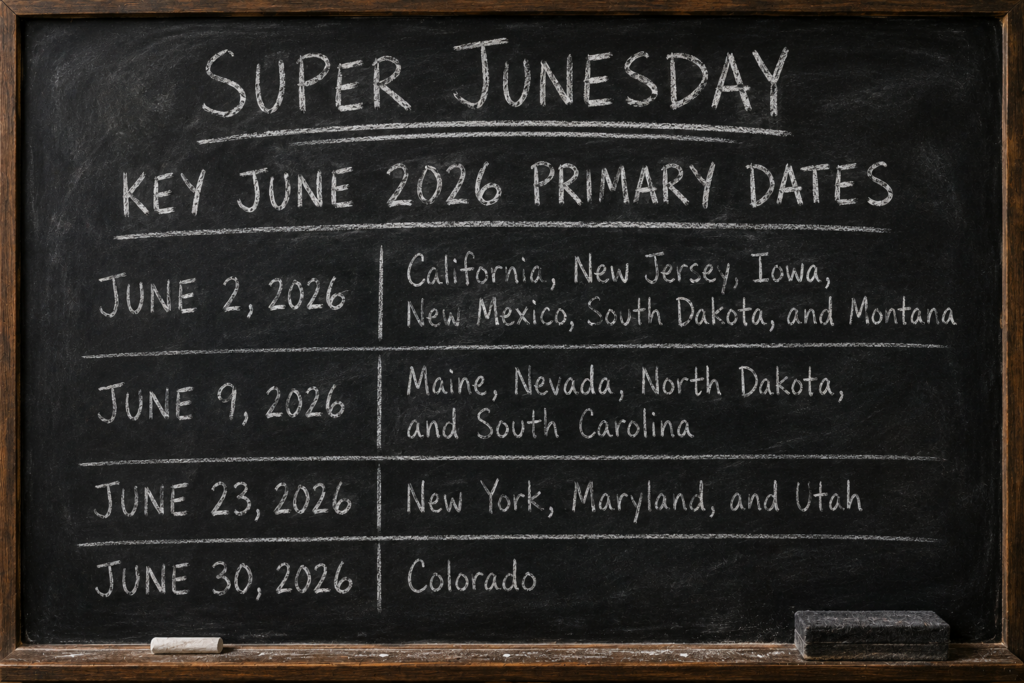
As you might suspect, the Washington office is following the 2026 primary elections closely. The reason is obvious: we’re looking to gain insight into how policy and process might change should either or both the House and Senate switch hands. With that in mind, we’ll be keenly watching what happens next week on Super Junesday when voters head to the polls in California, Iowa, Montana, New Jersey, New Mexico, and South Dakota. What’s that? You’ve never heard of the word “Junesday?” It’s a real word; I swear; in fact, presidents, politicians, and Washington politicos have a long history of coining new terms when they can’t think of the perfect word for a certain situation. Thomas Jefferson is said to have created more than a hundred words, including “authentication” and “anglomania.” John Quincy Adams invented the word “gag rule;” Abraham Lincoln coined the terms “relocate,” “relocation,” and the metaphor “a house divided;” and Teddy Roosevelt gets credit for “pack rat,” “mollycoddle,” “frazzle,” “loose cannon,” “lunatic fringe,” “bully pulpit,” and “pussyfooter.” It was Warren Harding who came up with “Founding Fathers,” “normalcy,” and “bloviate.” Describing where the Supreme Court stood on an issue, FDR first used the world “iffy,” he changed the name of the “Report to Congress” to the “State of the Union,” and the Oxford English dictionary cites him as being the first to use “cheerleader.” Lyndon Johnson called handshakes “pressing the flesh;” George W. Bush is remembered for calling himself the “decider;” and President Obama came up with “snowmageddon” and “shovel-ready.” Even the most recognized word in the world—“OK”—is said to have come from President Van Buren’s 1840 presidential campaign. Van Buren’s nickname was “Old Kinderhook,” and he signed documents using the abbreviation “O.K,” which eventually caught on. Not surprisingly, President Trump has claimed to have invented a growing list of words and expressions, including “equalizing,” which has been in the English language since 1599; “priming the pump,” a standard economic metaphor for more than 80 years; and “caravan,” which originated in the 16th century. However, due to a typo in a social media post, President Trump has been given credit for popularizing the term “bigly.” So, if you’re looking for a take on how the primaries are going and/or how the results of the midterm elections may impact the public policy, contact the “bipartio electorati” in the Washington office.
Thought Leadership from our Consultants, Think Tanks, and Trade Associations
Eurasia Group Says Inflation and Uneven Growth Will Weigh on Republicans’ Midterm Prospects. With April’s core PCE at 3.3% y/y, the highest since October 2023, and headline PCE at a three-year high, inflation continues to be a drag on middle and lower-income consumers. Although headline growth is holding up, it is concentrated where its political boost to President Trump is smaller, and it remains reliant on top-quintile spending (boosted by wealth effects), business investment (including AI-related capex), and a still-supportive fiscal stance. At the same time, real average hourly earnings have declined since the start of the Iran war due to the March-April inflation jump. President Trump’s polling on handling the economy is deep underwater, with his net approval at -41% on inflation and -30% on the economy. Recent polls now show most of respondents trusting Democrats more than Republicans on economic issues, cost of living, and inflation, which is a significant shift as the economy is an issue on which Republicans almost always lead. If sustained, the issue will add to Democratic tailwinds heading into the 2026 midterms. An unlikely dovish pivot from a Warsh-led Fed would not fix the political problem and could make things worse for the broad consumer base. Letting inflation run would disproportionately hurt lower-income consumers while benefiting asset-rich households and business investment—deepening the growth-composition problem driving GOP economic numbers down.
Inside EPA Sees Officials ‘Aiming Higher’ on Deregulation Due To High Court Cases. An EPA official says the agency is “aiming higher” in its deregulatory ambitions compared to President Trump’s first term, arguing that recent Supreme Court decisions support the administration’s aggressive rollbacks of climate, water and other rules. Those decisions from the high court scrapped judicial deference to agencies’ reasonable interpretations of ambiguous statutes, while also limiting agencies’ attempts to issue novel rules affecting major parts of the economy using vague statutory authority. Recent decisions the EPA has cited include: the Loper Bright Enterprises v. Raimondo ruling, which ended Chevron deference to agencies’ reasonable interpretations of ambiguous statutory authority and said courts must determine the “single, best meaning” of a statute; Sackett v. EPA, a ruling that curtails Clean Water Act (CWA) jurisdiction; and the West Virginia v. EPA ruling that crystallized the major questions doctrine limiting agencies’ ability to act on major political and economic questions without explicit congressional authorization. For example, EPA’s repeal of the 2009 greenhouse gas endangerment finding leans heavily on Loper Bright, with the agency claiming its interpretation of the Clean Air Act is the “best reading” of the law. In fact, the administration’s use of the Supreme Court rulings has deep roots. Early in his second term, President Trump ordered EPA and other agencies to repeal rules they believe would not pass muster under Loper Bright and other high court decisions.
Politico Reports White House has Sent Billions in Tariff Refunds Back to Companies. U.S. Customs and Border Protection says nearly $20.6 billion in tariff refunds has already headed out to importers, part of roughly $85 billion in refunds accepted for processing through the agency’s online system. At the least, the figures suggest that straightforward refund claims are moving through the system faster than importers initially expected after the Supreme Court ruled that the Trump administration had unlawfully imposed the tariffs. They also indicate that more than half of the tariffs covered by the ruling are now being processed for repayment. In fact, CBP has received 157,402 refund declarations from companies or their brokers through its online refund portal. Of those submissions, 108,760 cleared the agency’s initial validation checks. CBP said filings that passed those checks covered nearly 15.9 million import entries tied to goods entering the U.S., submitted through the Consolidated Administration and Processing of Entries (CAPE), the agency’s online refund system. While CBP had said refunds could take 60 to 90 days after they are accepted and validated through the online refund system before being returned to importers, they also clarified that the initial phase of the refund process would only handle the most straightforward of cases. The agency has not yet said how it plans to address more complicated disputes—such as duties paid on shipments tied to ongoing anti-dumping or countervailing duty proceedings, which collectively account for tens of billions of dollars in tariffs collected by the government.
“Inside Baseball”
Reconciliation 3.0? Even as Congress abandoned plans to pass a second reconciliation bill before Memorial Day—with Republicans revolting against President Trump’s $1.776 billion settlement fund for key allies—House Republicans were discussing a third budget reconciliation bill to advance by the end of next month. Passing three reconciliation bills (the first was the OBBB tax cuts package) would be a feat that neither party has accomplished since the Nixon era. Yet just because House Speaker Johnson wants it to happen doesn’t mean it will. For starters, Republicans can only lose two votes to pass anything without Democratic votes, and the reality goes beyond partisan vote totals. Consider that the types of policies that help incumbent Republicans fend off challengers in primaries often aren’t the same ones that resonate in November. Meaning that the deep cuts to social services needed to make fiscal headroom for what couldn’t fit in last year’s bill may come with a political cost lawmakers are not willing to make. What’s more, Congress is short on time, with relatively few legislative days left before the November midterms. In fact, lawmakers will be out for all of August and October to campaign, which leaves only September and the lame-duck session after the midterms, when Republicans would control the legislative process for two months. But members may not be as keen to show up if they’ve lost reelection bids and are on the job hunt. It’s clear there are Republicans trying to get to a third mega-bill, but trying might be as far as they get.
In Other Words
“Humanity, created by God in all its grandeur, is today facing a pivotal choice: either to construct a new Tower of Babel or to build the city in which God and humanity dwell together,” Pope Leo XIV warning that artificial intelligence could become a new Tower of Babel—a dazzling human achievement that concentrates power, weakens truth, and turns people into data points.
Did You Know
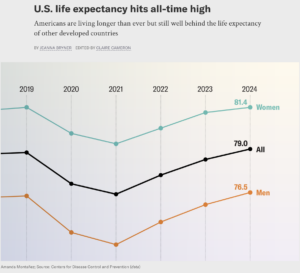
U.S. Life Expectancy at All-Time High. Due in large part to a 40% drop in drug overdose deaths, U.S. life expectancy has reached an all-time high, although it remains lower than comparable developed countries (82.7 avg. vs U.S. 79.0).
Graph of the Week
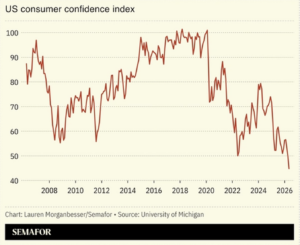
Kevin Warsh Sworn in as Federal Reserve Chair. Kevin Warsh’s swearing in came just a few hours after new data showed that consumer confidence fell to a record low in May. The decline was driven by large drops among independents and Republicans. Although consumer spending has remained resilient amid rising prices, the longer the conflict in Iran drives up energy prices, the more likely the Fed will need to act to curb inflation. Regardless of whether President Trump wants the new Fed Chair to cut rates, Wall Street now says a “win” for Chair Warsh will be avoiding a hike.