Thought of the Week
Last week, I had a conversation with a veteran from my non-profit about the war with Iran, and at one point he said, “You know, if you set out to take Vienna, take Vienna.” The famous Napoleon Bonaparte quote is centuries old, and within it lies a warning about the dangers of taking half-measures or not finishing a job completely. Reflecting on my friend’s comments while driving home led me to think of another famous line uttered nearly a hundred years after Bonaparte’s, “Those who cannot remember the past are condemned to repeat it,” by George Santayana in 1905 and then later by Sir Winston Churchill following the close of WWII. For whatever reason, the two quotes, taken together, led me on a public policy thought tangent about how today’s data centers have become yesterday’s pipelines. It wasn’t that long ago that communities competed aggressively to attract economic development like data centers—governors touted billion-dollar investments and counties offered tax incentives. But that consensus has fractured. In 2026’s first quarter opponents blocked or delayed $130 billion worth of projects, more than 300 related state bills have been introduced so far this year, local moratoriums seem to pop-up almost daily, and a coalition of more than 500 organizations has called for a nationwide halt on new data centers. Public opinion has also shifted. 71% of Americans oppose data center construction in their community, although just 8% live near one. Some reports dismiss the backlash as run-of-the-mill NIMBYism or simply as public anxiety over AI finding a physical target, but this misses the wider point. What is being seen is an accumulation of local concerns about everything from electricity, water, land use, tax incentives, and AI being amplified through a well-structured political machine capable of combining individual concerns into much larger matters. By harking back to the past, the pattern is recognizable—the organizations, networks, and playbooks that once turned fights over pipelines into national political campaigns have found data centers as a new focal point. According to consultants from Delve, the difference this time is that the movement has merged the progressive and populist agendas into a single opposition force. For hyperscalers, developers, utilities, investors, and corporations navigating this new reality, history offers two lessons. First, data centers are just a vessel for larger interests. To residents, it’s about electricity, water, noise, and traffic; to landowners, it’s about farmland, transmission lines, and property rights; to fiscal hawks, it’s about tax incentives; to environmentalists, it’s emissions; and for others, it’s about corporate power and AI’s role in today’s economy. While each concern is different, and may carry some legitimacy on its own, together they create a broad coalition that has arrived at the same conclusion—data centers are bad—for different reasons, which explains opposition beyond those directly impacted by a new development. In sum, data centers have become the tangible focal point for concerns that stretch beyond the themselves. Second, the fight is no longer local. Although developers expect some level of political opposition, usually over zoning or permitting, to emerge locally, national organizations have identified data centers as strategic opportunity for opposition—coalitions push state, even national moratoriums; toolkits exist to organize opposition; and legislative proposals, legal strategies, and communications resources are shared across state lines. As opposition campaigns have matured, they have also expanded beyond local levels—a zoning dispute morphs into legislation restricting tax incentives; questions about electricity demand move to FERC proceedings; environmental issues receive national legal support; mayors and governors reconsider economic development strategies; and members of Congress call for hearings. The political objective has shifted from halting individual projects to changing the game under which future projects can be built. This is data centers’ pipeline moment. In fact, the campaigns being used today are eerily similar to those waged against Keystone XL, Dakota Access, and fracking. The networks, legal expertise, communications playbooks, fundraising, and national political relationships did not die with pipelines but became recyclable. The difference is that while pipeline fights were driven by environmental activism and the political left exclusively, data center opposition is drawing support across the progressive and populist spectrums, which makes today’s opposition broader, politically resilient, and less predictable. The lesson from the pipeline era is not that every data center project will become Keystone XL, but that data center opposition is not about permitting, but rather a new front in a broader political campaign. So, what can be done to counter this new normal? Responsible development, transparent engagement, and community relationships still matter, but are not sufficient. Corporations need to understand that data centers are no longer standalone local issues but need to be considered as part of the broad political ecosystem surrounding AI. The corporations that will be best positioned to take Vienna are those who have learned this history and can move across states, influence policymakers at all levels of government, and reshape the rules governing future development.
Thought Leadership from our Consultants, Think Tanks, and Trade Associations
Eurasia Group Says Michigan Race Will Shape Democrats’ 2028 Narrative. Abdul El-Sayed victory in the Democratic Senate primary in Michigan could shape the Party’s 2028 presidential narrative. The consequences of the primary, which pitted the progressive El-Sayed against the moderate Rep. Stevens (D-MI) generated an unusual degree of bitterness between the two sides, and has the potential to reverberate over the next year, setting up both progressive and moderate narratives for the 2028 presidential cycle. Nominating a genuine progressive in a swing state like Michigan is an untested strategy for Democrats. If El-Sayed loses to the Republican candidate, Mike Rogers, in the general election, it will feed concerns among moderates about the electability of progressive candidates in the swing states that Democrats need to win to clinch an Electoral College majority. However, if El-Sayed wins the general election, progressives will take it as a vindication that they can indeed win in swing states—even if that win occurs in a national environment that leans more heavily Democratic than would be typical in a presidential-election year. If progressives can assuage their electability concerns with a win in Michigan, this would be a boon to progressive presidential candidates like Reps. Alexandria Ocasio-Cortez (D-NY) or Ro Khanna (D-CA) in the primary. Electability matters to Democratic voters, with Super Tuesday exit polls in 2020 indicating that Democratic primary voters prioritized candidates who “can beat Trump” over those with whom they agreed on issues.
Eurasia Group Now Sees Senate Race as Nearly a Coin Flip. Recent polling in key states shows a tightened race to control the Senate, giving Democrats a boost heading into the fall. Analysts now see the race as a near coin flip in which Republicans have a slight edge (55% odds, down from 60%) but are at risk of losing further ground if the macro political environment turns more negative. Democrats need to hold Georgia, Minnesota, New Hampshire, and Michigan, and flip four of North Carolina, Maine, Texas, Ohio, Alaska, and Iowa to gain control of the chamber. In every Republican-held seat except Iowa, the bulk of recent polling has favored Democrats. Several signposts should be watched closely for hints that might give Democrats an advantage, including President Trump’s approval rating, the generic congressional ballot, polling in state races, Republicans’ financial advantage, and Democrats’ ability to unify after divisive primaries. Michigan is the key downside risk for Democrats. Abdul El-Sayed’s narrow victory in the primary leaves open questions about his ability to unify the state’s diverse Democratic electorate, and it will be difficult for a candidate as progressive as he is to appeal to moderates.
Observatory Group Looks at Primary Election Dynamics. Candidates aligned with the Democratic Socialists of America (DSA) have defeated establishment Democratic rivals from deep-blue New York City to states such as Michigan and Minnesota. This is parallel to the intraparty realignment that has reshaped the GOP since the 2010 Tea Party wave. Democratic voters, driven by populist anti-establishment urges, are embracing similar primary-enforcement mechanics that transformed the right. Primary electorates in both parties now routinely purge incumbents and establishment candidates for their long tenures and/or lack of ideological purity. The result has been a near total dismantling of moderation in Washington, irrespective of which party wins a given election cycle. Both parties have become hostage to their political bases. Today’s lawmakers, filtered through these primaries, are even more unwilling to negotiate durable statutory compromise. In turn, this pushes American governance towards the White House, with presidents of either stripe blasting out executive orders, emergency decrees, and new regulations. The resulting policy and regulatory whiplashcomplicates business and investment planning in the U.S., and it may affect activity abroad via shifts in U.S. trade and foreign policy.
Politico Summarizes the Economic Policy Debate Dominating the Midterm Election. Cost-of-living concerns are dominating voters’ attention in the run-up to congressional elections later this fall, a challenge that has intensified as inflation has remained above the Federal Reserve’s 2% target since early 2021. Affordability has taken on even more political salience in the wake of President Trump’s tariffs—which have pushed up prices on a range of goods—and the war in Iran, which has roiled energy markets, driving up prices at the pump, and increasing the cost of transporting goods. The housing market is also a significant point of voter dissatisfaction, as rising home prices and mortgage rates have put homeownership out of reach for many Americans.
“Inside Baseball”
Iran War Not Popular on K Street. As the U.S. war with Iran enters its sixth month, the memorandum of understanding (MOU) that was supposed to end the conflict didn’t go over well with K Street, according to Punchbowl News’ latest Canvass* survey. Nearly all K Street leaders(91%) view the Trump administration’s MOU with Iran as a failure. In fact, 70% said that former President Obama’s nuclear deal with Iran was a more beneficial deal, with almost half of the Republican K Street leaders saying Obama’s Joint Comprehensive Plan of Action was better. Since the MOU was signed in June, the fighting has resumed and four more Americans have been killed in the hostilities. In all, 18 troops have been killed since the conflict started and more than 600 have been wounded. The ongoing war is unpopular on Capitol Hill as well, but Congress’ successful passage of a war powers resolution has done nothing to stop President Trump’s Middle East action. Going forward, Hill Democrats will look to the appropriations process to limit military operations in Iran. Since the war started, the relationship between the U.S. and Israel has been front and center. Most K Street leaders (82%) believe the relationship between the two countries has worsened as a result of the conflict, and 65% say Israel’s involvement has had a negative impact on the outcome.
*The Washington office participates in the Canvass Survey.
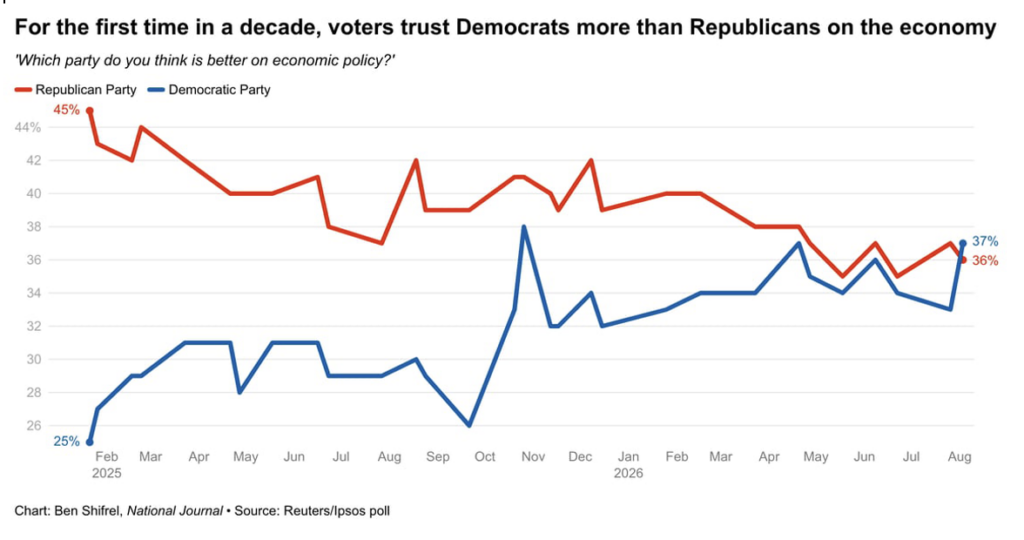
Democrats New Advantage—The Economy? Americans trust Democrats more than Republicans on the economy for the first time in a decade, according to a new Reuters/Ipsos poll. The shift reverses the Republican advantage on one of the party’s strongest political issues and comes as President Trump’s approval rating has fallen to 35%. The GOP’s approval has deteriorated throughout the president’s current term due to the Iran war’s impact on greatly increasing energy prices. At present, on a generic congressional ballot, Democrats now lead 42% to 37%.
“In Other Words“
“Woke one was crazy,” Rep. Alexandria Ocasio-Cortez (D-NY).
“The market for the Democratic primary race shows candidate Francesca Hong with a 95.9% chance to win the nomination, followed by David Crowley at 4.2%, and Kelda Roys at 0.1%,” Kalshi prediction market’s incorrect assessment of Wisconsin’s gubernatorial primary election.
Did You Know
Xi State Visit Expected in September. During his trip to Beijing in May, President Trump invited Chinese President Xi to the U.S. in September. The White House has suggested that the summit could take place on September 24.
Graph of the Week
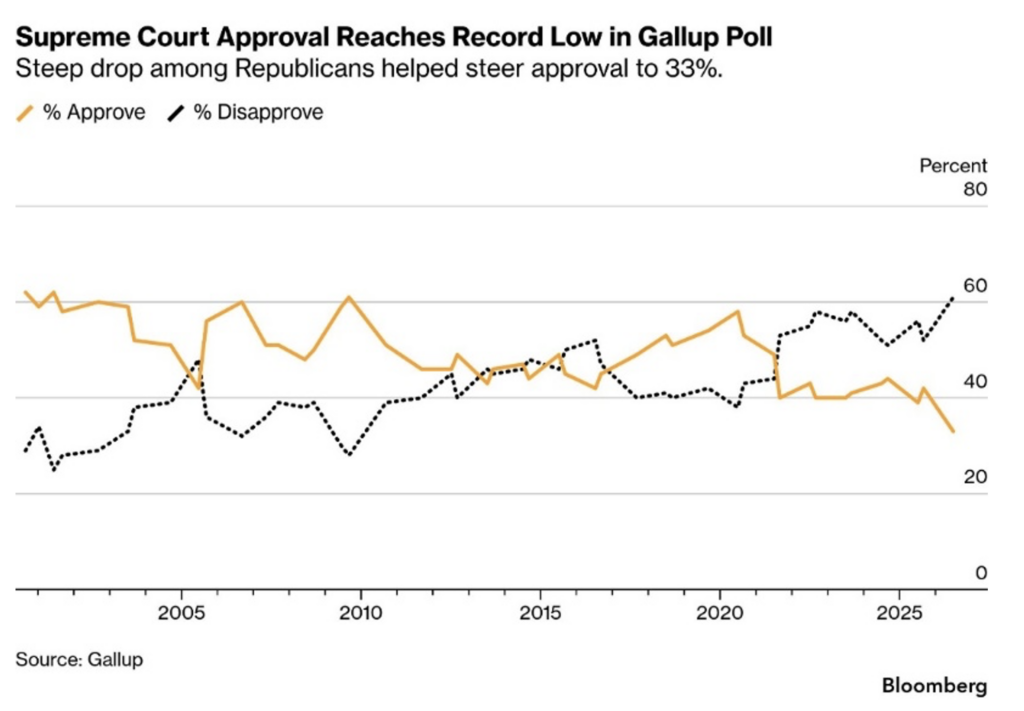
The Supreme Court has a Reputation Problem, and President Trump’s Attacks are Making it Worse. Recent polls show approval of the court falling after an ideologically divisive term, with one survey finding record-low support. President Trump’s attacks have fueled a slide among Republicans, and a majority of Americans now believe the justices tend to act for political reasons, not legal ones. The court’s reputation has taken a pounding in recent years, driven by a hyper-partisan confirmation process, polarizing decisions, and various ethics controversies.