Thought of the Week
Last week, I had a catchup meeting with a former consultant. In an off-hand comment, the younger professional on the other end of the screen said that her firm’s full work-from-home policy allows her to get so many more tasks checked off her daily to-do list. Not only did her statement remind me of things I’ve heard my similar-aged daughter say, in an odd way it reminded me of a recent chart from the American Enterprise Institute (AEI) I had come across. That chart showed that the percentage of 12th graders who have ever consumed alcohol fell from 92% in the late 1970s to just 47% today. On its face, underage drinking and work-from-home policies would seem to have nothing in common, but indulge me. While the decrease in drinking seems like unambiguous progress, and in some ways, it is—fewer drunk-driving deaths and lower rates of substance abuse are unquestionably good developments—social trends rarely move in isolation. When a behavior collapses so dramatically, it is worth looking not only at what disappeared, but also what disappeared with it. Today’s young adults socialize less than previous generations, they date less, they hang out less, and they attend far fewer parties. These parties, big events, work meetings, and social gatherings that knit my Gen X generation together are nowhere near as plentiful today as they were decades ago. In fact, multiple studies show that loneliness has climbed sharply since so much of social life has migrated to phones and screens. The AEI chart implied that for generations, drinking functioned and still functions—imperfectly, and sometimes dangerously—as part of broader rituals of social cohesion. Parties, bars, tailgates, weddings, work functions, and the like created opportunities for friendship, networking, romance, vulnerability, and collective memory. Today, those spaces seem to be disappearing faster than we are replacing them. Many of the experiences of my youth forced my generation into physical communities where we learned to navigate awkwardness, flirtation, rejection, humor, conflict, and friendship. By contrast, screens enable endless retreat. Although screens may allow for greater physical security and greater checks off a list, they are a poor metric for human flourishing. A culture that systematically removes opportunities for embodied community eventually produces loneliness, alienation, and social fragility. The question should not be solely about whether drinking declined, but what replaced the social world that drinking once lubricated. Based on my observations, in many cases, the answer is nothing, and this vacuum matters, and it matters for business and political advocacy. In business, social isolation causes elevated turnover and communication friction as younger workers struggle to build informal work networks. In political advocacy, the deficit of local belonging drives isolated youth toward hyper-partisanship, radical online presences, and often extremist views of market and social change. This post is not meant to be an argument for encouraging unadulterated drinking, nor is it meant to be an argument for a strict return to office policy. But it is an argument for perspective. Consider how different things are from a wider social perspective pre- and post-Covid. During Covid my daughter would tell me she missed the office comradery; post Covid, she recognizes that allow her younger team members may get more individual tasks done, they’re losing a bit of the mentorship that undergirds later critical thinking. We all need to do a better job at rebuilding the social infrastructure that gives people reasons to gather.
Thought Leadership from our Consultants, Think Tanks, and Trade Associations
Eurasia Group Says Redistricting Matters Beyond Elections. The transition to a system in which states controlled by Democrats are represented almost exclusively by Democrats, while states controlled by Republicans are represented almost exclusively by Republicans is a significant shift in the structure of U.S. politics. It will have many second-order implications beyond mere House control. Although these will take time to manifest, building over a number of electoral cycles, cumulatively, they will reshape the basic contours of the political system and make the U.S. a more difficult country to govern. First, the primary elections will boost the political extremes. The number of competitive House races has already shrunk substantially over the past 50 years, and in noncompetitive races, the general election is essentially meaningless, as all the action occurs in the primary. Because more extreme candidates from both parties will survive general elections under this structure, the likely result is that the parties will move even further to the ideological poles. The space for bipartisan compromise will shrink even further. Second, blue-state Republicans and red-state Democrats will all but disappear. Third, federal policy toward states will become more polarized. We’ve already seen this to an extent under the Trump administration, which has targeted Democratic-governed states for grant cancellations. And maximal redistricting will lead to presidencies more biased toward the states in their party’s column. Finally, state legislative elections will be more fiercely contested by national parties. When unified-government states have no more redistricting juice left to squeeze, the remaining advantage left to capture is in the purple states, where control is split between the parties. Few remain: Pennsylvania, Minnesota, Wisconsin, Michigan, and Arizona are the only ones where redistricting gains for either party are possible. Flipping any one of these toward unified control would provide a meaningful benefit in national elections. Both parties’ national committees will become more active in state-level elections, which will become even more “nationalized”—fought on national issues, not state-specific ones—than before. Putting these together, the picture looks negative. These changes will exacerbate the same trends that have made U.S. politics so volatile in the 21st century: polarization on ideological and geographic lines, the elevation of extreme voices, and the injection of national fissures into state and local politics. Such factors suggest that a Warren Harding-esque return to normalcy is not in the offing after 2028. Deep division is here to stay.
Inside U.S. Trade Highlights House Democrats’ Call for a New Trade Paradigm Focused on Workers. Nearly 30 House Democrats are backing a resolution that says the U.S. should prioritize “fair trade” for workers and shift away from a focus on advancing corporate interests. The “Fair Trade for Working Families Resolution” calls for a trade policy that supports “workers, consumers, independent farmers, small businesses, and the environment.” The vision is organized around 10 key principles, including those that state the U.S. should reorient its approach using trade authorities to impose tariffs designed to bolster strategic sectors, strengthen labor protections, and disincentivize companies from offshoring jobs. The legislation contends that U.S. trade policy for decades has put corporate interests first and benefitted wealthy individuals and large corporations at the expense of working families, farmers, small businesses, the environment, and U.S. national security. Of the 10 principles one calls tariffs a critical tool to counter unfair trade and corporate greed and to strengthen strategic sectors, and demands they be maintained under Section 232 of the Trade Expansion Act of 1962 and Section 301 of the Trade Act of 1974. The resolution also contends Congress should exercise its constitutional trade authority to address specific abuses when an administration fails to use duties to support U.S. workers, adding that tariffs must not be “weakened or removed if doing so exposes workers to import surges or trade cheating.” The measure calls for trade agreements to include “strong, binding labor and environmental standards and rules of origin” that are backed by enforcement mechanisms. The legislation includes several other tenets its backers say prioritize workers, such as mandatory country-of-origin labeling rules for agricultural products, measures to ensure companies cannot “undercut United States workers by exploiting weaker standards abroad,” and a provision saying investor-state dispute settlement mechanisms should be removed from existing trade deals. Among the unions and civil-society groups endorsing the resolution are the United Auto Workers, the United Steelworkers, Public Citizen, Rethink Trade, and the Sierra Club.
Observatory Group Sees U.S. Energy Deregulation and Industrial Policy Progressing, but Asks Whether They Will Stick? U.S. electricity demand is growing materially for the first time since 2007. Drivers include reshoring of manufacturing, electrification in autos, grid-scale data center buildout, and demand from widespread AI adoption. While the Trump administration has been pushing to accelerate domestic energy production via executive action since Inauguration Day, the effort seems to be approaching critical mass. It has two facets:
- creating the architecture for durable deregulation; and
- pursuing an aggressive industrial policy for the energy sector via national security and emergency authorities.
This approach is far more ambitious and interventionist, especially for fossil fuels and nuclear, than deregulation labels imply, and it constitutes a true reordering of American energy production. Although the new architecture runs the risk of being shot down via litigation, recent decisions signal that the Supreme Court is likely to rule in favor of the administration’s approach. While the main way of making the changes last over the long-term would be to pass new legislation on a bipartisan basis, observers expect nothing to materialize until after the midterms at the earliest.
“Inside Baseball”
The GOP Senate’s Ballroom Problem. Senate GOP leaders are considering reducing funding in their reconciliation bill for the Secret Service and President Trump’s controversial East Wing ballroom. The $1 billion sum could shrink as Senate Republicans weigh a wide range of changes to the text in a rush to find something that can win rank-and-file GOP votes, satisfy the White House, and pass muster with the Senate’s parliamentarian. At this point, the biggest challenge appears to be what GOP aides are calling “Trump management”—the White House’s hard push for ballroom funding to remain in the bill, despite complaints from vulnerable Republicans. At present, it’s proving difficult for Senate GOP leaders to lock down the requisite support. While the goal is to get 50 votes in the Senate, the House Republican leadership believes they won’t be able to pass a reconciliation bill that includes anything resembling funding for the ballroom. Although Speaker Johnson will face intense pressure if the bill reaches the House, a number of members have already said they will not support a bill that includes ballroom funding, absent reforms.
In Other Words
“At a very basic level, people think we’re making policy decisions. I think they view us as purely political actors, which I don’t think is an accurate understanding of what we do,” Supreme Court Chief Justice Roberts.
Did You Know
According to AdImpact, the $32+ million spent on advertising in Kentucky’s conservative 4th District made it the most expensive House primary on record. The contest pitted Rep. Thomas Massie (R-KY) vs. Ed Gallrein, a farmer and former Navy SEAL. Although many election analysts believed that Massie’s unique political identity and popularity would make it difficult to unseat him, most of the ad spending flagged Rep. Massie’s vote against the One Big Beautiful Bill Act, and ultimately proved effective.
Graph of the Week
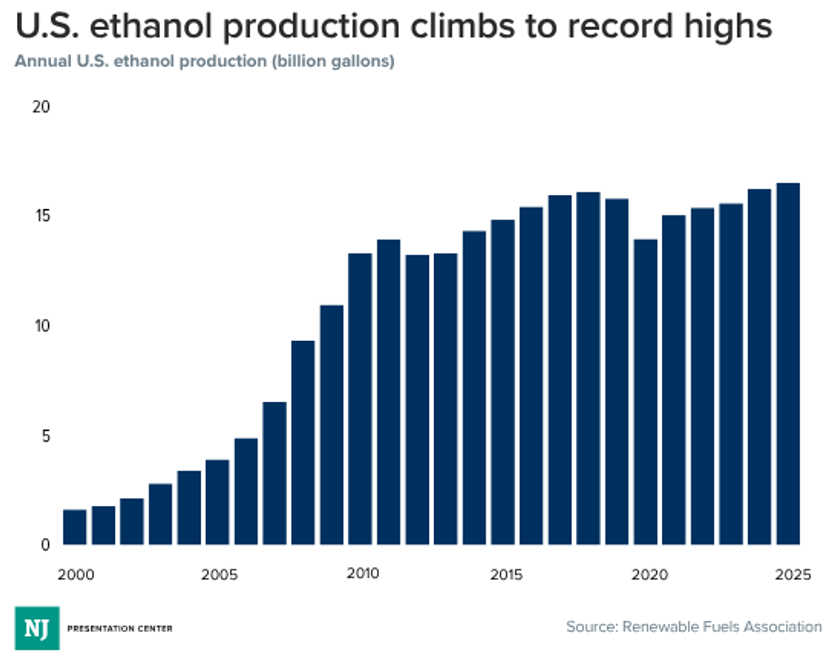
While the Iran conflict and the closure of the Strait of Hormuz have rattled global energy markets and raised gasoline prices, they have also acted as temporary catalysts for making ethanol and other biofuels more economically attractive as alternative fuel sources. However, the primary reasons U.S. ethanol production is at an all-time high are domestic agricultural abundance and favorable government blending mandates.