Thought of the Week
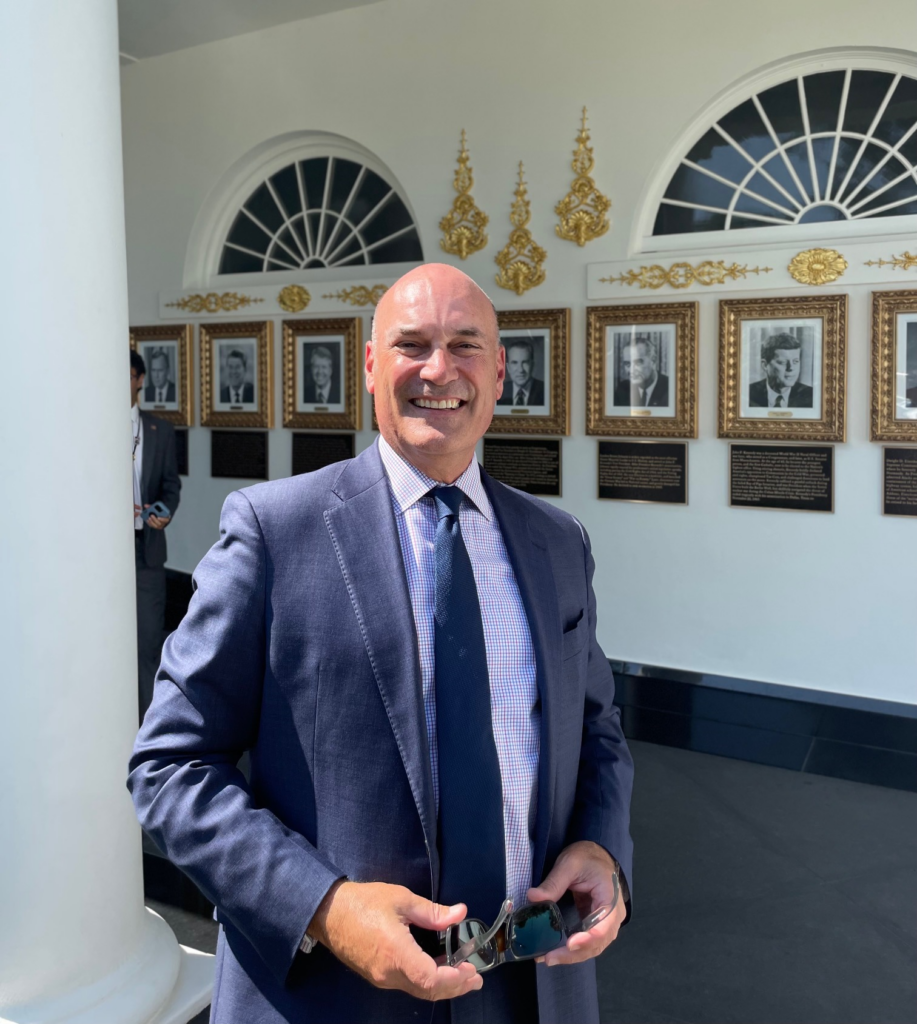
It’s not every day that one gets invited to the White House, but once you clear the spiked fence, pass through multiple layers of security, cross the South Lawn, and eventually hear “The President’s Own” U.S. Marine Band playing, there’s no mistaking where you are. And, so, there I was sitting in the Rose Garden waiting for the reigning, back-to-back World Series champion Los Angeles Dodgers to come out and be announced. You’ve seen this program before with countless professional and collegiate sports teams. The president cracks a couple jokes, refers to a few key plays during the championship run to pad his sports bona fides, and then the head coach or MVP present the commander in chief with a team jersey. But while waiting for “Hail to the Chief” to play, looking around the grounds, taking in exactly where I was sitting, the feeling was one of both awe and perplexity. There’s the Oval Office, no farther than a pitcher’s mound away. Quite literally, history has been made there, but does it really need to be labeled “Oval Office” in gold leaf? Same with the Rose Garden. The Israel-Jordan Peace Declaration was signed here; it’s also where President Nixon walked his daughter down the aisle; the flowers are already unmistakable, is the ornate signage necessary? And there’s the residence itself, striking in bright white against, dare an Orioles fan say, a crisp Dodger blue sky. Politicians, policymakers, political insiders, and world class sports fans are the ones who attend these things. Former Speaker of the House McCarthy was just two rows in front of me; DHS Secretary Mullin and White House Chief of Staff Susie Wiles were front row; Secretary Kennedy and his glamorous wife Cheryl Hines were off to my left; and of course, Congresswoman Young Kim (R-CA), who represents parts of southern California, was there. But it was not until I spied Peter Navarro, the architect of President Trump’s tariff policy, sitting directly in front of me and just a few seats away from President Kennedy’s nephew, that brought together an assortment of random thoughts together as one. The first time a poet took part in a presidential inaugural was Robert Frost during President John F. Kennedy’s 1961 ceremony. But it was not “The Gift Outright,” which was recited at Kennedy’s inauguration, nor even “The Road Not Taken,” Frost’s most famous work, but “Mending Wall” that registered due to the combination of the White House setting, the Kennedy name, and tariff policy. You may not know the poem, but I’m sure you’ve heard its iconic line, “Good fences make good neighbors.” Common usage of the line today is often straightforward and quite literal; it’s only upon reading the actual verse that you grasp that the line is meant to be ironic—a suspicion of barriers that serve no clear purpose, concern about walls that arbitrarily divide, thoughts about what is being both walled in and walled out; and doubt about the use of rigid traditionalism. Irony even extends to the poem’s physical details, a wall dividing landowners who cultivate different trees—to me, an obvious link to the economic principle of comparative advantage. Sound familiar? Taken together, the scene was a near carbon copy of White House trade policy and the ongoing effort to build a tariff wall. Like the wall in the poem, which requires seasonal rebuilding, the White House’s trade wall is replete with loopholes and tariff exemptions; rigid traditionalism harks back to the days of Smoot-Hawley; and the thought of what’s being walled out seemed to correlate directly with the tariffs placed on imports American manufacturers need to finish their products. It was at this point that the team was announced, and President Trump made his entrance. I have to admit the president has his own, unique brand of charisma, at once both oddly charming and annoyingly narcissistic. He cracked a few jokes, compared Dodger great Shohei Otani to Yankee great Babe Ruth—correctly identifying each as slugger, pitcher, and right fielder—and then explained, in great detail, how he overrode his staff, ordered four-inch seat cushions, instead of one-inch, and how we all should thank him for our current comfort. As I passed through the White House gate, it occurred to me that Frost’s poem also offers a solution to our current trade dilemma—while fences may not make good neighbors, the making of fences can.
Thought Leadership from our Consultants, Think Tanks, and Trade Associations
Eurasia Group Sees Midterm Elections Shifting Expectations on Federal Reserve Actions. U.S. midterm elections often trigger a rapid reset in market expectations for Federal Reserve rates by resolving uncertainty and, at times, reshaping the fiscal outlook following shifts in congressional control. Analyst assessments of how markets repriced Fed expectations after past midterms found that, on average, post-election moves lifted the implied Fed path, with markets pricing fewer cuts or more hikes. The 2026 midterm election’s base case implies likely fiscal expansion after the elections, making a hawkish repricing of Fed expectations the most likely post-election outcome because stronger fiscal support would raise expected growth and inflation pressures.
Inside the EPA Reports that the Data Center Boom Continues to Spark Debates on Environmental Risks. The boom in data center deployment is continuing to drive heated debates in Congress about how best to manage a variety of environmental risks from the facilities, including greenhouse gas emissions, potential water contamination, as well as the economic implications for residential power consumers. Ahead of the November midterm elections, House members and the White House are embracing high-level efforts to protect ratepayers from rising power costs due to the rapid expansion of data centers, even as lawmakers continue to spar ahead of the midterms over the extent to which officials should limit a variety of environmental and other risks from the facilities. In a rare example of bipartisanship, House Energy & Commerce Committee lawmakers advanced the Ratepayer Protection Act, which would require state regulators to “consider” establishing a standard for data centers and other large electricity users to cover “the full, incremental cost of any generation, transmission, or distribution upgrade necessary” to meet rising energy demands. The legislative activity comes as President Trump has announced that hundreds of new utilities and others have signed his voluntary ratepayer protection “pledge” aimed at limiting power price spikes, a measure that is broadly aligned with the bill—though environmentalists and other critics assert that it lacks an enforcement mechanism to ensure that technology companies pay their fair share for grid upgrades tied to their AI data centers. The twin announcements signal an effort by officials to quell voter discontent about increased power costs due to data centers before the November midterms, which will determine partisan control of Congress next year. Some lawmakers, including top Democrats, say a moratorium on new data centers is needed even after ratepayers are protected. While Democratic lawmakers are pitching more aggressive policies to address data center risks, some Republicans are beginning to express concerns of their own, including over water use and contamination. Still, other GOP lawmakers have downplayed data centers’ environmental harms and sought to clear regulatory and land-use hurdles to the development boom, arguing that the AI race with China supersedes local concerns.
Observatory Group Says New U.S. Tariffs, Meant for Leverage, Will Hit Some Countries Hard. Although the majority of new U.S. tariffs are designed for leverage to catalyze negotiations, including with Canada, the EU, and Brazil, tariffs on those countries may still be implemented. While certain tariffs are meant to rebuild the U.S. tariff wall in a legally sustainable manner, including the Section 301s on forced labor and industrial overcapacity, and to generate revenue, additional tariff-related announcements are imminent, including a Canada Section 338 implementation, tariffs for the Section 301 on industrial overcapacity, and a likely EU Digital Markets Section 301 investigation. As in the past, White House tariff policy should be taken seriously, but not literally. The rebuilding of the tariff wall should surprise no one. In fact, the Trump administration has never deviated from this goal, despite picking and choosing when and how aggressively to implement it. One new element is a proposition to use tariff revenue to fund industrial policy, which requires stable and long-term legal frameworks to generate recurring revenue. Via the Section 301 cases, rates on most major trading partners will be locked into a structure that is legally defensible over the long term, although specific tariffs rates could change with foreign legislation and/or deals with USTR. While tariffs relating to specific regions or situations may be implemented and collected, possibly for months, they are primarily meant to change trading partner behavior, with the goal being to remove or reduce them after negotiations, rather than have them become part of a permanent tariff architecture. Unless serious negotiations are scheduled ASAP, expect 50% tariffs on select Canadian goods to go ahead in mid-August. Because the U.S. and Canada remain far apart, the White House is piling on the pressure as part of USMCA negotiations; in contrast, the U.S. is proceeding smoothly with Mexico. Despite market fears and country-specific impacts, a wholesale trade offensive against all major trading partners as occurred in 2025 is not envisioned. The Trump administration has moved on from its use of hard power, and tariffs are now just one tool out of many.
“Inside Baseball”
Do Midterms and Iran Point to a More Hawkish Fed? The Federal Reserve voted to leave policy rates unchanged at this week’s Federal Open Market Committee (FOMC) meeting. However, three members dissented against leaving rates unchanged, voting instead for a quarter-percentage-point rate hike, which may be a harbinger for a hike at the next meeting in September. The policy debate centers on whether recent progress on inflation justifies continued patience or whether inflation remains sufficiently elevated to warrant another rate hike later this year. The softer June CPI report, steady payroll growth, and the Fed’s usual preference for moving gradually argue against more immediate action. However, the post-meeting data will quickly become pivotal. June PCE inflation and Q2 GDP will test both the disinflation story and Chairman Warsh’s productivity thesis, shaping the debate over possible hikes in September and December. What’s more, a likely divided Congress after the midterms is expected to add fiscal pressure, reinforcing the tightening path, as midterms have historically triggered a hawkish repricing of Fed expectations. In addition, likely U.S.-Iran escalation puts upward pressure on inflation at little cost to growth. While the Conference Board continues to expect no policy rate changes in 2026, pointing to moderating inflation, a gradually cooling labor market, and continued AI-driven investment to support a patient Fed, other analysts, like those from the Eurasia Group, argue that because the Iran war’s economic impact falls almost entirely on the inflation side of the Fed’s mandate this will lead to a hike later this year.
In Other Words
“Doc, let’s try something: What day of the week is it today?” Sen. Hawley (R-MO). “On the advice of counsel, I respectfully decline to answer based upon my rights under the Fifth Amendment to the Constitution,” Dr. Anthony Fauci. “What color is the carpet in front of you?”—Hawley. “On the advice of counsel, I respectfully decline to answer based upon my rights under the Fifth Amendment to the Constitution,” Fauci.
“Abolish the Senate?”, “True.”; “Abolish ICE?”, “Absolutely.”; “Abolish borders and give amnesty to anyone in the U.S. illegally?”, “Yep,” Democratic Socialists of America (DSA) Co-Chair Megan Romer in response to questions from Fox News. The statements have officially put DSA on the record regarding key midterm policy issues, and they are likely to be employed by GOP candidates running against progressive challengers, seeking to tie Democratic candidates to DSA’s progressive agenda.
Did You Know
Democrats are poised to start their 2028 presidential primaries in South Carolina, after the Democratic National Committee’s (DNC) rules and bylaws committee recommended keeping the state at the front of their calendar.
Graphs of the Week
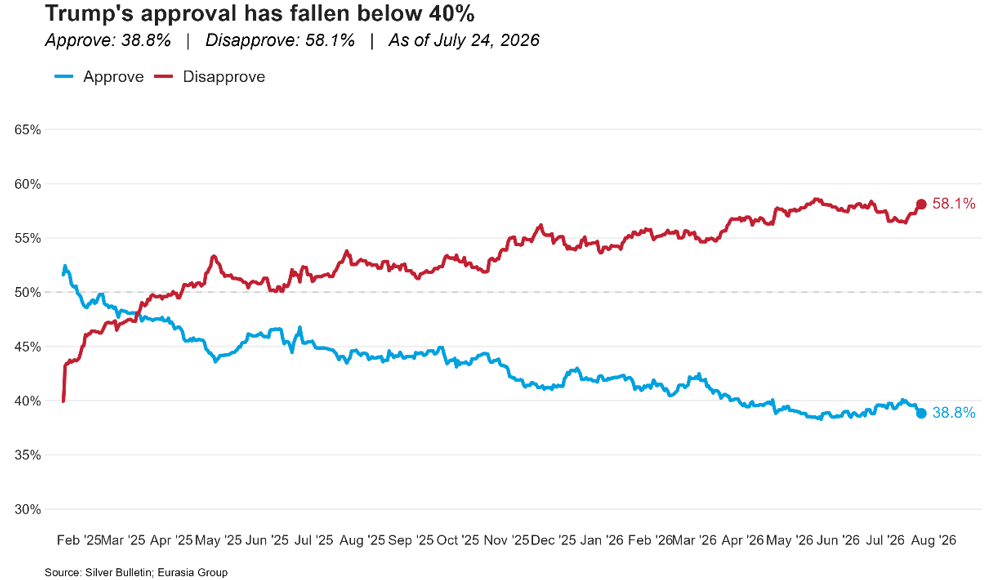
President Trump’s Approval Drops. President Trump’s approval rating fell by a point over the past week, from 39.8% to 38.8%, likely reflecting the impact of the recent spike in gas prices following escalation with Iran. The president’s approval rating is likely to hover below 40% for as long as the Strait of Hormuz remains closed and gas prices remain relatively high; rising above this threshold would require a decline in gas prices to at least below where they were before the recent round of escalation.