Thought of the Week
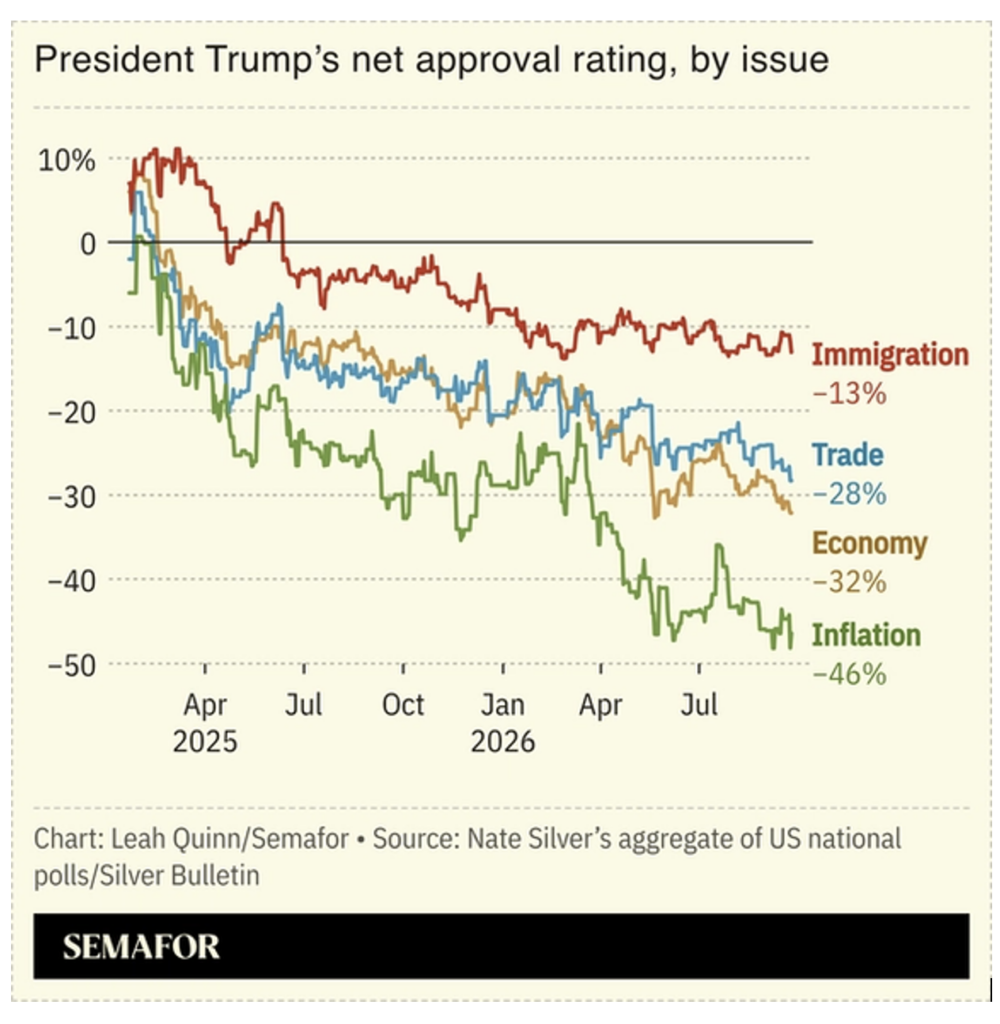
My wife and I recently purged, packed, and closed our public storage unit. It was time. Our kids had already moved on, and we down-sized years ago. It is amazing though the treasures you’ll find going through old boxes, old files, and old crates—my wife’s original graphic design portfolio, my son’s One Piece manga collection, my daughter’s Signature Collector Barbie dolls she never got to take out of the box, an unopened wedding gift, and my Little League baseball mitt. We also found photos, 100s of actual pictures, not digital images on a phone. Some pics were great, some not so great, but all were just a snapshot in time. To get a sense of the day, an event, or a milestone, a series of individual prints needs to be curated and placed in an album. As famed political analyst Charlie Cook has reminded me countless times, like individual pictures, individual polls can be good or bad, and they tell us something, but not everything. To get a true sense of where things may be going and where they may end up, the key is to look at polls’ trendlines over time. So, what are the trendlines telling us today? Based on a review of President Trump’s approval ratings, the mood of the country, the generic ballot over time, and individual race polls, the odds that Democrats take the House are now a near lock, and the chance that they also take the Senate have moved from no chance to even money to better than most. The Eurasia Group agrees. They’ve upgraded their odds of a Democratic victory in the House from 85% to 90% and in the Senate from 55% to 60%. What’s more, the durability of the polls in key races now points to a growing Democratic majority in the House; the consensus seems to be settling into as much as a 20-district flip to the left. And with opportunities expanding, a 52-seat majority for Democrats in the Senate, enough to block White House nominations, is not out of the question. If I had told you in May that Texas would still be in play for Democrats come mid-October, you would have been concerned about the sanity of SCOA’s government affairs team. I know what you’re thinking. We’ve seen this movie before. While the polls say one thing, the results end up being another. Ok, maybe, to an extent. However, Republicans’ cash advantage at this point in the election cycle, seems to be too little too late as there is little evidence that recent spending has moved the needle at all. What about the possibility of a 2024-style polling bias against Republicans you say? I recently posed this very same question to a Republican pollster (I can’t reveal his name due to Chatham House Rules, but let’s just say he’s a true insider). His answer was that they’ve been oversampling GOP voters just to counter this issue. With a little bit of consternation in his voice he said, “Jamie, this feels a lot more like 2018 than 2022.” The upshot being that the GOP lost 41 seats in 2018 while Democrats lost just 9 in 2022. After Election Day next month, we’ll be just two short months away from the next presidential election cycle’s beginning. There will be individual polls, and candidates will be up one day and down the next. Don’t worry, I’ll follow the polls’ trendlines, so you don’t have to; I also have a lot of photo albums to fill.
Thought Leadership from our Consultants, Think Tanks, and Trade Associations
The Conference Board Sees August PCE as Portending Further Rate Hikes. Strong consumer spending and a potential reacceleration of inflation, as energy supply shortages intensify heading into Q4, are likely to keep the Federal Reserve on a tightening path later this year and possibly into 2027. While the key reasons behind the downward revisions to Personal Consumption Expenditures (PCE) inflation were related to methodological changes, the adjustments were expected and did not change the trajectory of inflation. In fact, August PCE inflation remained above 2% on both a headline and core basis, which excludes food and energy. Two weeks prior to the Fed’s October 30 meeting, CPI and PPI data will be released on October 14 and 15, respectively, and could show a re-acceleration in inflation, although downward revisions to recent PCE inflation trajectories may lead some FOMC members to argue for skipping an October rate hike. With headline PCE inflation remaining above the Fed’s 2% target, and with potential price increases in the months ahead, an October hike remains possible. Additionally, when reviewing history, the Fed rarely changes its policy tack ahead of November elections, which also supports an October hike. At the same time, nominal and real consumer spending rebounded strongly in August, following July’s lull. With two months of Q3 data available, real personal consumption is tracking near 3.0%, and annual revisions revealed that nominal wages rose faster than inflation over the past year, rather than lagging it as previously reported, which helps explain consumers’ resilience. The savings rate was also revised materially higher, consistent with the pattern of prior annual revisions.
Inside U.S. Trade Says USMCA Renewal Likely Before End of President Trump’s Term Despite Trade Clashes; Eurasia Group Disagrees. According to reports from Inside U.S. Trade, President Trump is likely to agree to a long-term extension of the U.S.-Mexico-Canada Agreement (USMCA) before the end of his time in office rather than leave USMCA’s future up to another administration. Because it would make sense to negotiate a stronger USMCA, it is unlikely that the current White House would want to punt that to the next administration. Although the Trump administration declined to renew USMCA without changes in July, which triggered a series of annual reviews that could run as long as 10 years before the agreement expires if the three countries cannot agree on a revised deal, since then, the U.S. has engaged in bilateral talks with Mexico while tensions with Canada have escalated. In fact, President Trump imposed steep duties on many Canadian goods after negotiations to avert them broke down, and he has banned some imports altogether in response to Ottawa’s retaliatory tariffs. While Mexico has made good-faith efforts to negotiate, Canada’s approach echoes how it handled the original USMCA talks. Based on that precedent, there is optimism in Washington that Canada will return to active negotiations. Due to the intersections of the three economies, it is doubtful the U.S. could sideline Canada altogether and advance a bilateral deal with Mexico. Going forward, members of Congress are calling on the Trump administration to put any eventual agreement to a vote in Congress, which would block future administrations from withdrawing or making unilateral changes. At present, the White House continues to voice hostility towards Canada on trade.
The Eurasia Group sees things differently, contending that a “zombie USMCA” scenario, with no new trilateral agreement and continued exemptions from Section 301 tariffs, is likely to persist through the rest of President Trump’s term. While the U.S. and Mexico are likely to conclude a limited trade deal that would provide relief from U.S. sectoral tariffs on autos and steel (65% odds) by year’s end, a U.S.-Canada agreement in 2026 remains unlikely (40%), given the political conditions in both countries, although a major escalation is also unlikely. Auto manufacturing, the most integrated sector in North America, faces the highest risk of U.S. tariff divergence between Canada and Mexico; elsewhere, North American trade integration will likely continue broadly unchanged, with Ottawa and Mexico City able to rely on the Comprehensive and Progressive Agreement for Trans-Pacific Partnership (CPTPP) as a bilateral free trade backstop.
Observatory Group Believes New Operating Framework Matters More than Trump-Xi Summit Agreements on Trade. The Trump-Xi Summit’s biggest outcome was the commencement of an operating framework to help achieve the “constructive strategic stability” to which Presidents Trump and Xi agreed to in May. The decision to begin setting up the framework matters far more than the limited trade deal and short truce extension. The framework is expected to cover:
– Trade and Economics, via a Board of Trade and Board of Investment;-
– Technology, to include a recurring dialogue on AI-related issues and an incident hotline; and
– Security, through a communication channel for military crises.
Along with the Trump-Xi personal engagement, the above should provide useful guardrails to lower the risk of the U.S.-China strategic rivalry getting too far out of hand. Separately, the two leaders reached a limited consensus on Iran that includes no nuclear weapons and no tolls on traffic passing through the Strait. The inference being that the White House is seeking a wider bargain that would include China pressing Iran’s leaders to re-open the Strait. In contrast, the Taiwan issue was not mentioned in the two official readouts. Beijing probably saw no urgent need to push for more concessions because they expect the $14 billion worth of arms sales to Taiwan to be postponed even further.
“Inside Baseball”
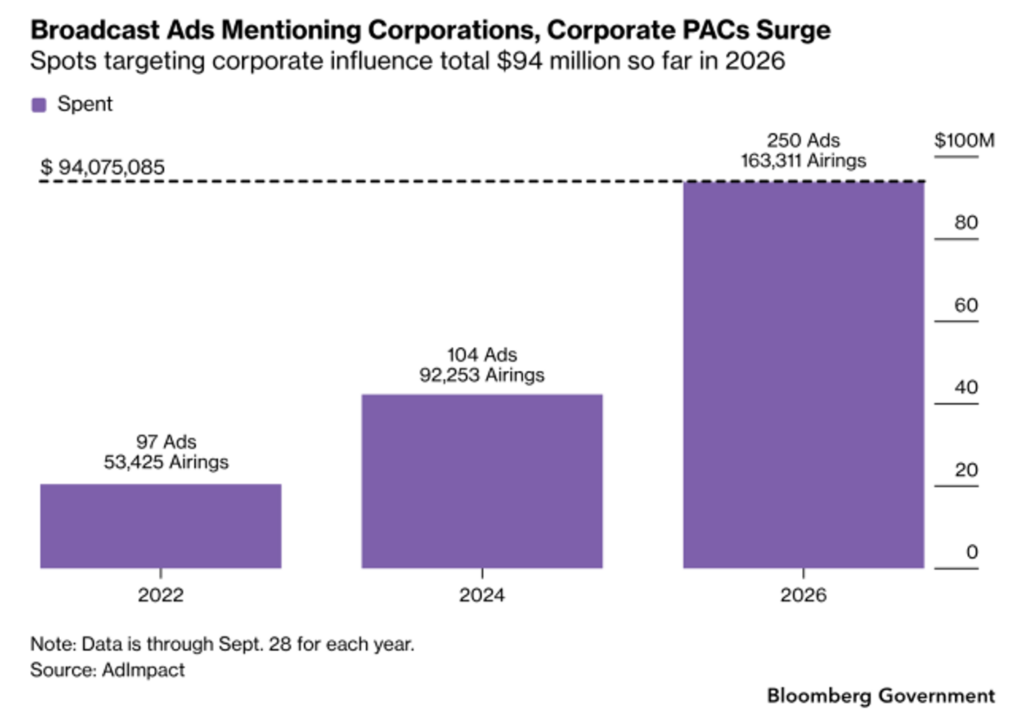
Attacks on Corporate PACs and Corporations Feature Prominently in Midterm Election Races. It would be easy to think that corporate PACs are on the ballot this year, given how frequently politicians are attacking them. The number of broadcast ads featuring corporate PACs and/or corporations has skyrocketed this cycle, already outpacing 2022 and 2024. In addition, more candidates, mostly Democrats, have pledged to refuse corporate PAC donations than in previous cycles. The upshot being that the ads herald that rocky turf may be ahead for business interests in the next Congress. At the least, it speaks to the Democratic Party’s increasing hostility to business and corporate America, which could eventually be reflected in their policy priorities.
In Other Words
“Whether you have a great president or not, Republican or Democrat, they don’t do well in midterms. I don’t know why. Nobody’s explained it,” President Trump.
“Don’t just keep telling me ‘Don’t have the votes. Don’t have the votes.’ You suck,” House Majority Whip Emmer (R-MN) about his Republican Senate colleagues.
Did You Know
Voters are increasingly using AI chatbots to help them research candidates and choose who to vote for. In turn, campaigns are scrambling to ensure such tools can identify their positions and relay them to users. In fact, the Center for Campaign Innovation (CCI) has researched which sites top chatbots pull from to characterize candidates. They found the types of sites used vary between AI models and based on how questions are phrased. Interestingly, the CCI’s study found that chatbots cited Democratic Congressional Campaign Committee (DCCC) websites in 146 answers for Republican candidates, while the National Republican Campaign Committee (NRCC) showed up for just 14 answers about Democrats. Although chatbots tend to pull from “official” sources with verified information, like the Associated Press, Wikipedia, and Ballotpedia, skeptics argue that the study proves that use of AI provides inaccurate responses.
Election trading volume is higher this year than it was in 2024, despite historically lower participation in midterms compared to presidential elections. Kalshi’s election trading volume has grown six times faster this year than its football trading volume. According to CEO Tarek Mansour, this year feels, in some ways, like the first prediction market election, or first meaningful prediction market election. In response, Kalshi is rolling out new guardrails as it looks to lean into the growth, like Brier scores that will use trading volume and event timing to approximate each probability’s accuracy. It’s also reupping efforts to crack down on insider trading, including by fining or suspending congressional candidates who engage in it, although the company declined to say whether they would act against congressional candidates before Election Day.
Graphs of the Week
The Reason More Republican Lawmakers are Breaking with President Trump Summed Up in One Graph.