Thought of the Week
In late September an unusually powerful, slow-moving, early-season Nor’easter slammed the East Coast. I drew the short stick to check on the status of our family’s beach condo. Little did I know that the flood that consumed our complex would be a harbinger for the blue wave that would wash across the U.S. on Election Day. Just a week earlier, in a presentation to SCOA’s credit manager’s, I predicted that Republicans would lose the House but narrowly maintain control of the Senate. By mid-October, I had changed my tune, and during meetings with our Houston office and Houston-based subsidiaries, I forecast an even worse night for Republicans, with growing losses in the House and a very good chance that Democrats would take the Senate as well. In private conversations, I conveyed my gut feeling that things in the House were shaping up to be like 2018 all over again, where the GOP lost 41 seats, and I candidly said that a 51-49 Democratic advantage in the Senate was probably where things would end up—but nowhere did I see the possibility of a 56-44 advantage for Democrats in the upper chamber. You can see where I was coming from, right? Although midterm elections historically favor the opposition party, heading into election season, just after Labor Day, the GOP held enormous cash advantages, had just gone through a redistricting exercise that was supposed to deliver as many as 8 additional House seats, and in the Senate races up for grabs not only were Democrats defending two seats in states that President Trump had won, but in the 22 seats Republicans were defending, not only did the president carry many of those by double digits, only one (Maine) was in a state which went for Vice President Harris. At the same time, however, the president’s approval ratings were falling, and the Iran war, lingering inflation, affordability, and overzealous immigration enforcement had in voters’ minds begun to overshadow the positives of rising GDP, 10 straight months of manufacturing growth, two straight quarters of increased foreign direct investment, tax savings from the OB3, reduced crime rates, and the closing of the southern border to illegal immigration. Ok, now what? Based on the results of the election, there can be no question that Americans are unhappy with the governance of their country, especially with respect to the economy. They’re frustrated, anxious, and angry, and what we saw this past Tuesday was a continuation of a “throw the bums out” voting pattern. Election Day was a referendum on the party in power, same as it was in 2022, 2018, 2014, 2010, and 2006; in fact, 12 of the past 14 elections can be described as “change elections.” While the results certainly continue the long-standing trend of the president’s party facing headwinds in midterm elections and reflect a referendum on the first two years of the second Trump administration, the question for GOP leaders is surely where the party should go from here. While a less devastating loss in the midterms might have allowed the MAGA faithful to convince the party to stay in line behind President Trump, to start, there needs to be a recognition that from its fundraising operations to its governing philosophy, the party has become an organization built around and for one man, and hollowed out and purged of anyone or any idea independent of the current president. The GOP’s traditional attachment to free markets, limited government, the rule of law, and a culture of family values has been superseded by the president’s personal desires, impulses, and peculiarities. In this regard I view the Republican Congress as enablers who failed to reign in the president’s excesses. While holding majorities in both houses, they raised no truly meaningful objections to unilateral trade wars with multiple countries or the actual war with Iran; acquiesced to the demands for mid-decade redistricting; offered no pushback as the administration took equity stakes in private companies; and stayed quiet as the White House moved forward vanity projects from renaming the Kennedy Center to building a 90,000 square foot ballroom, to plans to install a 250 foot arch on the National Mall. While the GOP doesn’t necessarily need to break entirely with the Trump brand, it needs to return to the party’s roots. There’s also a lesson here for the Democratic Party. Should they indulge their extreme left wing’s fantasies, rather than focusing on competent government execution, we may be see a red wave in 2028 and/or 2030.
Thought Leadership from our Consultants, Think Tanks, and Trade Associations
The Asia Group Reviews How Democratic Majorities Could Impact Energy Policy. Bottomline: the midterm election’s outcome is more likely to reshape congressional oversight and legislative priorities than to fundamentally alter the Trump administration’s pro-fossil fuel energy agenda. To date, Republicans have prioritized expanding fossil fuel production, exports, and related federal leasing provisions while paring back federal clean energy subsidies and climate rules. With their wins, Democrats may be able to secure some clean energy concessions, but a significant shift toward green energy investment remains unlikely. At the same time, rising electricity prices and surging AI and data center demand are prompting both parties to prioritize energy affordability and infrastructure, likely driving efforts to expand power generation and strengthen grid development. House Democrats are likely to use investigations and hearings to scrutinize the Trump administration’s energy policies and broader dealings. They will also seek to preserve remaining advanced manufacturing incentives and block further regulatory rollbacks. Permitting reform appears the most likely avenue for bipartisan cooperation, although differing priorities could complicate negotiations. With major standalone legislation unlikely given the Senate’s 60-vote filibuster threshold and the threat of a presidential veto, government funding negotiations may offer House Democrats their strongest leverage to secure concessions from Senate Republicans and the administration. However, disputes over energy provisions could push negotiations past funding deadlines and increase the risk of a government shutdown. Democrats’ energy affordability plan includes faster permitting with stronger environmental protections, expanded renewable energy and infrastructure investment, and safeguards against data centers’ impacts on local electricity and water supplies. Key watchpoints include the Senate scheduled November 9 permitting reform vote and FERC appointments—two commissioner’s terms, one Democratic and one Republican, expire between 2026 and 2028, where Senate confirmation proceedings could offer opportunities for greater scrutiny of energy infrastructure policy.
Capstone Sees Democrats’ Midterm Election Victory Leading to New Regulatory Hurdles for Data Centers and Headwinds for Permitting Reform. Democrats significantly outperformed expectations in the 2026 midterm elections, capturing at least 54 Senate seats and 232 House seats. The seismic shift in power in Congress will lead to far more uncertainty about the durability of the Trump administration’s existing energy policy, as well as where energy policy will go before the 2028 elections. Texas, Georgia, Ohio, New Mexico, Michigan, and Oregon are expected to continue or extend environmental permitting pauses on new data centers, a negative for developers, utilities, and independent power producers (IPPs). Q1 2027 will present the greatest regulatory headwinds, with more clarity coming as the year progresses. State utility commission elections in Georgia and Arizona also saw gains by Democratic candidates. Expect the resulting changes in commission leadership to increase regulatory scrutiny for utilities and data centers, as Democrats campaigned heavily on affordability. In addition, Democrats’ two-chamber control worsens the outlook that Congress will pass the bipartisan permitting reform bill text introduced in the Senate by the end of the year. House Democrats will be further emboldened to advocate for punting negotiations into next year. Likely Senate passage before Thanksgiving will indicate if the bill is a major priority for either party, but the House will pose risk. Democrats face an uphill climb to enact a full reversal of the energy tax credit cuts in the One Big Beautiful Bill Act (OBBBA) while President Trump is in office. However, Democratic leadership could seek to extend the 48E and 45Y tax credits in a more modest package that would not attract the same level of Republican pushback. The outlook for a 45X expansion to new technologies and extension into the 2030s is positive.
The Eurasia Group Foresees President Trump Continuing the “Donroe Doctrine” Despite Midterm Defeat. Republican losses in both houses of Congress will not have a meaningful impact on President Trump’s approach to Latin America. The region will remain a priority because of domestic politics, geopolitical considerations, and the president’s growing focus on his legacy. Most relevant policies also depend on executive action. The approach includes the full Venezuela sanctions and licensing framework, as well as trade policies affecting the region. The White House will continue to support allies through the Treasury Department, the U.S. International Development Finance Corporation, multilateral institutions, and security assistance, while using sanctions authorities to pressure adversaries. The Trump administration’s country-specific priorities include delivering economic gains in Venezuela, securing symbolic change in Cuba, and targeting cartels in Mexico and elsewhere in the region. In fact, this issue will remain important to the Republican base through 2028. While Democratic control of Congress will bring heightened scrutiny of President Trump’s regional policies, investigations are likely to focus on Venezuela oil deals and revenue management. Because a Democratic victory also constrains the administration’s ability to confirm appointees, cabinet changes after the midterms could also shape policy, as a relatively small group of decision-makers direct the administration’s regional policies, which could have significant implications for both Venezuela and Argentina.
Observatory Group Says Parties’ Reactions to the Blue Wave is What is Consequential for 2028. Although the base case was a narrow Democratic House majority and only a 50/50 chance of the Democrats taking the Senate, Democrats won both the House and Senate overwhelmingly. Nearly all analysts underestimated the size of the House win and were too cautious on the Senate, given the Republican-leaning map. Ultimately, this midterm followed a familiar historical pattern: voters punished the party in power. While the results mainly reflect voters’ continued frustration with the status quo, compounded by the president’s polarizing policies, Election Day did not represent a fundamental shift in the direction of American politics. Affordability remains the central grievance, and neither party has convinced voters it can solve this economic problem. The Trump administration exacerbated voters’ frustration by promising immediate relief that did not materialize, while some of his policies made matters worse. The results present a test for both parties in the run-up to the presidential election in 2028. They could provide Democrats with an opening to demonstrate independence from their progressive wing and Republicans with a chance to distance themselves from the White House. However, neither party is expected to really change course. Despite a big night for Democrats, the party’s progressive wing to exert tremendous pressure on the leadership to embrace more left-leaning policies, and the resulting internal divisions will push both the current Democratic leadership and prospective 2028 presidential contenders further left, which could materially jeopardize the party’s prospects in 2028. At the same time, President Trump’s grip on the GOP is unlikely to loosen while he remains in the White House. In fact, a smaller Republican congressional caucus could paradoxically strengthen his influence within the party, as the remaining members may be more concerned about avoiding primary challenges from Trump-endorsed candidates than how they will fare in the 2028 elections. We expect congressional Republicans to continue toeing the Trump party line and to defend him and his actions during upcoming Democratic investigations. The midterm results will deepen political polarization and probably lead to policy paralysis in most spheres outside the exclusive discretion of the executive branch. However, deadlines on funding the government and defense as well as dealing with the debt limit may force Republicans to make concessions on social and other spending initiatives. In this political environment, a vote against one party is not necessarily a vote of confidence in the other. How the parties now act and start to sculpt their policy agendas over the next nine months will betray what is likely to happen in the 2028 elections than the midterm results themselves.
Punchbowl News Recaps How Things Went So Wrong for Republicans. When President Trump stood on the White House lawn on July 4, 2025, gushing about the One Big Beautiful Bill (OB3), he was surrounded by GOP leaders, Speaker Johnson gave him the gavel used to close the House vote, and B-2 bombers flew overhead. For the White House, it was the signature moment in President Trump’s return from the political wilderness after 2020’s defeat and the January 6 Capitol riot. Since then, GOP lawmakers have searched fruitlessly for a mission while the president did his own thing: he launched a hugely unpopular war with Iran; remade the White House and pursued other vanity projects; and raked in billions of dollars from crypto holdings and other business dealings even as concerns about White House corruption grew. Unsurprisingly, inflation is up, gas and diesel prices have soared, mortgage rates are over 7%, and Americans’ faith in the economy—and the president—tanked. Republicans’ hold on Congress is gone, and this means major changes for President Trump’s final two years in office. Before the president points to scapegoats, beyond the Iran war and the internal corruption mentioned above, the following offers a few general answers explaining how this all happened. First, the GOP failed to recognize the political risk of massive Medicaid and safety-net cuts in the OB3, and of letting Affordable Care Act tax credits expire, which allowed Democrats to trigger a record-breaking government shutdown in October 2025 that dramatically shifted Washington’s political dynamic. A later partial shutdown over ICE and the Border Patrol didn’t pay off for the GOP either. Second, Elon Musk’s DOGE backfired. While Musk, himself, admitted that the exercise was only “somewhat successful,” the trillions in savings the White House promised never materialized; however, chaos did. Third, remember Liberation Day? The president’s own tariff wars raised prices while spurring only limited manufacturing growth. In fact, the tariffs are a perfect symbol of President Trump’s second term: a bold plan to remake U.S. and world trade, undermined by his own unpredictability and personal vendettas. Fourth, despite sealing the border and deporting hundreds of thousands of undocumented immigrants, the administration’s harsh immigration crackdown sparked national uproar when federal agents shot two protesters in Minnesota. What’s more, times changed—the farther the U.S. got away from Election Day 2024, the more voters began to worry about the economy and inflation than immigration. Finally, a Trump-led House redistricting scheme proved to be fruitless, and once the president backed scandal-marred Ken Paxton in Texas, pushed North Carolina Sen. Tillis out, warred with Georgia Gov. Kemp, and endorsed the untested Sen. Graham (R-SC) for a full Senate term, the GOP’s Senate majority was lost.
“Inside Baseball”
The American Enterprise Institute (AEI) Asks Whether the U.S. is Experiencing “Dutch Disease?” In the 1960s, the Netherlands experienced a natural gas production boom. Gross domestic product (GDP) grew rapidly, along with wages in the gas sector. But the success of natural gas pulled resources away from other industries, which became less competitive. What’s more, the value of the country’s currency soared, which reduced other sectors’ exports. Measured by GDP growth, the Dutch economy was strong, and growing—but it didn’t feel that way for many. Today, a similar form of what economists term “Dutch disease” is infecting the U.S. economy. While the artificial intelligence (AI) build-out, led by tech firms, has caused a boom in construction and stock prices have responded with near record highs, Americans outside the sector, are unhappy with the overall state of the economy.
In Other Words
“I guess I’ll become Mr. Veto. I’m not going to let them ruin it,” President Trump when asked how he would respond if Republicans lost control of Congress.
“The reason we lost is the war. The president himself said so last night. If you’d like to argue it was worth it, that losing the Senate for the next 6 years was worth it, then do so. Argue it was a worthwhile cost to pay. Agree or disagree, that’s at least honest. But everyone knows why we lost. And any honest conversation about where we go from here must start there,” Vice President Vance.
Did You Know
While Democrats gained definitive control of both the House of Representatives and the Senate, the Democrats’ 13-point national popular vote margin for the House was the largest congressional popular vote margin for either party since 1976.
Graph of the Week
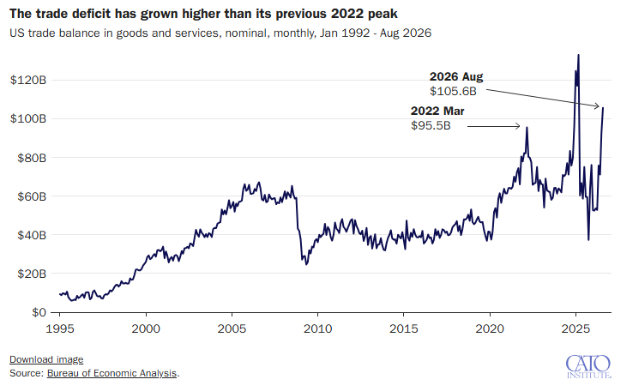
CATO Not Surprised that the U.S. Trade Deficit is Back to Pre-Tariff Levels. Despite more than a year of historically high tariffs and after wild pre- and post-tariff gyrations, the nominal U.S. trade deficit was higher in August than before the Trump administration’s grand tariff experiment began last spring—just as trade economists and other experts predicted it would be before the tariffs began.