Thought of the Week
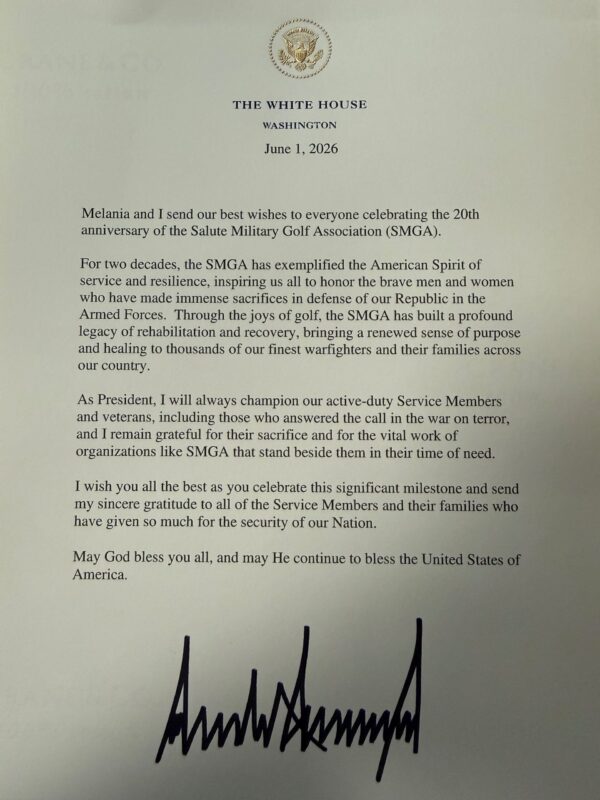
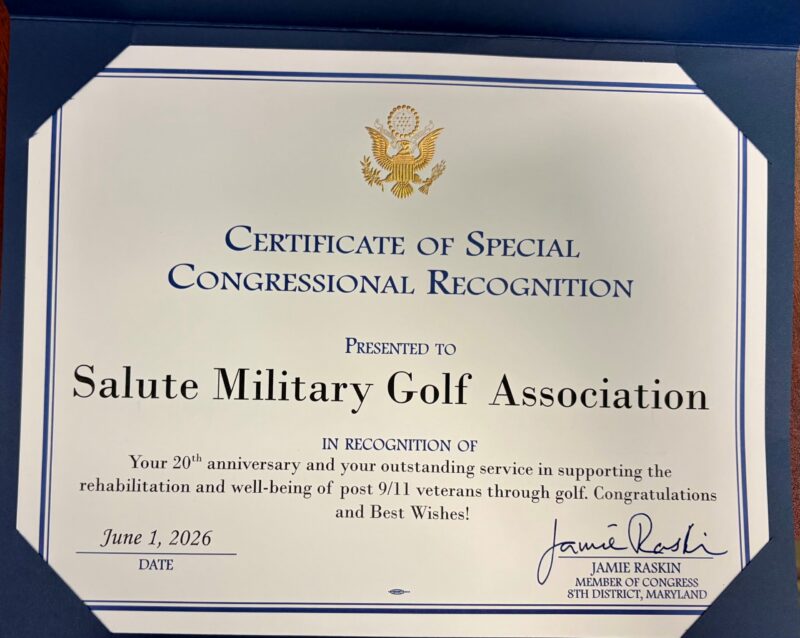
This coming July 4, the United States will celebrate its semi-quincentennial anniversary. Over its 250-year history, the U.S. has had its fair share of political rivalries. Early American rivalries were deeply personal and philosophical, at times pitting former allies against one another. The intense rivalry between Alexander Hamilton and Thomas Jefferson gave rise to America’s first two political parties: the Federalists and the Democratic-Republicans. During the volatile election of 1800, close friends and fellow Founding Fathers, Thomas Jefferson and John Adams, became bitter rivals, and at one point did not communicate with one another for more than a decade. Extreme animosity between Alexander Hamilton and then-Vice President Aaron Burr eventually led to a duel that resulted in Hamilton’s death in 1804. The 1828 presidential campaign between Andrew Jackson and John Quincy Adams was renowned for the vicious personal slurs each candidate hurled at the other, with Jackson believing the stress of the campaign directly led to his wife’s death. The Lincoln-Douglas debates of 1858 showcased possibly the most famous political rivalry in U.S. history, ultimately culminating in the fracture of the Democratic Party, the election of Abraham Lincoln, and the eruption of the Civil War. Teddy Roosevelt’s anger with his handpicked successor’s (William Howard Taft) more conservative policies, led him to form the progressive Bull Moose Party; that effort split Republicans and handed the 1912 election to Woodrow Wilson. Even the 1960 winning presidential ticket of JFK and LBJ suffered from acidic personality clashes and ideological differences. More recently, the 1980 rivalry between Jimmy Carter and Ronald Reagan established a stark conservative vs. liberal divide that has only deepened over time into intense partisan polarization. In the 1990s, the icy rivalry between Democratic President Bill Clinton and Republican Speaker Newt Gingrich led to several government shutdowns and Clinton’s eventual impeachment. It took a Supreme Court ruling to reconcile the 2000 presidential contest between George W. Bush and Vice President Gore, and by the early 2000s, neoconservatives and liberals clashed over the Iraq and Afghanistan wars. President Obama faced intense legislative obstruction from GOP Senate Majority Leader McConnell, culminating in the blockade of Supreme Court nominee Merrick Garland. For the past ten years, President Trump has faced a near constant barrage of impassioned opposition—initially clashing with the Republican establishment; exchanging heated personal attacks with former Democratic Senator and Secretary of State Hillary Clinton; facing relentless opposition from Democratic Speaker Pelosi, which eventually translated into two historic impeachments and the highly contested 2020 election of President Biden. In today’s Washington, rarely does one see the political spectrum’s polar opposites reach near unanimous agreement. Earlier this week, I was fortunate enough to witness such an occurrence. President Trump and the Lead House Manager during his second impeachment trial, Rep. Jamie Raskin (D-MD), came to the same conclusion. I received the attached two letters on the exact same day. The occasion gave me hope that not only are there paths to bipartisan compromise, but that the country may remain one country under God for another 250 years.
FYI: The Washington office’s Senior Director of Government of Government Affairs, James Winslow, and the Co-Founder of the SMGA, received the following two letters, one from the White House, the other from his congressman, on the 20th anniversary of the SMGA’s founding. We congratulate him for his tireless efforts to help our veterans!
Thought Leadership from our Consultants, Think Tanks, and Trade Associations
Global Business Alliance (GBA) Reviews the House Armed Services Committee’s National Defense Authorization Act (NDAA). Although a Chairman’s Mark, scheduled for markup this week, contains fewer provisions targeting foreign-owned companies than recent NDAAs, one proposal could have significant implications for GBA members competing for Defense Department contracts. Section 1806 would establish a preference for “United States companies” in the award of DoD professional services contracts. The provision references an existing DFARS definition of “foreign entity” that considers factors such as place of incorporation, principal place of business, stock exchange listing, and ultimate ownership.
The question is whether U.S.-incorporated subsidiaries of foreign-headquartered companies would qualify as U.S. companies or be treated as foreign entities because of their ultimate ownership. If interpreted broadly, the provision could disadvantage employers that maintain substantial American operations, workforces, and investments solely because they are ultimately owned by shareholders outside the U.S. Despite concerns surrounding Section 1806, the Chairman’s Mark is generally more favorable to foreign-headquartered companies than many recent defense authorization bills. The legislation does not include broad new restrictions on foreign-owned firms’ eligibility for defense contracts, major expansions of CFIUS authorities, BIOSECURE-style prohibitions, or provisions that would broadly limit participation by allied-country companies. Several supply chain and industrial base provisions also recognize the role of allied-country suppliers in supporting U.S. critical materials and manufacturing objectives. Rather than relying exclusively on domestic sourcing requirements, the bill generally focuses on strengthening trusted supply chains and reducing dependence on adversarial countries. In addition, provisions addressing foreign investment and ownership are primarily targeted at adversarial capital and national security risks rather than foreign ownership generally. While questions remain regarding implementation, the Chairman’s Mark largely avoids treating allied-country investment as inherently problematic and remains focused on risks associated with strategic competitors. GBA is engaging with the House Armed Services Committee and will monitor the markup for any changes affecting foreign investment, ownership, defense contracting eligibility, or allied-country participation in the defense industrial base.
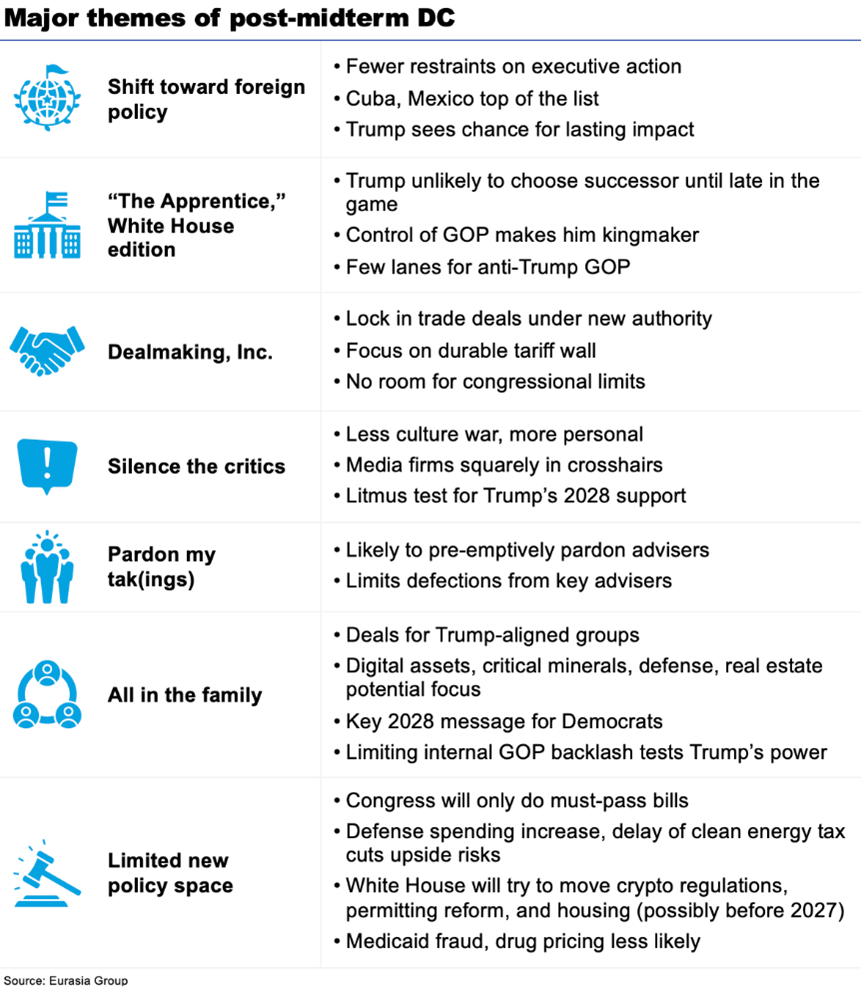
Eurasia Group Looks Beyond the Midterms. The bottom line is that President Trump’s executive actions and legacy building will dominate the last two years of his term post-midterms (see Graphs of the Week for details). In fact, the president is unconcerned by potential midterm losses because he will govern through executive action rather than legislation after the elections. He will likely focus on personal grievances, business interests, and foreign policy ambitions, all areas in which losing control of Congress imposes few constraints. A Democratic House would use investigatory and oversight power to build a narrative of corruption around President Trump’s business dealings and use of executive authority, while lacking political incentives to meaningfully cooperate with the White House. A trade-off between moderate defense spending increases and delayed cuts to either clean energy tax credits or social welfare programs seems to be the most likely point of potential cooperation, but only in the most productive scenario for relations. The Trump administration will prioritize remaking the GOP over winning elections, purging establishment Republicans to assert ideological control as Trump himself cares more about creating a more MAGA party than a more electorally successful one. Democrats will begin their 2028 jockeying shortly after the midterms, with the broad contours of a 2028 policy platform taking shape throughout the year.
Observatory Group Outlines Iranian War Scenarios. While observers have been waiting for a clear signal—either a deal that ends the crisis or a resumption of war that forces a resolution—there is a good chance that neither will occur, leading to what analysts call the “Purgatory” scenario that sees no war but also no deal for two years. The primary reason why full-scale war is unlikely is that both sides are exhausted. The U.S. has drawn down interceptor and cruise missile inventories and naval deployments are stretched, while Iran has depleted armaments, underlying social tensions are high, and the regime isn’t at imminent risk. A return to 40-day war intensity would be deeply unpopular for President Trump approaching midterm elections and intolerable for the Iranian population, meaning that the threshold for resumption is high. At the same time, a comprehensive deal is unlikely anytime soon. The factors blocking a deal—Trump administration political constraints on being seen to pay off Iran, the structural incapacity for technical negotiations, and Iranian distrust—are unlikely to change materially before the end of the president’s term. What’s more, Iran is willing to tolerate extraordinary pain rather than make concessions it doesn’t believe will hold. The second risk scenario involves what’s been ongoing—a persistent low-grade conflict, but not full-scale war resumption. Sporadic strikes, disabled tankers, Iranian attacks on Gulf infrastructure, and ongoing Strait of Hormuz friction. In fact, each occurring incident perpetuates the broader crisis without either side feeling it has crossed a line. Both sides believe their actions are “targeted” and not a resumption of war, which is precisely what makes them so difficult to stop. The bottom line: a framework deal is theoretically logical and the sequencing is structurally simple, but practically very difficult because both sides face credibility problems they have not resolved. Even if a framework is signed, the path to a comprehensive agreement runs through institutional and political obstacles the Trump administration is poorly positioned to navigate. The dominant scenario is not war and not peace, but a sustained limbo—with real and accumulating economic costs—that could persist through the end of President Trump’s second term. Corporate risk management should focus on navigating the friction of a prolonged purgatory.
“Inside Baseball”
82% of K Street Leaders Say Reconciliation 3.0 is Unlikely to Pass in the 119th Congress. A majority of K Street leaders say a third reconciliation bill is unlikely to pass the 119th Congress, according to Punchbowl News’ latest Canvass Survey.* Despite the pessimism, most respondents say supplemental military funding for the war in Iran (79%) and taxes (51%) would be addressed in such a package. In fact, a third reconciliation bill could include hundreds of billions of dollars in defense funding. House Budget Committee Chair Arrington (R-TX) said he wants to pass the reconciliation package before the August recess. Rep. Arrington also said he wants to cut “fraud” and include provisions to make housing and health care more affordable. K Street respondents are more optimistic about a second reconciliation bill, with 88% of respondents saying a package will pass. Senate Republicans were set to pass the roughly $70 billion package to fund ICE and CBP before recess, but President Trump’s $1.8 billion “anti-weaponization” fund drew GOP blowback and derailed the bill.
*The Washington Office participates in the Canvass.
Tariff Trade-Offs. When forced to choose between lower prices for goods or a more resilient domestic manufacturing base, most Americans would choose low prices, according to the latest Reagan National Economic Survey. The survey of 1,000 registered voters found that 64% said keeping prices low through free trade, even if it means relying on other countries for goods, should be the priority over strengthening domestic manufacturing That result is a worrying sign for the Trump administration’s messaging that the tariffs are necessary to shore up domestic industry. There is a partisan component to the survey, however. In fact, the numbers improve for Republicans when sorted by ideology—58% of respondents that identified as conservative or very conservative said strengthening domestic manufacturing is more important. Similarly, although 57% of respondents said they agreed that recent tariffs and trade disputes will generally slow global economic growth in the coming years, a plurality of Republicans, 37%, said they disagreed.
In Other Words
“We won’t rely on past practices when we find better alternatives. In the coming quarters, I expect that together we will have open, clear-eyed discussions of Fed strategies, policies, and operations,” Fed Chair Warsh in an opening statement to employees.
Did You Know
In 1964, President Johnson declared the War on Poverty, which set in motion the creation of the modern social safety net, including a major expansion of food stamps, the introduction of Medicaid and Medicare, and policies such as refundable tax credits. Although previous research found that poverty had fallen since the 1960s, it remained unclear whether the modern social safety net was necessary to produce the decline. Today, new research from the American Enterprise Institute (AEI), CATO Institute, and Cornell University offers the first comparison of poverty trends before and after the War on Poverty began, using comprehensive and consistently defined measures of income from 1939 to 2023. From 1939 to 1963, the overall poverty rate fell from 48.5% to 19.5%, a 29.0 percentage point reduction. Between 1963 and 2023, the poverty rate fell another 15.7% to 3.7%. The conclusion: poverty was already falling substantially without the modern social safety net, and the pace was no faster after the War on Poverty began than before.
Graphs of the Week
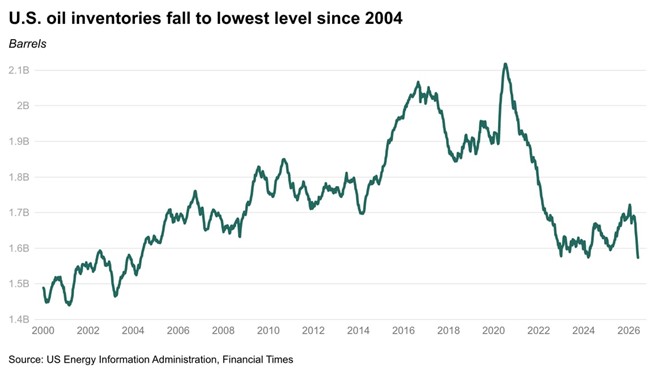
U.S. Crude-oil and Petroleum Inventories Fell by 10.6 million Barrels Last Week to 1.57 billion, the Lowest Level Since 2004. A combination of rising exports and drawdowns from commercial stockpiles and the Strategic Petroleum Reserve has pushed inventories lower as global markets adjust to diminishing Middle Eastern supply. Smaller inventories could leave the United States less able to deal with future supply shocks and may cause oil and gas prices to continue rising.
Eurasia Group Outlines the Major Themes Post-Midterm Elections.