Thought of the Week
I had a fraternity brother in college who could recite the movie Caddyshack line-by-line, from beginning to end. I have another friend who can quote random movie lines off-the-cuff that fit almost any occasion. So, I was bit surprised the other day, when a few friends and I were reminiscing about movies made in Washington, D.C., when we were in college or had just recently graduated, and more than one had not seen St. Elmo’s Fire. No Way Out, True Lies, and The Pelican Brief? Sure, they had seen them, but not St. Elmos Fire. Even for a graduate from archrival George Washington University, I thought it was cool that the “Brat Pack” filmed a movie as recent Georgetown University graduates, hanging out at “The Tombs” (and playing football at nearby University of Maryland as a surrogate for Georgetown). Incredibly, these same two had not heard the line about “double secret probation” from National Lampoon’s Animal House, which has since become a pop culture catchphrase representing heavy-handed, bureaucratic ridiculousness. In the film, once Dean Wormer learns that the Delta Tau Chi fraternity is already on regular probation, he immediately places them on “double secret probation,” an absurd punishment with no official meaning. With its announcement of an “Economic D-Day” against Iran, the latest tariff announcements on Canada, and, particularly, the threat to rename Lake Ontario Lake America, in some respects, at least with regard to trade policy, the White House and President Trump are beginning to sound a bit like Dean Wormer. Eighteen months into the second Trump administration, countries have begun adapting to the president’s “double secret probation” trade policy by pursuing nonbinding agreements that offer immediate appeasement but provide limited enforceability. According to the Center for Strategic and International Studies (CSIS), it is now possible for us to draw several conclusions and lessons from White House trade policy. The first being that President Trump’s policies are not quite faring as originally intended in terms of substantially reducing the aggregate trade deficit or triggering a broad reshoring boom for American manufacturing. But the larger lesson revolves around the learning curve that has occurred, and how White House targets have adapted as they have begun to better understand the tactics employed. Countries have learned that while certain individual tariff actions may still have teeth, the wider policy has a number of cavities in it. In fact, by trying to reorient the global trading system to suit his personal concept of what is in the best interest of the U.S., President Trump’s abrupt changes have created a predictable path—initial panic, followed by whining and complaining, eventual negotiations, ending in workarounds designed to mitigate the effects of the threats and what has been negotiated. The result is a new equilibrium that accommodates minimal changes, pays lip service to a few specified demands, but attempts to maintain as much of the status quo as possible. Whether the latest tariffs will follow this same path is still yet to be seen. But if they do, like others, Canada being placed on double secret trade probation will end with TACO (Trump Always Chickens Out). Fortunately, or unfortunately, President Trump will still believe that even when he backs off his version of “double secret probation,” he still ends up better than where he started.
Thought Leadership from our Consultants, Think Tanks, and Trade Associations
Akin Outlines U.S. Trade and Congressional Outlook Through the End of the 119th Congress.Trade is expected to remain a significant focus through the end of the year, with the executive branch continuing to drive most major actions regardless of the 2026 midterm election outcome. The election is more likely to influence congressional priorities and the intensity of oversight than to alter the administration’s overall trade agenda. After the Supreme Court ruled that the International Emergency Economic Powers Act (IEEPA) does not provide authority for tariffs, the administration turned to other mechanisms, including Sections 232, 301, and 338, and proposed sanctions legislation that would grant the President additional tariff authority. For Japanese companies, the key question is how the announced measures will be implemented. Issues such as product classification, tariff stacking, export controls, exclusions, and eligibility are likely to be more important than any broad negotiations within the U.S.-Japan trade framework. The most significant outstanding risk remains USTR’s Section 301 investigation into structural excess capacity, which includes Japan. Before the election, Congress is expected to devote most floor time to appropriations and other priority legislation. Among trade-related matters, the Senate-approved Russia and Iran sanctions bill is the most consequential item awaiting House consideration because it would authorize tariffs on major purchasers of Russian energy, including potentially Japan; however, it remains to be seen whether the House will bring the bill to the floor during the September work period. The post-election lame duck session is the most likely opportunity for Congress to complete work on the FY27 National Defense Authorization Act (NDAA). The bill could serve as a vehicle for other economic provisions, customs measures, or targeted supply chain initiatives, but Congress will not take up comprehensive trade reform.
Asia Group Highlights the Closing of Iran’s Most Important Economic Route. The UAE’s suspension of all trade with Iran marks the closing of Iran’s single most important commercial channel. The Asia Group says Abu Dhabi’s decision—taken after Iranian ballistic missiles struck Emirati territory, and following repeated attacks on shipping interests linked to ADNOC—makes the UAE the most effective enabler of the next phase of U.S. economic warfare against Iran. Going forward, there are four important notes to consider. First, any tentative détente has collapsed. The suspension reverses months of de-escalation. Security officials from both countries met face-to-face in June for the first time since the start of the U.S.–Israeli war against Iran, shipping between the two countries rose five-fold between June and July to pre-war levels, and Iran resumed scheduled flights to Dubai in late June. The UAE then absorbed more Iranian missiles and drones than any other Gulf state while still recognizing that it must co-exist with a permanent geographic neighbor. That calculation has now shifted. Second, Washington is substituting economic pressure for military escalation. The Emirati move landed as another round of indirect U.S.–Iran talks foundered on enrichment rights, sanctions relief, and control of the Strait of Hormuz. Treasury Secretary Bessent has described a campaign of coming economic isolation without parallel against what is already the second most sanctioned country in the world after Russia. The preference for economic warfare is an effort to avoid a war in which Iran strikes Gulf energy infrastructure, tightening oil markets, and fueling inflation ahead of the U.S. mid-term elections. The bet is that hardship stirs unrest that weakens the regime from within. Third, Iran loses its most important economic lifeline. No two countries matter more to Iran’s economy than China and the UAE—China buys over 80% of Iranian oil, while the UAE is Iran’s largest trading partner and the biggest transshipment hub for indirect Iranian imports, estimated at $21 billion/year. UAE-based exchange houses have also served as a conduit for Iranian foreign currency transactions that would otherwise fall under American sanctions. President Trump has warned that countries providing Iran a “lifeline” face sanctions of their own. Last, the UAE and Saudi Arabia are following diverging strategies. The Emirati announcement followed last month’s U.S. decision to reclassify the UAE as an A:5 nation under export control regulations—a tier typically reserved for NATO and Five Eyes allies, allowing license-free imports of dual-use technology including military equipment and AI chips. Saudi Arabia has moved the other way, signing the Mecca Agreement, a collective defense pact with Pakistan and Turkey that signals openness to an alternative regional security architecture. The underlying shift is that the Gulf’s two largest economies are now positioning on opposite directions of the same conflict—one doubling down on U.S. economic and security ties as leverage over Tehran, the other diversifying its security partnerships.
Observatory Group Says U.S.-Canada Trade Dispute Will Be Defined by China. The White House and the Prime Minister of Canada have each cited reasons for why talks between the U.S. and Canada fell apart late last week. The most discussed reasons are:
U.S. refusal to lower tariffs on medium and heavy-duty trucks;
U.S. backtracking on metal tariff relief;
U.S. demands related to product packaging and digital media that were incompatible with Canadian protections for the French language; and
Concerns from Canada about retaining full sovereignty over its trade relations.
While the specific trade and tariff issues between the two countries are complicated and challenging, tariff rates and trade deficits are not enough to spark an escalating trade war on their own. Only the sovereignty rationale has the existential consequences that can justify this course of action. The Trump administration wants to prevent Canada, which it sees as dependent on the U.S. for its national security (NORAD, NATO, 5 Eyes) and the vast majority of its trade, from deepening its trade relationship with China. This is the minimum ask—the White House wants Canada to follow the lead of Mexico and consider matching U.S. tariffs on China to create a “fortress North America” vision of USMCA. Although President Trump’s critics are panning the idea that the U.S. is starting a trade war with its neighbor and ally, the action is not surprising in the least. Instead, from a U.S. perspective, Prime Minister Carney should not take it for granted that Canada gets preferential market access that is superior to all other nations and U.S. military protection, while courting America’s strongest adversary. The base case is that the standoff may continue for months, if not until January 2029 after President Trump leaves office.A great deal will depend on broader geopolitical developments, Prime Minister Carney’s choices on Chinese investment, and the performance of the Canadian economy. For now, Carney has Canadian popular opinion and a solid electoral majority on his side.
“Inside Baseball”
U.S. Debt Won’t be Fixed Without a Political Forcing Event. Gross debt crossed $40 trillion in August—more than double the $20 trillion reached in late 2017. Both Republican and Democratic policymakers responded with predictable outrage, but neither party proposed anything to change the trajectory of indebtedness. The Observatory Group believes that meaningful fiscal correction is unlikely without an external forcing mechanism. Such a mechanism could be a market-driven crisis or an imminent threat to entitlement checks not covering promised benefits. Whatever the source, such a pressure point must make the cost of inaction higher than the cost of action. Until then, expect continued short-term fixes from administrations of either party and only rhetoric from Congress. Populism, economic shocks, and extreme partisanship have hollowed out the constituency for fiscal constraint. Democrats blame Republican tax cuts; Republicans blame Democratic spending. Neither side will name the actual drivers of the debt—Social Security, Medicare, and increasingly, interest on the debt itself—as the real problems. In this populist political era, any reform of entitlement programs is characterized as taking benefits away. Policymakers are therefore reluctant to touch them, even as debt-service costs climb. Importantly, voters aren’t pressuring policymakers to enact reform. Few voters volunteer debt as the country’s top problem. When asked about specific government programs, the typical response is to tell policymakers not to change them. Insolvency of Social Security, currently projected in 2032, is the most concrete deadline in view, but a market-driven funding crisis could force the issue earlier and would have a less prescribed and far more politically dangerous response.
In Other Words
“Canada wants the benefits of being a State, without being one!!! They have also charged our great farmers, for many years, massive amounts of Tariffs. No more!!!” President Trump.
“As a classic free-market guy, I’ve been pretty concerned about the direction we’re going down for a while now. With JD Vance, it’s on steroids,” Vance Ginn, former chief economist in the Office of Management and Budget during President Trump’s first term. Vice President Vance’s rejection of classic conservative economic policies and recent criticism of figures like Milton Friedman has rattled old-guard Republicans, a faction that has a volatile relationship with the president and is hoping to move the party away from populism in the lead-up to 2028.
Did You Know
In the Alaska Senate race former Anchorage mayor Dan A. Sullivan has endorsed GOP Sen. Dan S. Sullivan for re-election over retired teacher Dan J. Sullivan.
Graph of the Week
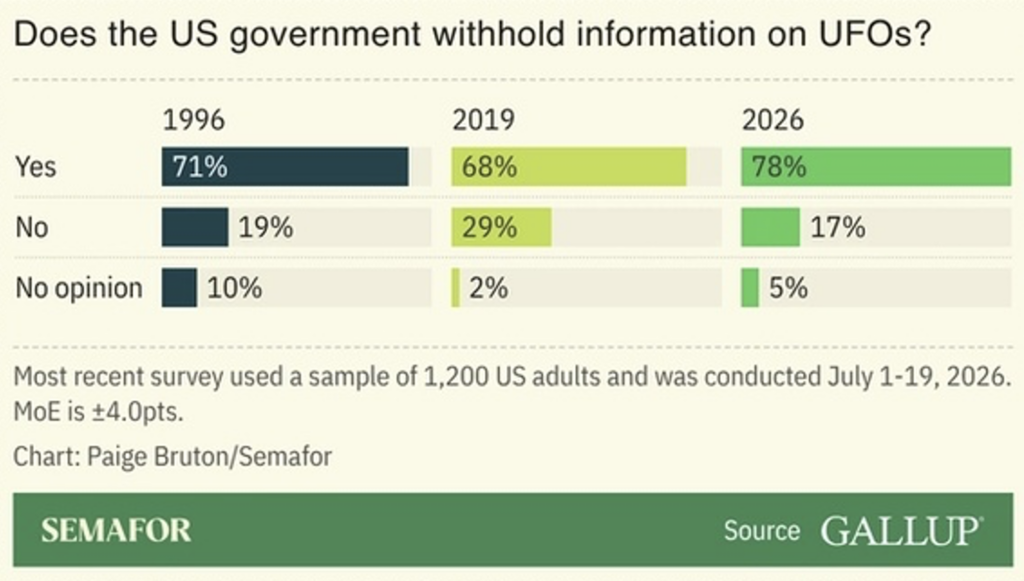
Americans Evolving Views on UFOs. More Americans believe that UFOs have an earthly explanation than think they are spaceships from another planet, according to new Gallup polling. 49% of U.S. adults believe sightings of UFOs are tied to human activity or natural phenomena—fewer than in 2019, when 60% said the same. Although the percentage who believe at least some UFOs are alien spacecraft (37%) hasn’t risen much, more Americans have just become unsure. While the Trump administration has been releasing Pentagon files on UFOs, which could be adding to the uncertainty, most are, at least, convinced that Washington is hiding something: Nearly 80% believe the federal government knows more about UFOs than it has told the public.