Thought of the Week
When I was a kid, my elementary school had an “All Purpose Room;” we didn’t have a gymnasium. The All Purpose Room served as our cafeteria, our theater, and our gym. When it was time to teach the fundamentals of basketball in gym class, the teacher wheeled out a portable hoop. We didn’t have an indoor full court with glass backboards on either end. This bit of nostalgia came up in a discussion I had with my daughter about inflation, people’s perceptions, and the role of public policy. The truth is we hear a lot about the shrinking middle class; so much so that it’s become a hot button political issue with both parties claiming to be fighting to preserve Middle America. But the middle class is shrinking simply because the ranks of the rich and the upper middle class are growing. According to the American Enterprise Institute (AEI), the middle class shrank from 36% in 1979 to 31% in 2024, while the percentage of Americans who were poor or near-poor plunged from 30% to 18% over the same time. What’s more, the share of upper-middle-class and rich Americans exploded. In 1979, 10% of families were upper middle class, by 2024 that percentage had more than tripled, to 31%, and the percentage of rich Americans went from a microscopic 0.3% to 4%, a more than tenfold increase. The truth is that Americans have never been richer than they are today—the U.S. hasn’t had a true recession in 17 years, the stock market routinely hits all-time highs, home ownership stands at 65%, two-thirds of American households own stocks, and the unemployment rate is 4.3%, a level economists consider “full employment.” In fact, GDP growth over the last quarter-century has far outpaced growth in Europe and Japan to such an extent that some of Europe’s wealthier economies are merely as prosperous as America’s poorest states. Consider that British and French living standards, as measured by disposable income, are comparable to Mississippi, the poorest state, not to America as a whole. But who wants to hear objective economic analysis when the subject is general economic malaise. Today’s Americans are expressing the lowest levels of consumer sentiment in 75 years…lower than during the COVID pandemic, the Global Financial Crisis, the dot-com crash, the Carter-Reagan recession, and the 1970s oil crisis. Some in D.C. chalk it up to partisanship, and say economic optimism/pessimism flips depending on who’s in office, with Republicans instantly more optimistic when Republicans win the White House, and Democrats feeling the exact same way when their party controls it. Their conclusion: a closely divided country will never express broad-based economic optimism. However, I think there’s more to it. One explanation is that wealth is relative. Although costs for things like buying a home and funding an education have risen, most Americans forget that they live lives today that would look extraordinarily prosperous compared with previous generations. For all the complaints about housing affordability, Americans, on average, live in far larger and more luxurious homes than past generations. Previous luxuries—like central air, big-screen TVs, home computers, cell phones, and multiple cars—are commonplace today. A second explanation, and one driving the current political debate, is that while the U.S. is wealthier overall, aggregate wealth is increasingly concentrated. According to the Wall Street Journal, the top 10% of earners account for 50% of all spending, and the top 40% account for 75%. These staggering figures mean that rational economic choices by individuals drive the macroeconomy to cater to the wealthy, a combination that makes middle-class Americans who may be well-off by historical standards feel as if they’re second-class citizens. A third explanation has to do with relentless inflation on everyday staples—groceries, gas, healthcare, childcare, and education. Because the cost of living is rising, even when wages advance handsomely, people feel as if they’re doing no better than running in place. The trap of social comparison is a fourth factor. Psychologists point to comparison effects as major happiness-killers. Social media exposes people to constant representations of luxury and affluence, which inflates their own expectations. When material well-being is measured less by absolute living standards and more by relative position to peers, many average earners feel as if they’ve fallen behind. Last, is post-pandemic volatility. Extreme economic volatility, including sudden unemployment spikes and 40-year high inflation marks from the early 2020s, deeply shook consumer confidence. The experience left a lasting psychological mark, which makes Americans feel much more uncertain about their future, regardless of what the broader GDP might suggest. In the end, the traditional middle class shrank because so many families became better off, not because more people are falling short. The gaping inequality between the rich and the rest does not change this conclusion. While the middle class has not been hollowed out, whether inequality has risen, and whether that has been harmful, are different public policy questions. By the way, my daughter’s public elementary school not only had a gym, but a swimming pool…a swimming pool! Just think how much we could save if we went back to all purpose rooms.
Thought Leadership from our Consultants, Think Tanks, and Trade Associations
Conference Board Contends that Limited Passthrough from Energy Shock Solidifies the Fed’s Status Quo. The May Consumer Price Index (CPI) demonstrated that the war-related energy price shock is weakening consumer purchasing power. However, broader inflation passthrough remains limited. While the energy price shock may still feed into a broader set of prices as the year progresses, consumers are focused on purchasing necessities, tamping down demand for discretionary goods and services. This should help cap inflation for these items. While prices of affected goods and services, such as gasoline, food, and airfares will likely remain elevated, the pace of the increases may have peaked. In addition, the tariff-related price shock seems to be largely over as forecasted. Separately, the statistical quirk that boosted shelter prices in April partially unwound in May. So, tariff- and shelter-related inflation should have limited impact on CPI ahead. As long as inflation spillovers into broader sets of goods and services remain contained, the Fed will look through the supply shock by remaining firmly on hold through the rest of 2026.
Eurasia Group Explains that Overcapacity Tariffs are Likely to Layer on Top of Forced Labor Baseline. Forced labor tariffs under Section 301 will become the new baseline for the U.S.’s global tariff architecture after the late-July expiration of the 10% Section 122 tariffs. Section 301 tariffs on 16 economies, as part of an investigation into industrial overcapacity, will likely build on the forced-labor tariffs, which will then finalize rates near those agreed to in trade deals before the IEEPA emergency powers tariffs were struck down by courts earlier this year. Both sets of tariffs, the forced labor and overcapacity, are likely to be imposed by late July, although there is a possibility that the overcapacity tariffs could be postponed until August. Shifting to Section 301 tariffs does not dispel legal risks for the Trump administration’s tariff agenda, given overhanging questions about congressional authorization. Litigation on this issue will take shape over the next six months.
Politico Reports on New Tariff Windfall. The Committee for a Responsible Federal Budget, a think tank that advocates eliminating the national debt, projects that the Trump administration’s proposed new Section 301 tariffs over forced labor laws will bring in nearly a trillion dollars. In an analysis the think tank found that the new tariffs would bring in about $980 billion over the next 10 years, less than the projected $2.7 trillion that it anticipated as of November 2025. The group also found that the administration’s efforts to lower steel and aluminum tariffs on some imports will equate to net savings for companies over the next 10 years. The study found that the recent changes to the Section 232 duties that exempted agricultural machinery and air conditioning units will collect $10 billion less than the old rules. In total, the group projects that the government will collect $1.9 trillion in tariff revenue through the next 10 years—about $800 billion short of the projected revenue had the tariff regime from November 2025 stayed in place.
Rapidan, and Other Analysts, Say Hormuz Energy Flows are Unlikely to Normalize Before the End of the Month. Geopolitical disruptions to global crude production held steady at an estimated 12.3 mb/d in May, and it is now expected that the record geopolitical-driven energy supply disruption will last through at least June. With the closure of Hormuz entering its fourth month, the ceasefire Washington and Tehran brokered in early April is holding. Regardless, there has been no material change in Hormuz transit patterns, keeping roughly half of Middle East crude production offline. While diplomatic activity will ultimately lead to an MoU (70% odds), disruptions will persist through at least June. And although risk remains skewed towards a longer disruption, a near July 1 reopening scenario remains the baseline. Odds of a US-Iran MoU remain at 70%, supporting a gradual reopening of Hormuz beginning sometime in early July. A proposed interim agreement would extend the current ceasefire by 30-60 days and allow for a phased resumption of shipping. However, unresolved disputes over Iran’s nuclear program, sanctions relief, regional proxies, and long-term Hormuz governance leave a meaningful risk of renewed tensions. The MoU largely postpones negotiations on the most contentious issues, leaving follow-on talks vulnerable to stalling as discussions shift from the reopening of Hormuz to more challenging disagreements over Iran’s nuclear file and broader regional security.
“Inside Baseball”
In an Uber, on the Metro, at cocktail parties, one consistently hears a version of the statement: “Republicans in Congress do whatever Trump wants.” True, there have been plenty of instances where members of the GOP went along with the president when they should not have—various nominations come to mind. At the same time, congressional Republicans have ignored or outright rejected the Trump administration’s requests many times. For example, the Senate has rejected plenty of nominees for high positions in the executive branch. Recently, we saw Republican defiance of the president when GOP senators balked at the president’s creation of a $1.776 billion fund to pay individuals claiming to have been victims of weaponized government. According to Senator Cruz (R-TX), 20 senators berated Acting Attorney General Blanche, who was dispatched to meet them. Just days later, the House Armed Services Committee pushed back against the White House’s effort to draw down U.S. military troops in Europe. The committee’s draft National Defense Authorization Act (NDAA), which sets military policy and spending for the coming year, continues the standing requirement that the U.S. have 76,000 troops in Europe ready to repel Russian aggression. It also authorizes $175 million in spending for the Baltic Security Initiative—money the Trump administration did not request. The draft NDAA also pushed back against the Department of Defense’s delay in rotating a second Armored Brigade Combat Team into Poland. While it’s true that partisanship is a potent drug and has led Republicans, and Democrats, to fall supine before a co-partisan chief executive, legislators always squabble with the president because the U.S.’s Madisonian system channels diverse interests that can never be fully harmonized. In an era of extremely narrow partisan control of Congress and plummeting presidential popularity, do not be surprised to see even more GOP legislators refuse to play follow-the-leader.
In Other Words
“Your elections are crooked, and you’re crooked, and Meet the Press is crooked. And so is ABC and CBS and CNN. You’re one-sided, crooked networks. Let’s call it quits. Because I’ve had enough. Thank you darling,” President Trump leaving the set of Meet the Press.
Did You Know
Inside the Senate, there’s a specific desk that has one job: be full of candy. The tradition began in 1965 after Sen. Murphy (R-CA) was elected to office. When Murphy took a desk in the back row near the most frequently used entrance, he kept lozenges in his desk, and offered his colleagues candy—starting the tradition. The candy desk doesn’t have a permanent place, but it must meet four criteria: it must be on the Republican side, in the last row, on the aisle, and next to the chamber’s busiest entrance. Whoever is assigned to the candy desk must keep it stocked for their full two-year term. Some notable senators have kept it full with candy representing their home states. Former Sen. Santorum (R-PA) kept his desk full of Hershey’s, and Sen. Young (R-IN) filled it with Red Hots and local Indiana chocolates. While the desk sits on the GOP side, the need for sweets ascends party lines, with senators from both sides of the aisle enjoying the tradition.
Graphs of the Week
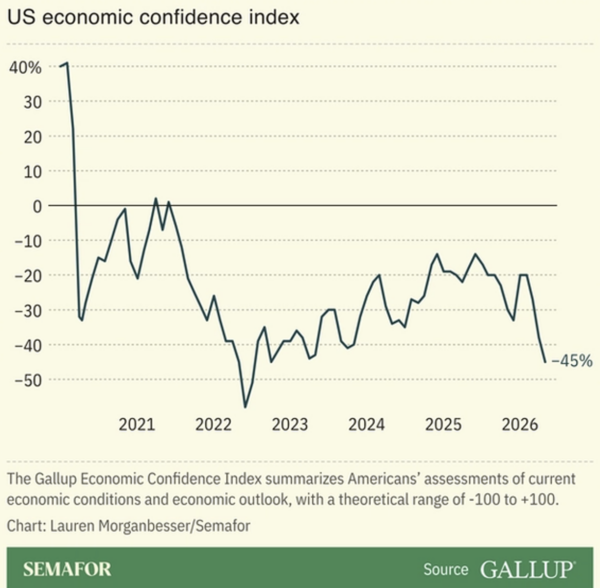
Americans are Souring on President Trump’s Economy. Nearly seven in 10 voters say they disapprove of how the president is handling inflation. Consumer data explains why: a majority of Americans report cutting back on spending—on entertainment, extras, and groceries—and nearly 40% say they’ve cut back on driving. The White House potentially faces even more bad economic news this week, with fresh inflation data; economists expect annual inflation to rise to 4%, the highest rate in three years. Last week’s stronger-than-expected jobs report was a rare bit of good news for the White House, but even that data has intensified speculation that the Federal Reserve may raise interest rates ahead of the midterms.
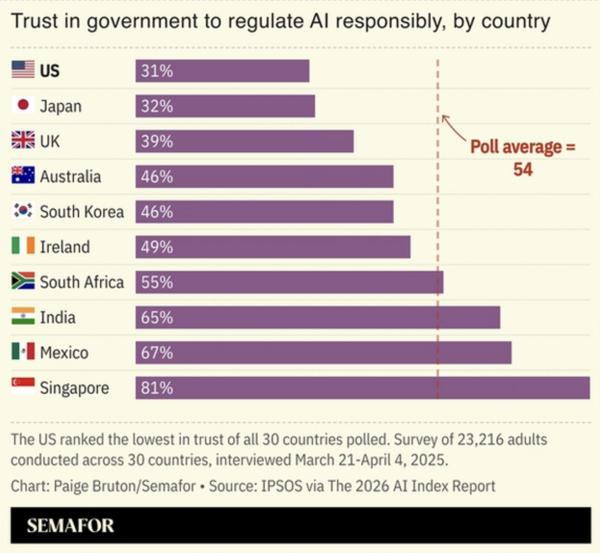
Trust in U.S. Government’s Ability to Regulate AI Low. As Silicon Valley’s artificial intelligence (AI) boom powers the U.S. economy and shapes its national security priorities, political leaders are struggling with how to regulate the technology, if at all. The answer, increasingly, is a set of rules restricting how children can interact with AI. Even as research around the technology and children remains contested, America’s political class is in near unanimous agreement with the view that because social media destroyed a generation of children, controls need to be put on AI so it doesn’t do the same thing.