Thought of the Week
Making just a single digit mistake , or being just one letter off, can result in wildly different outcomes. Last week, Ryan Fox’s birdie putt on the final hole of competition allowed him to become the “Champion Golfer of the Year” by one shot; a typographical error stating that Hubert Humphrey became Vice President in 1964, rather than 1965, forced the U.S. Postal Service to destroy and reprint, at great cost, over 300 million stamps; an off-by-one error in an index calculation caused the European Space Agency’s $370 million Ariane 5 rocket to self-destruct 37 seconds after liftoff; when stepping on the moon, Neil Armstrong’s famous omission of the article “a” rendered “man” and “mankind” synonymous; and just this morning I missed out on $10,000 when my scratch-off lottery ticket’s winning number was 15, and I uncovered 14 and 16. From the jump to the Gregorian calendar in 1582 to the Y2K programming bug to NASA rounding errors, a single misplaced number can lead to a “butterfly effect” with massive unintended consequences. So is the case with politics. Most famously, President Andrew Johnson’s final impeachment tally was exactly one vote short of the two-thirds necessary to convict and remove him from office. Today, a growing number of companies are facing a dilemma when being asked to donate to 501(c)(3) and 501(c)(4) non-profit corporations. The primary differences between 501(c)(3) and 501(c)(4) non-profit lie in their political and lobbying restrictions, and whether donations are tax-deductible. 501(c)(3) organizations are strictly charitable, educational, religious, or literary; donations to them are tax deductible; lobbying cannot be a substantial part of their activities; they cannot endorse or oppose political candidates; and they are required to disclose their major donors to the Internal Revenue Service (IRS). 501(c)(4) organizations can engage in unlimited lobbying and support political candidates; donations to them are generally not tax-deductible; with limited restrictions, they are permitted to endorse or oppose specific candidates; and they can conceal donor identities, a practice which is often referred to as “dark money.” Politicians and their allies actively set up and utilize 501(c)(4) organizations to advance political goals and influence elections. Because these organizations act as “social welfare” groups, they are legally permitted to engage in unlimited lobbying and certain campaign activities without disclosing their donors. In fact, many organizations, the Sierra Club for example, set up a paired structure with both a 501(c)(3) arm for charitable work and a 501(c)(4) arm for aggressive political advocacy. 501(c)(4)s’ dark money contributions are often used to fund “issue ads” or other expenditures that support or oppose political candidates. What’s more, many politicians, particularly those in leadership positions, create a network consisting of an official campaign committee, a traditional Political Action Committee (PAC), and an allied 501(c)(4). The structure allows them to build a wide support base and direct political traffic across different entities. One pattern that growing number of companies are beginning to face on Capitol Hill is the requirement for a PAC donation to open doors and the need for a 501(c)(4) donation to move the needle on legislation. What a difference a single number can make.
Thought Leadership from our Consultants, Think Tanks, and Trade Associations
Eurasia Group Sees Oil Prices Rising as Multiple Geopolitical Conflicts Tighten the Market. Iran in the Strait of Hormuz, the Houthis in the Red Sea, and Ukraine’s attacks on Russian targets in the Black Sea are combining to drive oil prices higher as the early July “mini-glut” following the short-lived peace deal fades. Iran is unlikely to back down, and while the Houthis are threatening to expand their actions against Saudi Arabia, a concerted effort to close the Red Sea would trigger even greater escalation. Ukrainian attacks on Russian refineries and tanker traffic in the Black Sea will continue, adding to pressures keeping prices high and threatening both Russian and Kazakh crude exports. Prices are likely to rise into the $90s for Brent, and potentially higher if the U.S. or Iran escalate their confrontation. Renewed escalation in the Iran conflict is widening estimates of growth and inflationary impacts from energy prices by roughly 30% since late June, with the base case seeing oil settling in a $90-$110 band. European, South Asian, and Southeast Asian importers are the most exposed—with a strong El Niño adding to these woes in many countries—while an AI-driven investment boom is masking the shock in tech-heavy economies such as South Korea, Japan, Vietnam, and Singapore. U.S. gasoline prices climbing back above $4 a gallon will heighten American consumers’ cost-of-living concerns, but the prospect of losing the midterms will not deter President Trump from pressing ahead in the Middle East.
Inside U.S. Trade Reports that USMCA Non-Renewal is Creating ‘Palpable’ Uncertainty. The U.S. decision not to renew the U.S.-Mexico-Canada Agreement has fueled significant uncertainty among businesses, investors, workers, and consumers that could delay long-term investment decisions and erode North American competitiveness, according to former North American Free Trade Agreement (NAFTA) negotiators. Earlier this month, the U.S. declined to renew the trilateral agreement for 16 years in its current form, saying it would continue to engage with Canada and Mexico to discuss outstanding issues during a 10-year review period before the pact expires. President Trump has sent mixed signals about whether he intends to remain in the agreement—on June 10, he said he was “not looking to renew” the pact and argued that the U.S. did not “need anything” from either Canada or Mexico; a week later, he told reporters the U.S. “would do better” without the agreement while leaving the door open to a renewed version. Because the U.S. has not clearly articulated its economic rationale for declining renewal, that, along with the Trump administration’s history of policy reversals on trade, has left markets, companies, and governments uncertain as to what will be the new equilibrium. In fact, the non-renewal decision has already begun to affect investment across the continent. While all three countries had begun to think of themselves as a unified trade and investment area, the Trump administration’s approach—eschewing renewal in favor of annual reviews without a clear long-term vision—has created unnecessary anxiety that is giving North America’s rivals, specifically China, an opening. In fact, prolonged uncertainty risks undermining the very integration that has made North America more competitive globally. While strengthening the continent’s ability to compete with China was a fundamental objective behind NAFTA, an objective the Trump administration shares, it baffles trade analysts how surrendering continental-wide advantages makes the U.S. a more effective competitor in the global market.
Politico Says Wall Street is Obsessed with Washington. Wall Street isn’t just betting on company performance, it’s also betting on Washington. As investors hunt for the Trump administration’s next winner, they’re increasingly trying to anticipate which industries and companies will benefit from White House policy—from tariffs and export controls to procurement, subsidies, and presidential attention. And this is changing how investors think about risk. Beyond earnings and cash flow, they’re weighing which CEOs have the White House’s ear, whether a presidential announcement could transform a company’s prospects overnight, or whether a public falling-out could wipe out billions in market value. Political consultants report that clients increasingly ask whether industries ranging from copper to polysilicon are about to land on the administration’s radar, viewing government attention as either a potential advantage or new source of risk. Most recently, the White House floated the idea of taking stakes in AI companies, raising questions among Silicon Valley leaders. Although markets work best when investors are rewarded for identifying the next breakthrough, not the next company to win political backing, Intel is Wall Street’s clearest example of the new phenomenon, and IBM could become the next test case following White House plans to back a new quantum chip foundry. The calculus is the same for critical minerals, where the administration’s backing has even come with policies that directly improve companies’ bottom lines rather than simply signaling confidence. Purchase guarantees, price floors, and other forms of support aimed at reducing dependence on China have given investors reasons to expect higher revenue and lower risk, making government involvement a much stronger investment signal than an equity stake alone. The administration’s deal with MP Materials crystallized that distinction for investors, combining an equity stake with long-term purchase commitments and price guarantees that directly strengthened the company’s economics. However, there are areas, such as artificial intelligence, where government intervention may give investors pause. AI is advancing rapidly, regulation remains in flux, and although the White House lifted export restrictions on Anthropic, the industry remains exposed to abrupt political intervention. Unlike critical minerals, where government support comes with purchase guarantees and tangible economic benefits, AI companies already enjoy strong investor demand and rapid growth. Policy experts say a government equity stake would not help those companies’ fundamentals. What’s more, a government stake could introduce regulatory uncertainty, because the same government investing in AI companies would be writing the rules governing them. For investors trying to read Washington, the question is no longer whether and where the government may intervenes, but whether political favor has become a market signal in its own right.
“Inside Baseball”
Sen. Graham’s (R-SC) Death Matters Most to Ukraine, Israel. Senator Graham’s (R-SC) unexpected death has already begun to reverberate across the policy landscape, mostly over his relationship with President Trump, with the most immediate implications being for Ukraine and Israel. Sen. Graham was a notable proponent of U.S. aid for Ukraine, and his death will remove one of the loudest voices in President Trump’s ear. In addition, the senator argued strongly in favor of continued alignment with Israel despite the president’s political differences with Prime Minister Netanyahu, and the South Carolina senator’s death could widen those differences. Although Sen. Graham’s South Carolina seat is up for re-election this year, it should not be at risk absent a monumental Republican collapse nationally or with the nomination of a candidate toxic to moderate voters.
In Other Words
“Everybody call John Thune at the Senate. He’s the leader of the Republican Party. And tell him to get this stuff approved,” President Trump speaking about Sen. Thune’s (R-SD) refusal to schedule votes on the SAVE America Act and abolishing the filibuster, two proposals that would likely fail if voted on.
“I went from, ‘OK, he’s president,’ to ‘How can I get to be in his orbit?’ to ‘How can I get to have a say in what’s going to happen today, tomorrow, and next week?’” Sen. Graham (R-SC), who died on July 11, referring to President Trump.
Did You Know
Washington, D.C., residents elect two shadow senators. These senators are unpaid, non-voting officials whose primary mission is to advocate for D.C. statehood and full congressional voting rights. They lobby federal lawmakers, promote statehood initiatives, and represent the city’s interests before the U.S. Senate. They differ from D.C.’s non-voting delegate who serves in the U.S. House of Representatives and has the authority to introduce legislation and vote in committees.
Graphs of the Week
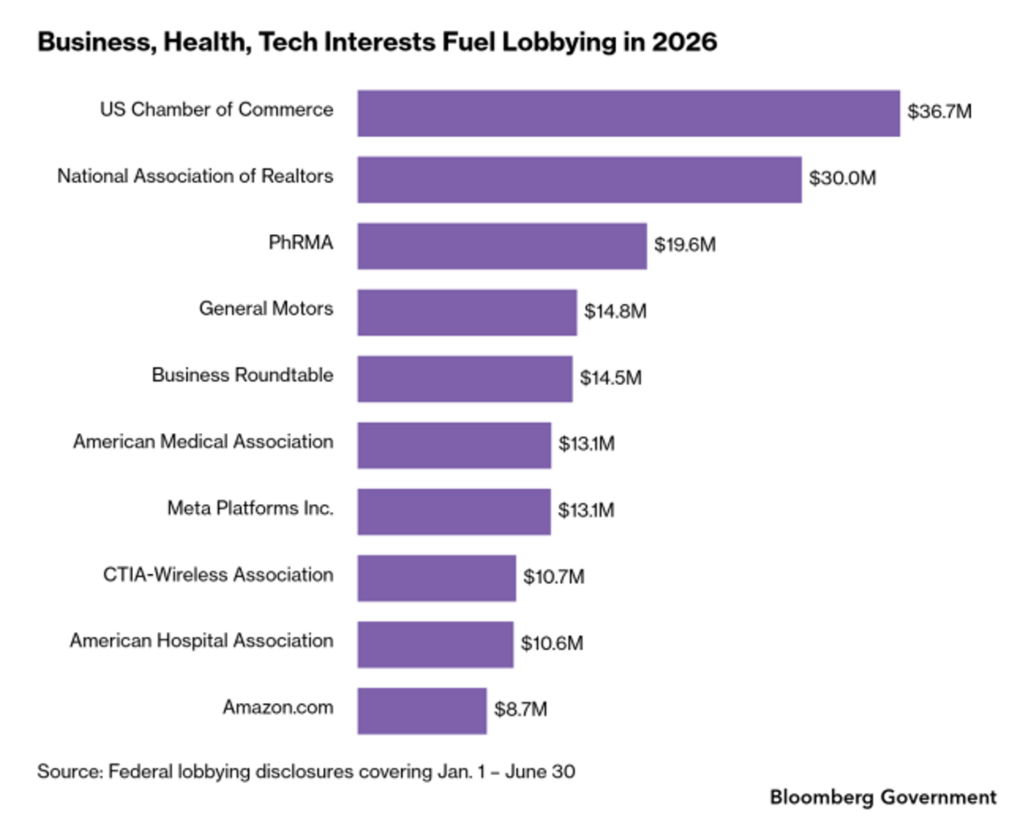
Democratic Lobbyists are Getting More Buzz (and job offers) with Midterms Around the Corner, but K Street is Still Trump’s Town. Firms boasting ties to President Trump dominated the first and second quarters, led by Ballard Partners’ $63.5 million in lobbying fees in the first half of the year—an 84% increase compared with the first half of 2025. Top Washington lobbying firms hauled in record revenue during the first six months of 2026, fueled by potential regulation of everything from trade to artificial intelligence. “Clients are looking at Washington through two lenses. One is focused on advancing their priorities with the Trump administration, and another is the recognition that clients will need bipartisan opportunities to achieve their goals,” said Nadeam Elshami, who co-leads Brownstein’s lobbying practice (the Washington office retains Brownstein). As corporate America braces for the coming midterm elections, the U.S. Chamber of Commerce, Meta Platforms Inc., and the other top 10 biggest spenders on federal lobbying spent a combined $172 million so far this year.