Thought of the Week
There’s been quite a bit of ink spilled the last two weeks…well, maybe not ink, but, you know, number of keyboard strokes typed…explaining how Democrats pulled off a generational blue wave in the midterm elections. Every analysis includes some combination of tariffs, the Iran war, “affordability,” AI and data center backlash, immigration, redistricting, poor candidates, and, of course, President Trump. While understanding the vectors that led to Democrats’ net gain of 9 seats in the Senate and 42+ seats in the House are important—they’ll help us predict how future elections may play out and assist our scenario planning for what legislation and regulation might be on the horizon—just as important, and maybe more important for business, and certainly for lobbyists, is to know what to do next. The 120th Congress will include the largest freshman class in nearly 100 years. At this moment, at least one hundred twenty new members are set to take the oath of office on January 3. The class, comprised of 84 Democrats and 36 Republicans, represent more than one-fifth of the entire Congress. Fortunately, some of the lessons learned navigating the “new” Washington of 2025 can be applied to navigating the new, new Washington of 2027. First, it will be important to cultivate friends, and champions, on both sides of the aisle. Today’s majority should be viewed as tomorrow’s minority. In fact, in every election between 2014 and 2026, seven elections in a row (and 10 elections of the last 11), at least one house of Congress or the presidency has flipped control. Because Washington will still be writing legislation and regulation long after this next alignment ends, companies will need friends from both sides. Second, the importance of building trust preemptively and being transparent with members cannot be overstated. Consider the case of data centers. Fueled by NDAs and lucrative tax breaks, hyper-scalers launched the largest infrastructure build-out in American history. Whether due to the thought of rising power bills, increased inequality, fear of job losses, or even threats to humanity, few foresaw the threat of an electoral backlash. Trust built before shovels hit the ground costs far less than rebuilding trust after the ballots are counted. Third, new members should be engaged where they are on the political spectrum, not where partisans claim them to be. Consider that of the 260 House Democrats expected in 2027, 59 hold seats in districts President Trump carried in 2024, 30 of them by 10+ points; what’s more, there will be 3 times as many “Blue Dogs” and 17 times as many “New Dems” as members of the DSA, which will number just 8. This points to a far more centrist Congress than your favorite talk radio host or podcaster contends. Fourth, if your narrative doesn’t include prices or corruption, staffers are unlikely to listen. The message from voters was clear: lower prices and cleaner government, and because Democrats ran on affordability and accountability, they should be expected to govern accordingly. If your Capitol Hill ask advances neither of those, expect nothing more than a cordial greeting, if you can even get through the door. The truth is that companies are often seen as part of the pricing problem and/or benefiting from insider deals. Climbing out of such a hole requires transparency, persistent engagement, and a sustained commitment to finding constructive solutions. Fifth, U.S. politics are less calcified than generally believed. Swing voters are not extinct, and by most counts they just netted 45 House and 9 Senate seats. A wave that big means that a lot less members feel safe and most will be open to hearing solutions that come from the middle. Translation: advocacy should focus on local jobs, prices, and local impacts. Last, don’t wait for Washington. Sure, Congress and the White House will still write many of the rules, but with the probability of legislative gridlock high, states may be where the action is on a variety of issues—did I hear someone say data centers.
Thought Leadership from our Consultants, Think Tanks, and Associations
Akin Previews the Trump/Xi Talks. President Trump traveled to Manila this week to attend the ASEAN Summit, after which he headed to the APEC Leaders meeting in Shenzen, China, where he met with President Xi. They discussed trade and the Busan trade truce; as expected, no major trade decisions came out of those meetings. Any decisions—like whether and on what terms to extend the Busan trade truce—are more likely to happen during and after the next bilateral meeting between the two leaders during the G20 meetings in Miami in mid-December. However, things could get rocky. Between U.S. frustrations that China is not living up to its existing commitments on agricultural purchases and rare earth licenses, the danger that China will consider President Trump to be weakened by the election and provoke him by overplaying its hand, the unfolding Nvidia news, and the likelihood that the Congress could enact stricter export control measures that will anger China, there are a lot of bumps in the road between now and any extension of the trade truce. Conventional wisdom holds that the truce will be extended because the U.S. and China remain too important to one another for either side to want a prolonged high-intensity trade conflict. Still, do not be surprised if things get heated, possibly with further tariff threats, before the truce is extended.
Observatory Group Sees Steeper Rate Path Ahead, but a 50 bp Hike Improbable. The market’s expected rate path has moved sharply higher on Fed Governor Waller’s comments, including airing the possibility of a 50 bp hike; the hot 0.3% October core CPI; and the slew of Fed speakers calling for more hikes. Still, the base case remains 25 bp hikes in December and March, consistent with Philly FRB President Paulson’s preference for a gradual pace, which serves as a good indicator of the balance of opinion on the FOMC. But there is no doubt that the chances of a January hike have risen; in fact, it’s now a close call. The FOMC’s policy slant in early 2027 could hinge partly on whether the Atlanta Fed presidency is filled.If no one is appointed by the January FOMC, more hawkish FRB St. Louis President Musalem would cast a vote in place of Atlanta.
Politico Says Stephen Miller Will Upend the Way Lobbyists Work with the White House. According to a memo from new White House Chief of Staff Stephen Miller, White House staffers will need to receive prior approval from the Office of White House Counsel if they want to meet with registered lobbyists related to government policy. The memo didn’t shock lobbyists on K Street as COS Miller is known to eschew relationship-based favors, doesn’t sway easily on issues, is ideologically driven, and fiercely loyal to President Trump. In fact, Miller’s intense ideological stances on mass deportations, anti-woke culture, and the America First agenda are well-known in Washington; however, his elevation to chief of staff will make things more difficult for lobbyists seeking to influence the administration the next two years. Although Miller’s predecessor, Susie Wiles, made it a point to maintain downtown relationships, how Miller will manage any of those in his new role remains to be seen. For the past two years the business community has enjoyed direct access to President Trump, who is known as a relationships-oriented person. CEOs have either had face time with the president or been able to just pick up the phone and call him—and that’s the same model many lobbyists plan to follow. One trade association CEO said Miller’s elevation means it’s more important than ever to establish a direct line to the president. Other lobbyists say they will continue to work with staffers on the White House’s Domestic Policy Council and National Economic Council instead of going through Miller. Others say they are still figuring out how to navigate the new normal. No doubt, Miller’s alliances in the MAGA advocacy space, along with his reputation for fiercely fighting for Trump’s top priorities, will shape the new era at the White House. Still, many in-house lobbyists at major companies are saying their focus for the next two years will now be avoiding land mines rather than trying to hit home runs.
The Response from K Street Lobbyists. Sizing up COS Miller’s push to restrict when White House staffers can meet with lobbyists, the response has been one big eye roll. While the new policy requires White House staff to get legal signoff on any meetings they have with registered lobbyists on White House grounds, including the EEOB, it also includes many of the same loopholes that have stymied previous efforts to crack down on corporate influence. For instance, under the new policy, lobbyists may find staffers more willing to meet off campus at one of the many clubs or restaurants surrounding White House grounds, read Ned’s or Joe’s, which already serve as popular haunts for Trump administration officials. But one likely consequence of the current effort is drawing a significant amount of attention. Consider that the policy specifically targets those lobbyists who have registered and done everything required under the Lobbying Disclosure Act, while allowing those who haven’t registered, and openly cheat the system, to continue to shadow lobby in the same way that was seen when President Obama instituted a similar ban. Although lobbyists say the new policy is unlikely to remove corporate influence from the decision-making process, they are perplexed that it singles out those who have complied with lobbying registration requirements while leaving the door open for unregistered consultants and Trump allies to continue to enjoy White House access. Ironically, the White House doesn’t seem to fully appreciate that by banning registered lobbyists who follow the law and ethics rules while allowing non-registered “advisers” to continue unabated is akin to prioritizing illegal immigrants over those individuals who comply with the terms of legal immigration.
“Inside Baseball”
Corporate Deals to Remain a Feature of Trump Administration Tariff Policy. With the Trump administration using tariffs as a source of leverage over global companies as well as governments, corporate bargaining for exemptions has become a structural feature of White House trade policy. Although a Democratic-controlled Congress will scrutinize this practice more closely, a framework of corporate agreements in exchange for tariff relief will likely continue for the remainder of President Trump’s term. In fact, it is expected that the Trump administration will continue to use tariffs to secure other objectives beyond the scope of trade, such as onshoring commitments and pricing plan deals.
U.S. Trade Policy in the Wake of the Midterm Tsunami. Although the midterms dealt Republicans a historic defeat, President Trump’s trade agenda is unlikely to suffer the same fate. In fact, the Democratic midterm sweep is unlikely to produce a major shift in U.S. trade policy, as Congress lacks the votes to overcome filibusters or override presidential vetoes. With Democrats constraining the White House’s domestic agenda, the president is likely to lean more heavily on foreign policy, including trade, and return to his favored tool of tariffs. While Congress can increase scrutiny and press for targeted action, particularly on Canada and USMCA renewal, broader tariff relief and changes to core trade authorities remain unlikely. While a weakened President Trump may be less able to resist calls for tougher action on China, several pending or newly enacted measures could bring additional tariffs, sanctions, and export controls.
In Other Words
“If there is, they will pay a price the likes of which no country has ever paid before. I hope it’s not, but we take it very seriously because they happen to be crazy,” President Trump responding to reports of an Iranian dirty bomb threat targeting Washington, D.C.
“Mr. Huang’s sexual appetite—his decision to have extramarital sex is the most expensive sex that has happened since Helen of Troy,” Sen. Kennedy (R-LA).
“I’ll make the determination at the beginning of the year. So, we’ll spend the next few weeks with the family and make a decision early February,” California Governor Newsom on his timeline for a decision on whether to run for president.
Did You Know
In December 1621 Pilgrim Edward Winslow* wrote the only eye-witness account of the first Thanksgiving celebration; it read: “Our harvest being gotten in, our governor sent four men on fowling, that we might after a more special manner rejoice together, after we had gathered the fruits of our labors. They four in one day killed as much fowl as, with a little help beside, served the Company almost a week. At which time, amongst other recreations, we exercised our arms, many of the Indians coming amongst us, and among the rest their greatest king Massasoit, with some 90 men, whom for three days we entertained and feasted, and they went out and killed five deer, which they brought to the plantation and bestowed on our governor, and upon the captain and others. And although it be not always so plentiful as it was at this time with us, yet by the goodness of God, we are so far from want that we often wish you partakers of our plenty.”
*The Washington office’s James Winslow is a direct descendant of Edward Winslow and his brother, Kenelm.
This was the most expensive election in history. Campaigns spent more than $12 billion on ads this cycle, shattering the previous record of $11.2 billion set in 2024. This was the first midterm election to outspend a preceding presidential election, and it was a whopping $8.9 billion more expensive than the 2022 midterms.
Graph of the Week
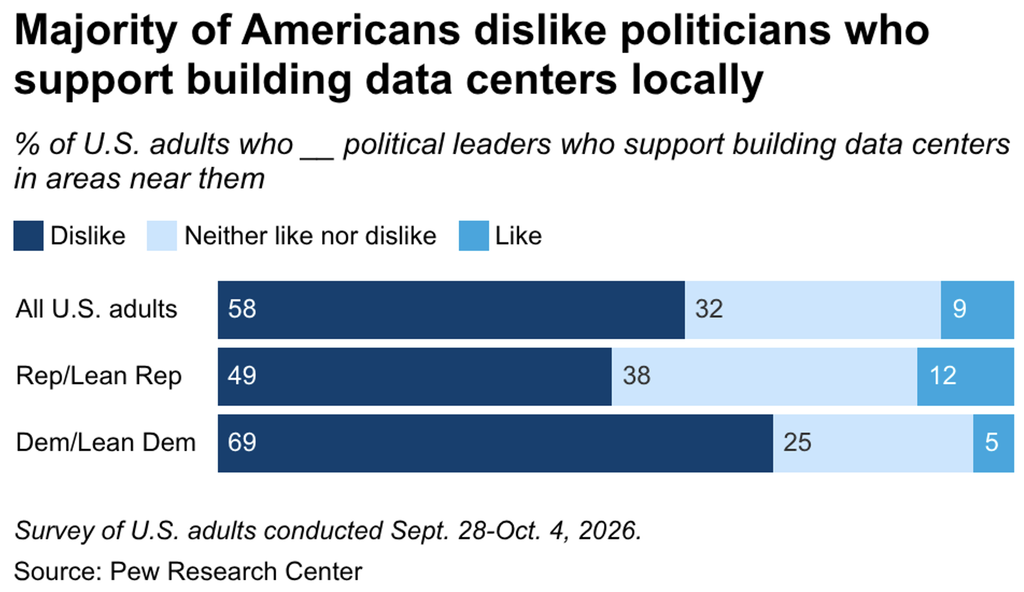
The Public Backlash Against Data-Center Development Manifested Itself at the Polls. Earlier this month, municipalities across the country voted on data-center-focused ballot measures, and nearly all of the measures passed will prohibit or limit the development of data centers in those localities. Most of the bills that were voted down would have allowed data centers or increased their development. In keeping with voters’ rejection of data centers, a recent survey found that a majority of Americans aren’t just against centers in their backyards—they think less of politicians who want to put them there. In fact, Pew Research found that very few Americans held positive views of political leaders pushing for local data centers. A large number of Democratic governors elected—even in red states—campaigned against data centers.