Thought of the Week
Within a popular quote, “A lie gets halfway around the world before the truth has a chance to get its pants on,”1 lies a lesson companies would be keen to heed heading into the start of the 120th Congress. Come January, Democrats have pledged to investigate companies for sector-specific issues linked to affordability and use corporations to indirectly probe President Trump and his administration for corruption. And although such investigations can lead to legal action, reputational damage is the much wider-reaching threat of such inquiries. In fact, while congressional hearings may evoke a courtroom feeling, companies facing Democratic probes should treat them more as public relations campaigns. When Congress investigates public officials, reputational fallout can dent or tank political careers, but for companies, unflattering content, out of context narratives, and outright falsehoods from investigations can hurt stock prices, profits, and trust among business partners. A congressional probe is a public relations nightmare waiting to happen. If called to the Hill, firms should expect elected officials to ask executives detailed questions about both the company’s core business and its interactions with the administration. Because these affordability and anti-corruption investigations will be designed to be soundbite-ready, C-suites, boards, witnesses, and communications teams should be prepared for the possibility of a social media firestorm. The point being not to fear the three-hour hearing so much as the viral five-minute YouTube clip. And even if a firm escapes a call to Capitol Hill, that doesn’t necessarily mean it’s in the clear—an enquiry into one company, can lead to scrutiny for numerous other businesses, making the entire industry guilty by association. As our general manager, Yasuko Fumuro, continuously warns, “If you’re not at the table, you’re on the menu.” Therefore, to have a fighting chance at winning any messaging battle associated with an oversight hearing, or at least reaching a draw, at a minimum companies need to be prepared to do at least three things: (1) build relationships with committee leaders, both old and new; (2) craft their own narratives; and (3) be ready to retain experienced outside teams—both legal and comms. In terms of relationships, companies should recognize that because hearings and investigations are typically a means toward a larger objective, such as legislation, it’s smart to form connections with members as soon as possible to try to understand what they’re truly after. Concerning the messaging battle, because one of the primary goals of any investigating committee is to create headlines, controversy, and an overarching storyline, it is important to recognize that it can be extremely dangerous to let members and congressional staffers control the narrative on their own. Shaping the public narrative, recognizing that sometimes it’s better to release embarrassing details on one’s own terms, and bringing committees something that might be more interesting to pursue are all strategies that can be pursued. But hoping nothing ever surfaces isn’t a winning formula. And that’s where experienced teams can assist. Reputational risk can intersect with legal risk during congressional hearings as companies face not only bad press but the possibility of class actions, shareholder lawsuits, and Justice Department action. To manage all these angles, legal departments need to move in lockstep with government affairs and communications teams, which can be more difficult than it sounds. For instance, declining to comment in the press while practical in a legal sense, looks guilty from a comms perspective. Experienced outside teams can serve as a pragmatic coordination tool for any company under fire. Now is the time for firms to begin preparing for what may come. Incoming House oversight committee chair Rep. Garcia (D-CA) foreshadowed as much, telling companies and other targets to “lawyer up” after Democrats’ landslide midterm election win. As Benjamin Franklin observed, “By failing to prepare, you are preparing to fail.”
1 – Often falsely attributed to either Winston Churchill or Mark Twain, expressions about falsehoods outpacing the truth trace back much earlier. In fact, a version of the quote appeared in a 1710 work by Jonathan Swift, the essayist best known for his novel Gulliver’s Travels.
Thought Leadership from our Consultants, Think Tanks, and Trade Associations
Capstone Sees a Steep Climb for Permitting Reform in the Lame-Duck Session as House Democrats Remain Divided; Data Centers Would Benefit from a Delay in Passage. Democrats’ two-chamber flip reduces the probability that the permitting reform bill, the Bipartisan American Affordability and Jobs Act of 2026 (BAAJA), passes in the current congressional session. Although the Senate is expected to approve the bill, House Democrats are likely to wait until the next Congress to advance elements of the legislation they favor. That said, support from 70-plus Senators would put pressure on House Democrats to pass the bill this year, especially given the time it has taken to reach a compromise and the possibility that President Trump would not sign a proposal crafted primarily by Democrats. While Senate approval is likely to address concerns raised by various coalitions, project certainty, and transmission provisions, House Democrats are likely to take issue with changes to the National Environmental Policy Act (NEPA), tribal issues under the NHPA, and the project certainty provisions. If passed, the bill would benefit energy technologies across the board by speeding the permitting process and reducing red tape. Beneficiaries would include independent power producers (IPPs), energy transmission companies, renewables, oil and gas companies, geothermal developers, and mining companies operating on federal land. The legislation would increase data centers’ operating costs, so they would benefit if it fails. Bottom line: the Senate permitting reform bill faces an uphill climb to becoming law before year’s end. While the Senate is poised to pass the measure, House Democrats remain divided. By speeding the permitting process and reducing red tape, the reform is positive for utilities, renewables, and developers in the oil, gas, geothermal, and mining industries. The legislation would increase operating costs for data centers, so they benefit with failure.
The Conference Board Believes the Robust Employment Report and the Hot October CPI Strengthens the Case for Further Fed Rate Hikes. The October employment report provides yet another reason for the Fed to continue raising interest rates: payroll growth rebounded sharply, unemployment declined, and wage growth remained firm. Payrolls rose by 165k in October, well above expectations, while revisions added another 84k jobs to the prior two months. The unemployment rate edged down to 4.1% as job creation exceeded the pace needed to keep up with population growth. The three-month average payroll gain accelerated to 137k, a pace that is more than sufficient to keep unemployment low and reinforces the Fed’s assessment that the labor market remains solid. Wage growth remains firm, but still on a downward trajectory, consistent with other measures such as the employment cost index (ECI). Average hourly earnings rose by 0.4% m/m in October, but the pace of growth edged lower from 3.2% y/y to 3.1% y/y. Hiring broadened across professional and business services, healthcare, and manufacturing. Manufacturing employment continues to benefit from investment in computers, electronics, machinery, and related production. Early holiday season hiring was evident in transportation and warehousing jobs. With the economy growing strongly in the third quarter, inflation reaccelerating, and the labor market firming rather than weakening, the report strengthens the case for two more rate hikes, one in December 2026 and the other in March 2027.
Both headline and core CPI were higher than expected in October, reinforcing the case for a December rate hike and further tightening in Q1 2027. Headline CPI rose by 0.4% m/m, while core prices increased by 0.3%, exceeding consensus forecasts of 0.3% and 0.2%, respectively. Underlying inflation broadened as an earlier spike in energy prices filtered into other goods and services categories. Assuming a similar contribution from PPI in October as in September would lead to an increase of 0.4% m/m in headline PCE and 0.3% m/m in core PCE. Headline PCE is expected to rise by 4.0% y/y, with core PCE at 3.3%. As a result, expect to see 25 bp hikes in each of December 2026 and March 2027. Although discussions of a possible 50 bp bump in December does not change expectations, it does reinforce views that December will not be the final hike. Persistent inflation and higher borrowing costs will further constrain purchasing power, leaving consumer spending vulnerable in 2027.
Observatory Group Says the Democratic Senate Majority Implies a Steadier Fed. The Senate is the part of the Democratic sweep that matters most for the Fed, because that chamber confirms every new governor and the Board’s two Vice Chairs. Any governor leaving now is most likely to leave a seat empty, because a Democratic Senate by a simple majority can and almost certainly will refuse to confirm a partisan nominee. Note that a fully staffed Board of Governors is in fact the exception, not the rule. All seven seats have been filled only about 30% of the time since 2000, which makes today’s full Board historically unusual. With little prospect of a partisan replacement, Jay Powell may find it easier to leave early. It would also blunt the impact of the administration removing Lisa Cook or Michael Barr. That isa big positive for preserving Fed independence. It also implies that after Philip Jefferson’s term as Vice Chair ends in September 2027, his Vice Chair position will likely remain vacant. One implication is a lower ratio of governors to Reserve Bank presidents on the FOMC, giving the presidents more weight. But we do not see that materially impacting its policy slant or how much influence the Chair has over its decision-making. Separately, the US Treasury’s quarterly refunding announcement hinted that cuts to the size of note and bond auctions may be coming, consistent with larger buybacks and a growing reliance on bill issuance. That could lower Treasury’s near-term borrowing costs and flatten the curve, but it would also make the government’s interest bill more sensitive to Fed rate hikes.
“Inside Baseball”
Don’t Expect a National Popular Vote Compact. In theory, Democrats control enough state governments to bring the National Popular Vote Compact—an Electoral College workaround—to fruition; however, the party is unlikely to do so ahead of the 2028 election. The National Popular Vote Compact subverts the Electoral College by having states pledge to award their electors to the winner of the national popular vote, not the popular vote in their state, if states totaling 270 electoral votes, a majority, have also pledged to do so. This would mean that the national popular vote winner would always win the Electoral College. With unified control of state governments in Arizona, Michigan, Nevada, Pennsylvania, and Wisconsin, Democrats could try to enact the compact in those states, bringing the total number of electors under the compact to 283. Still, this is unlikely to happen because of the list of above states, all five are swing states that are extremely influential under the current Electoral College system and would see their relevance diminished or eliminated entirely if the president were elected by a national popular vote. It’s difficult to see why any of those states would surrender their influence. What’s more, potential legal challenges and the fact that Electoral College was biased towards Democrats, not against them, in 2024 are also relevant, but the structural disincentives are the most important. If any swing-state governors express openness to the idea, a reconsideration of this view may be warranted.
In Other Words
“I know ’em all, I like ’em a lot. So I may or may not get involved. I don’t know. Maybe I’m better off not getting involved,” President Trump about whether he’ll endorse a candidate for the 2028 Republican presidential nomination..
Did You Know
Rep. Jim Jordan (R-OH) was elected to lead a much-diminished House GOP as minority leader next year, beating out Majority Leader Steve Scalise (R-LA) in his third attempt to lead Republicans on Capitol Hill.
Jordan won the secret ballot vote 106-73.
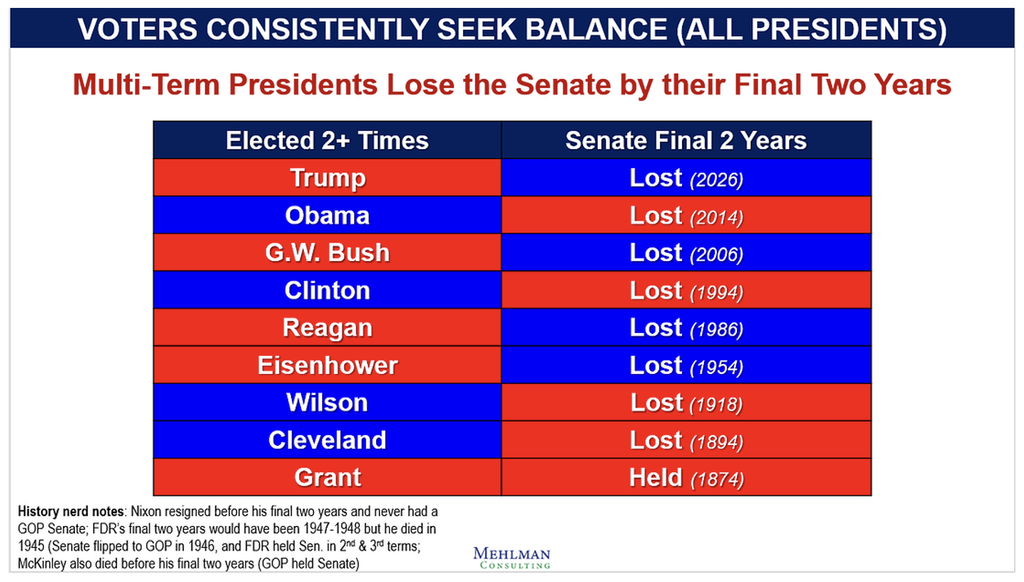
Graph of the Week
Voters have been Taking the Senate Away from Multi-term Presidents for Over a Century (see graph). While polls did catch last Tuesday’s wave, they missed out on its magnitude, understating Democrats in 13/15 key Senate races. Democrats succeeded by mobilizing their base, persuading independents, and winning-over a fraction of the GOP. Although midterms are referendums on the current president, it should be remembered that the system is built for balance and the political pendulum almost always swings back. Going forward, analysts expect that the next two years will be among the most disruptive and unpredictable in modern memory. In fact, businesses will be squeezed between a still-powerful Executive Branch it must work with and an electorally-emboldened Congress determined to find and expose corruption.