Thought of the Week
Last week, I had an interesting business trip to Houston. While meetings with members of the Houston team and Houston-based subsidiaries were compelling and productive, the trip, and its immediate aftermath, were interesting for different reasons. My first night, after a full day of travel, meetings, a presentation, and dinner, the hotel’s fire alarm was tripped in the middle of the night. Believing it was a false alarm, I checked what others on my floor were doing. A quick visual revealed that about half the rooms headed down the stairway and about half waited at their doors for an announcement to be made. Just as I made the decision to evacuate, the alarm switched off. Having already committed, I had to travel all the way down from the top floor just to take a crowded elevator back up. The next day, heading to my first morning meeting, my Uber search revealed that the single address I had for the subsidiary I was visiting had two locations, four miles apart. Murphy’s Law prevailed, and I chose the wrong one; having to redirect caused me to be a few minutes late and to shorten my presentation on the fly. Then, upon deciding to take an earlier flight back at the end of the trip, I arrived home late at night. As I climbed into my own bed and fell asleep, I was awakened by one of the most horrifying sounds ever created by man—the chirp of smoke detector’s dead battery. Having no 9-volt batteries in the house, I unplugged the detector from the ceiling and tried to go back to sleep. Taken together, the three served as a reminder that actions have consequences. What is largely overlooked is that elections have consequences as well. Too often, votes are cast strictly on personality, likability, party preference, or, particularly during midterms, as a proxy for the administration in power, even though they’re not on the ballot (in the 20 midterm elections held since 1946, 18 of them have seen the president’s party lose seats in the House of Representatives). In fact, a recent study by the National Institutes of Health (NIH) calls the phenomenon of candidates, rather than policy positions, driving election outcomes, the “personalization of politics.” Data from the study suggests that political outcomes are heavily influenced by personality traits and party identification, giving credence to election predictions that rely on polls gauging the mood of the country, the generic ballot, and presidential approval ratings—predictions that have proven quite accurate. But what about the consequences of election outcomes driven by personality? No doubt, the results of the November 3rd midterm elections will inform how Congress is likely to legislate policy over the next two years. At present, various analysts and prediction markets show Democrats having a 90% probability of winning the House and 61% chance of taking the Senate. The consequences of a flip in party control in even a single house of Congress will reverberate across all industries; let’s quickly look at two. On one hand, if Democrats reclaim at least one chamber, it is likely that various sections of the Clean Electricity ITC/PTC for utility-scale wind and solar projects would be heavily debated, with tax credit negotiations posing an upside for the Section 45Z Clean Fuel PTC. On the other hand, data centers would face increased scrutiny from Democrats in a split government. Although impactful policy reforms would not pass Congress, developers would be subjected to continued oversight and investigations. What gets lost in all the emotion surrounding elections and candidates is that voters’ choices have real world consequences. To get a look at how your industry or business sector may be impacted by the result of the midterms, please contact the Washington office.
Thought Leadership from our Consultants, Think Tanks, and Trade Associations
Bloomberg Government Says an Era of Disruption is What is Jolting K Street. While the most dramatic growth on K Street came from AI companies disclosing record sums, the National Association of Realtors ousted the U.S. Chamber of Commerce as the overall top spender on federal lobbying through the third quarter of this year. Going forward, corporations and industry lobbying groups are gearing up for a post-election lame-duck session and dedicated influence campaigns as they look toward the next Congress. Individually, Anthropic and OpenAI shelled out the most they ever have on federal lobbying in the third quarter; Anthropic spent $5.6 million, while OpenAI reported nearly $3.8 million. The spending comes as Washington debates whether to set new regulations on AI and as candidates work to respond to voters’ concerns about data centers. Beyond AI, K Street is setting the stage for new priorities in the 120th Congress, with Democrats pledging to pursue a robust investigations agenda, to include corporate clients, especially those with ties to the Trump administration, if they control the House and/or Senate. Although the third quarter of an election year tends to be a sleepier period for K Street, there hasn’t been much of a break as companies engage in contingency planning, scenario planning, and offer counseling about all the various permutations firms may face in the lame duck and in the new year. Ballard Partners dominated its rivals on K Street, pulling in $34.9 million in revenue during the third quarter, bringing its haul through the first three quarters of 2026 to more than $98 million. Ballard reported more than 100 individual contracts worth at least six figures during Q3. BGR Group and Brownstein were neck and neck for second- and third-highest revenues last quarter, with each pulling in nearly $22.6 million from July through September (SCOA is a client of Brownstein). And Akin Gump rounded out the top five firms by revenue in Q3, reporting $18.9 million in lobbying revenue. While AI lobbying blanketed Congress, the single largest spender wound up with a more tangible result. The National Association of Realtors, which has spent $57.4 million on federal lobbying so far this year, touted passage of a major, bipartisan housing bill.
Eurasia Group Believes a Democratic Midterm Sweep Would Bring Limited Changes in Policy Direction . A likely Democratic sweep in the midterms would limit the legislative agenda in the next Congress but not force a major change in policy direction from the Trump administration. Moderate fiscal expansion is likely if Democrats win at least one chamber, while the risks of market-disruptive brinksmanship over the debt limit is extremely limited, given Democrats’ historical unwillingness to seek leverage from the issue. Investigations and impeachment would be a major focus, with key committees probing the business dealings of figures in or close to the administration, but these would provide little leverage over the White House in the absence of any serious threat of removal from office.
Inside U.S. Trade Reports that Former USTR Lighthizer will Host USTR Greer for Closed-Door Pentagon Advisory Talks on Trade Policy. Former U.S. Trade Representative (USTR) Lighthizer will chair the first meeting of the Defense Department’s reconstituted Defense Policy Board (DPB), gathering behind closed doors with his successor, USTR Greer, and others to discuss how to integrate defense and trade policy. Lighthizer, who served as USTR during President Trump’s first term, was named the panel’s chair in June, nearly a year after Defense Secretary Hegseth announced the committee of outside advisers would be reconstituted; Secretary Hegseth had disbanded it in April 2025. Traditionally, the board’s meetings are closed to the public. The purpose of this week’s sessions is for the board to “obtain, review, and evaluate classified information related to the DPB’s mission to assess the defense implications of various trade and economic policy issues as they relate” to the department. Topics will include how the Pentagon can “best support and integrate with the Administration’s trade and international economic strategy; supercharging the Defense Industrial Base; increasing burden-sharing with allies and partners; and the potential effects and strategic implications of ‘China Shock 2.0.’” The first and second Trump administrations have emphasized the idea that “economic security is national security” and used national security as the justification for many trade actions. Under President Trump, the Commerce Department has launched a record number of investigations under Section 232 of the Trade Expansion Act of 1962, which allows the executive to issue trade restrictions for the purposes of national security.
Observatory Group Sees Post-Midterm Lame Duck Congress Punting on Big Policy Items. Congress will return to Washington on November 9 with a long list of bills to pass and little capacity to finish them. The prevailing view is that with Democrats almost certainly winning the House, and possibly the Senate, Congress will punt, i.e. delay, on almost every policy issue. While the agenda is lengthy, ranging from government funding, through the National Defense Authorization Act (NDAA) to a possible third GOP-only reconciliation bill to increase defense spending and possibly suspend the debt limit, there is only a 75% chance that Congress passes the bare minimum on each of these:
A continuing resolution (CR) to fund the government at current spending levels until March or April 2027, thereby averting a government shutdown;
NDAA passage; and
Short-term extensions of the farm bill and highway reauthorization.
There is just a 25% chance for each of these:
Another reconciliation package;
Infrastructure permitting reform; and
Full-year government funding through September 30, 2027.
The punting, particularly on fiscal issues, will stack deadlines for a divided government in spring 2027 when government funding and the debt limit come due. Democrats, even if just controlling the House, will look to exert maximum leverage over the Trump administration.
“Inside Baseball”
Golf Course Dispute is More Serious Than it Looks. The Trump administration appears set to move ahead with plans to begin renovation of the East Potomac golf course in Washington, even though a court order is in place blocking elements of the project for now. The dispute has been unusual due to White House efforts to remove Judge Ana Reyes from the case and claims that the Interior Department does not need formal approvals to move ahead. While the dispute may appear trivial—the renovation of a single golf course in D.C., a pet project of the president’s—its implications are less so. The administration has certainly strained the relationship between the courts and the executive branch, but it has rarely been in outright defiance. If the administration does push ahead with its plans, this would be a signal of how it intends to test executive-judiciary relations after the midterms. Even with more concerted domestic pushback in the form of a Democratic-controlled House and/or Senate, President Trump is likely to keep pressing boundaries. The spat over East Potomac suggests that even though the president’s policy ambitions may be more limited after the midterms, he will still be able to erode the norms of the constitutional system, even through small-scale disputes. President Trump doesn’t need massive, high-profile fights with the courts over issues like tariffs or deportations; instead, norm erosion after the midterms may tend towards “death by a thousand cuts,” making it harder—though not impossible—for institutional norms to return to the status quo, post-Trump.
Hotter-than-Expected September CPI Reopens October Hike Debate. Results from the September Consumer Price Index (CPI) report sharpened, rather than resolved, the monetary policy debate over future interest rate moves. While the data support calls for two additional rate hikes this year—in October and December—downward revisions to Personal Consumption Expenditure (PCE) inflation, the recent rise in longer-term interest rates, and a weaker-than-expected September payrolls report have all been featured in recent Fedspeak as the case for a pause. Taken together, the recent Fed commentary argues against an immediate October move, but it does not argue against further tightening. September CPI still points to inflation pressures that are too broad and persistent for the Fed to declare victory, particularly as higher energy, transportation, and producer costs continue to move through the supply chain to consumers. Therefore, the October decision will hang on the distinction between what the data suggests the Fed should do and what the Committee has signaled it is prepared to do.
In Other Words
“He didn’t end the Lindsey Graham sanctions. He’s just suspended the enforcement of them for now” Energy Secretary Wright. President Trump’s use of a national security waiver to delay, or avoid, sanctions on Russia aligns with the Eurasia Group’s view that such a waiver is the easiest offramp to manage tensions in Ukraine and draw Putin to the negotiating table. In fact, despite the waiver, it remains possible for sanctions to be placed in the future.
Did You Know
The U.S. federal budget deficit widened to nearly $2 trillion for the 2026 fiscal year, a fresh reminder of the scale of government borrowing. For the fiscal year through September, the deficit widened to $1.99 trillion; that marks a 12% increase on the $1.78 trillion gap recorded for last year.
Graphs of the Week
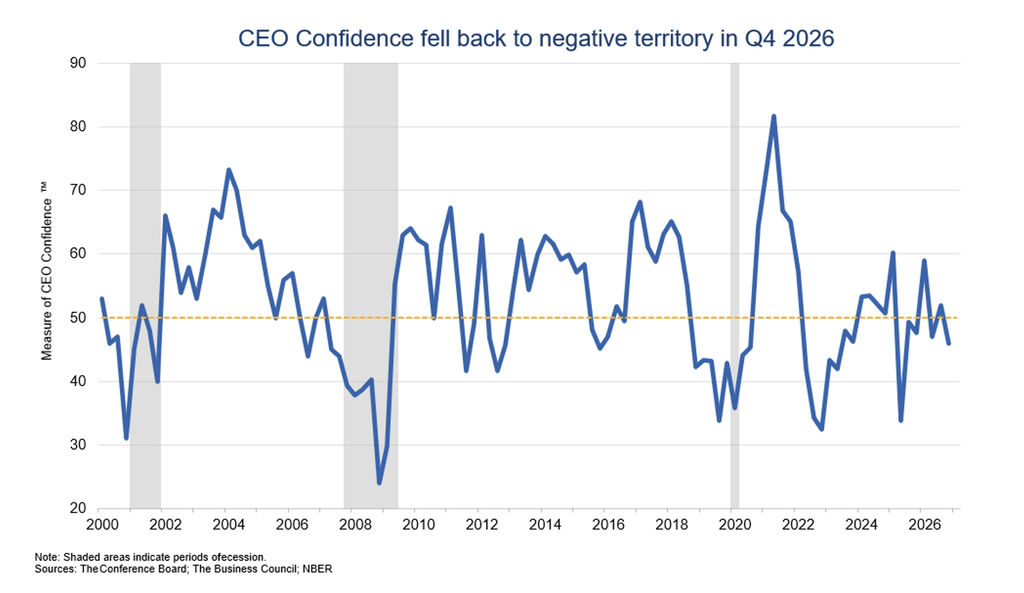
CEO Confidence Declined in Q4 2026. The Conference Board’s Measure of CEO Confidence fell to 46 in Q4 2026, down 6 points from 52 in Q3 (a reading below 50 reflects more negative than positive responses). CEOs’ assessments of current economic conditions were significantly more negative, with 41% expecting conditions to worsen over the next six months, up sharply from 19% in Q3. Regarding their own industries, CEOs were much less positive about current conditions and expect little to no improvement six months hence.
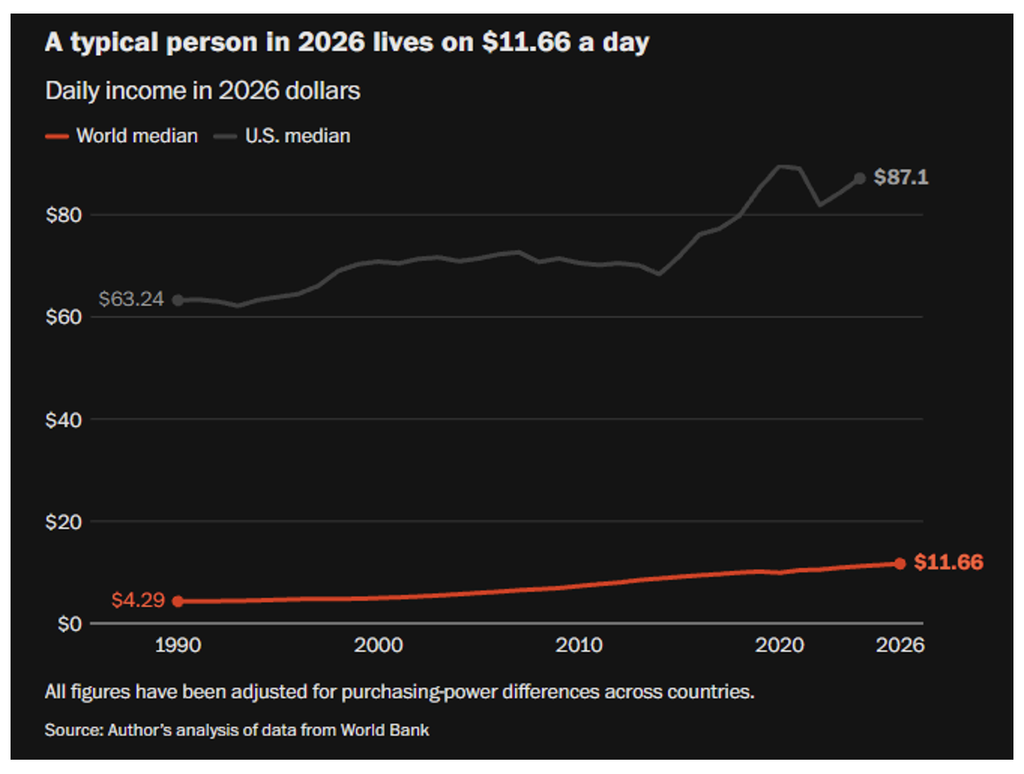
What Does $11/day Buy You. Since 1990, the global median daily income has increased from $4.29 to $11.66, and the number of people living in extreme poverty has fallen by nearly 1.5 billion. This extraordinary rise in global prosperity is being attributed to technological progress, market-oriented reforms, and an international order grounded in free trade and the rule of law.