Thought of the Week
Make the trek up Capitol Hill any day Congress, either the House or Senate, is in session, and you’ll see groups of people wandering the halls from House Cannon to Rayburn and Senate Russell to Hart wearing matching t-shirts, hoodies, ties, or buttons. These aren’t run-of-the mill tourists looking to spot the Speaker of the House or tour the Capitol building, but engaged citizens looking to exercise their first amendment rights to speak freely, peaceably assemble, and petition the government for a redress of grievances. Yes, I mean lobby. Just last week, groups as diverse as the National Farmers Union, pharmacy compounders, flight training advocates, the Armenian National Committee of America, and many others hosted their annual or semi-annual fly-ins. What’s a fly-in? It’s a government affairs’ organized event where members, employees, or other advocates travel to Washington, D.C., or a state capitol to meet face-to-face with lawmakers and their staff. Also known as lobbying, advocacy, or Hill days, such events are typically coordinated by trade associations, non-profit institutions, and corporations. The primary purpose of a fly-in is direct constituent engagement as lawmakers prefer hearing real-world stories from actual voters and local business owners rather than professional lobbyists alone. A second key purpose is education and advocacy. Fly-in participants are given the opportunity to directly explain how pending legislation or regulations may impact local communities and industries. After nearly twenty years of federal lobbying, I can attest that the number one thing congressional staffers appreciate more than anything is a detailed summary from constituents of the unintended consequences of legislation their boss is considering voting for. Third, fly-ins build relationships. Regular annual visits help organizations establish long-term visibility and credibility with key congressional or state representatives and their senior staff. The idea being that it is much easier to build friendships prior to a crisis than in the middle of an emergency. Beyond direct Capitol Hill visits, fly-ins can include briefing sessions where advocates learn about specific policy positions, key talking points, and effective storytelling strategies before entering an office. And they can also include networking events, primarily via trade associations, where participants connect with peers from across the industry who share similar legislative interests. So, why do I bring this up now? Well, SCOA recently held what I’d call a quasi-fly-in. Last week, credit managers and CFO’s from SCOA subsidiaries descended on Washington, D.C, for two days of meetings that included a trip to the Capitol and various congressional offices. Participants received a behind-the-scenes tour of the Capitol building (including a look inside Speaker Johnson’s (R-LA) prayer room), watched House debate from the gallery, and took part in direct lobbying meetings with legislators spanning the ideological spectrum from Sen. Ted Cruz (R-TX) to Rep. Jonathan Jackson (D-IL). With 2026 being a mid-term election year, there is no better time to schedule your fly-in, or visit, to Washington to engage with your relevant House and Senate offices. As Sen. Isakson (R-GA) once said to me, “Jamie, you know the best time to plant an oak tree was 50 years ago; the second best time is today.”
Thought Leadership from our Consultants, Think Tanks, and Trade Associations
Bloomberg Government Forecasts Defense Policy in a Democratic 120th Congress. Congressional scrutiny over the Pentagon and the Trump administration’s military policies is expected to intensify if Democrats win a majority in one or both chambers this November. A Democratic majority could use subpoena power for greater oversight on Defense Secretary Hegseth‘s management of the military and rein in military operations against Iran that lack congressional approval. While pushback on the White House’s defense agenda may remain limited if Republicans maintain their majorities, some GOP lawmakers have expressed a willingness to break with the president over key defense issues, including Iran. Regardless of outcomes, next year lawmakers will need to address depleted U.S. munitions stockpiles and changes to military operations driven by the increasing use of drones on the battlefield.
Eurasia Group Says Diesel to Keep Rising, Crude to Remain Elevated in the $90-$110 Band. Despite U.S. success in moving oil through the Strait of Hormuz, crude prices will remain elevated, and product prices will continue to climb. Refinery outages and shipping disruptions caused by the Middle East and Russia-Ukraine conflicts will remain key sources of pressure, especially as Russian diesel exports collapse. While Saudi Arabia is expected to shift its crude exports to the Persian Gulf in an effort to take advantage of the U.S. escort system as the East-West pipeline slowly comes back online, skyrocketing fuel prices will not be enough to force U.S. concessions to Iran ahead of November’s midterm elections. Still, significant military escalation remains unattractive given the risks of Iranian retaliation. Iran is expected to manage the U.S. pressure campaign as it continues its attritional strategy, utilizing proxies and tanker attacks to push up prices, in the hope the U.S. blinks first. Regardless, the U.S.-Iran standoff is expected to persist through year-end as neither side is close to a deal, and the U.S. is in a wait-and-see posture rather than pursuing decisive escalation or negotiation. Going forward, Chinese import levels and regional oil flows are the two key variables that could push prices outside the $90-$110 range. Middle distillates are the acute pressure point globally—diesel, heating oil, and marine bunker fuel are all in structural shortage across the U.S., Europe, and Asia, with Q1 2027 flagged as a potential crisis point if the standoff persists. What’s more, as political pressure to take action regarding high diesel prices is growing, the White House is likely to impose export controls on diesel and other refined products (65% odds) if diesel prices remain elevated past their 2022 high of $5.82 per gallon past October 15.
Observatory Group Sees Trump-Xi Summit’s AI Talks as Limited, but the Start of a New AI Cold War. During this week’s U.S.-China summit, the two sides will hold their first-ever bilateral dialogue on AI governance. Coming against a backdrop of ever more intense AI competition between Washington and Beijing, American tech leaders and the public are calling for applying brakes to the AI frontier model development. However, both governments see AI development as key to their countries’ relative power, and neither is remotely likely to slow its pace of development. So, expect the summit talks to be confined to declaring basic governance principles and setting up lines of communication. The Trump administration has played up the AI dimension of the summit, to look as though it is addressing popular AI concerns in front of the midterms. In fact, an AI Cold War between China and the United States has already started, with countries taking sides under the Pax Silica and the World AI Cooperation Organization (WAICO) agreements. Follow-ups from the summit should result in some AI guardrails which mirror those created for nuclear weapons during the original Cold War.
“Inside Baseball”
A Look Inside Think Tanks’ (Brookings, CATOs, and International Economic and Law Policy Blog) Overall Attitudes Toward Trump Administration Trade Policy:
CATO Institute: President Trump’s vaunted “trade deals” are much less than meet the eye. Foreign governments have offered big, flashy numbers but small, concrete concessions, while maintaining almost all of their “sensitive” sacred cows and looking to run out the clock on everything else. Over time, the commitments have gotten thinner, not thicker, and little of it is set to endure when President Trump leaves office in 2029. Bottom line: the administration’s 20 trade deals are “a demonstrable failure.”
Trade Analyst Simon Lester, International Economic and Law Policy Blog: There is no end in sight to the Canada-U.S. trade war. It’s quite a mess, and it remains unclear whether and how the key actors can get the two countries out of it. While there’s always a way for each side to make small concessions, declare victory, and get out, at present, policymakers do not feel the economic or political incentive to do so.
Brookings Institution: President Trump’s tariff fix leaves U.S. trade policy in permanent flux. Many in Washington, both Democrats and Republicans, believe the U.S. needs a fundamentally different approach to trade in an era of rising geopolitical tensions and rapidly changing technology, and that the debate is worth having between the White House and America’s trading partners. What’s clear is that Section 301 is not the answer. A tariff regime built on Section 301, a statute that is repeatedly revisited through successive investigations and reviews, sidesteps the debate rather than resolving it. The real question is not whether Section 301 can support a new tariff regime, it’s whether the U.S. can decide what that regime is for.
In Other Words
“It’s ‘Not great, Bob!’, as they say on Mad Men. Trump’s approval numbers are down. That’s not good. They’re making strategic decisions based on polling numbers—that’s what happens in political races,” GOP strategist Nachama Soloveichik on the worsening national environment for Republicans.
“You should not be here covering me. You said you weren’t going to cover me. You shouldn’t be covering me,” President Trump to CNN’s Kaitlan Collins after he banned CNN from the White House press pool.
“I told Kevin, I said, ‘You might as well vote with the board because it’s just not going to matter.’…The board is very hostile. They’re very political. They’re doing the wrong thing. They’re a bunch of politicians,” President Trump about the Fed’s decision to raise interest rates.
Did You Know
Even when the House is on recess, it holds pro forma sessions to satisfy the U.S. Constitution’s “three-day rule,” which prevents either chamber from adjourning for more than three days without the other chamber’s consent.
Graphs of the Week
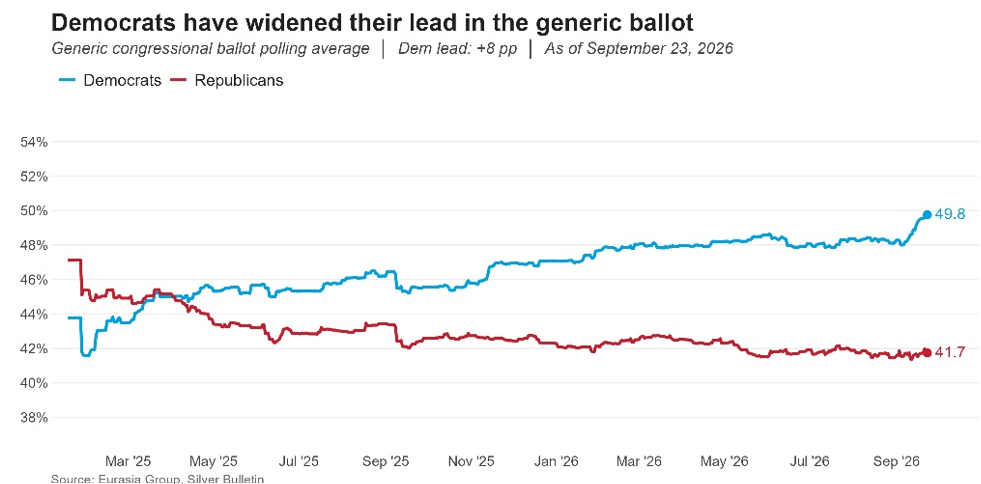
Democrats are Now Narrow Senate Favorites. Campaign analysts now give Democrats a slight edge to win a Senate majority (55% odds), driven by a substantial shift in the generic congressional ballot and sustained polling leads for the party in crucial states. If Democrats flip North Carolina as expected and hold all their current seats, they will need to win three of five key races—Maine, Texas, Ohio, Alaska, and Iowa—to claim the Senate majority, with weaker-than-expected polling in Michigan, New Hampshire, and Minnesota leaving them as only narrow favorites. While Democratic control of the Senate in addition to the House would not have major policy ramifications over the course of 2027 and 2028, beyond holding up White House nominations for executive and judicial positions, winning the Senate this year would give Democrats a head start on retaining control in 2028.
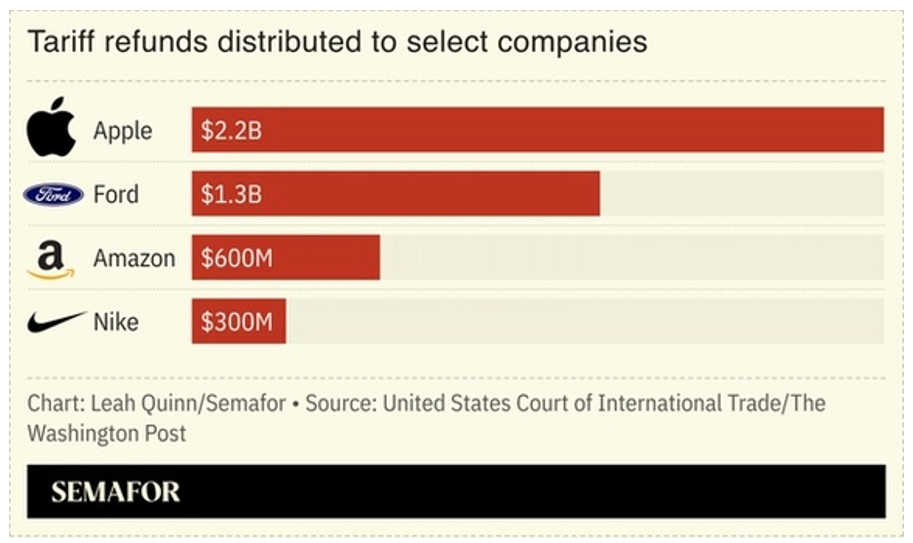
Senate Democrats Press for Tariff Relief. In a letter to U.S. Trade Representative (USTR) Greer, six Senate Democrats urged the Trump administration to refund consumers alongside importers after the Supreme Court struck down a previous round of IEEPA tariffs. The private sector, which has recouped nearly $100 billion, is trying to do some of the work itself by plowing the money into price cuts and parceling out refunds. In fact, companies that opted out, including Ford and Costco, are facing lawsuits. While asking White House officials whether they are monitoring firms’ actions and weighing direct refunds, like tax relief, the Democratic lawmakers are laying the groundwork for future oversight of current levies should Democrats take one or both houses of Congress in midterm elections.