Thought of the Week
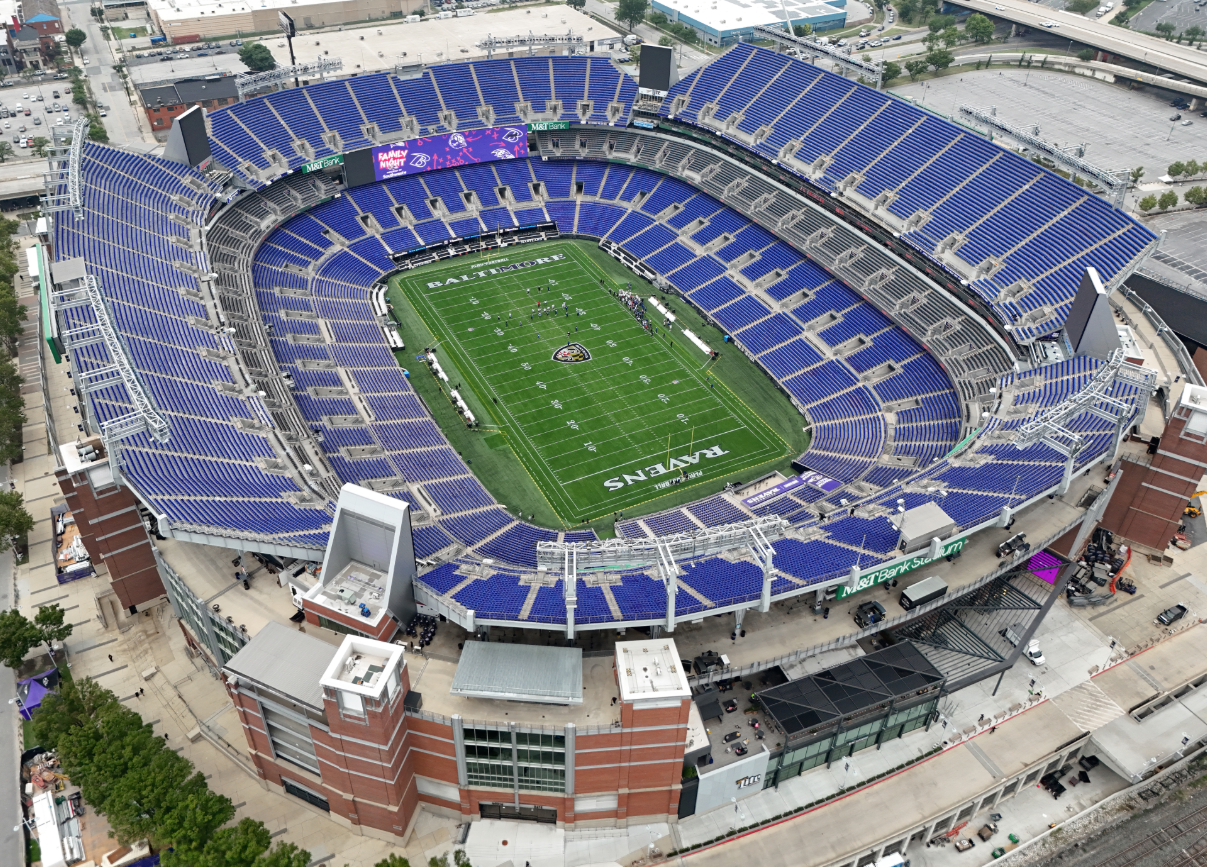
This past weekend, I headed north up I95 to Baltimore for the Baltimore Ravens-Cincinnati Bengals football game. Heading toward the stadium, one walks down Eutaw Street past the retired numbers of Orioles legends like Cal Ripken, Jr.; by the statue of Babe Ruth, who was born just a block away; in front of Boog’s BBQ, where Maryland pit beef is served high all summer; and right past the plaque showing where Ken Griffey, Jr., hit a ball to the B&O warehouse during the 1993 All Star Game Home Run Derby. In the shadows of Camden Yards (the Yard), crossing the A parking lot, and on your way to M&T Stadium (the Bank), you weave through tailgates galore, with Baltimore’s Marching Ravens, led by mascots Edgar, Allen, and Poe, leading fans down Ravens Walk into the stadium guarded by statues of former greats Johnny U and Ray Lewis. Once inside, the Navy Seals’ Leapfrogs (the official U.S. Navy Parachute team) deliver the American flag from 15,000 feet; the Morgan State University Choir sings the National Anthem, written in Baltimore, flawlessly even with the crowd’s traditional yell of “O;” and pregame is topped off by a 4-ship formation flyover of Chinook helicopters. Right before kickoff, a sellout, with 70,000 fans standing in unison, you can feel it, there is no question that you are standing in the middle of an “Event.” To improve voter turnout, Election Day needs to become an “Event.” Hear me out. Throughout U.S. history, voter turnout among the voting eligible population has varied, ranging from below 12% (6.3% in 1792) to 83% in the 1876 election. In the nation’s early years, turnout in presidential elections was relatively low, but increased dramatically in 1824 once the popular vote was used by every state to determine who electors would vote for. Interestingly, until the 1840 and 1842 elections, midterm elections had a higher turnout rate than their corresponding presidential elections, although this trend has since been reversed—presidential elections now routinely see higher turnout than midterm elections. Through an increase in voting rights, for black males in 1870, women in 1920, and the drop in the voting age from 21 to 18 years old via the Twenty-sixth Amendment in 1971, the share of the total population who are legally eligible to vote has increased significantly. Yet, as the number of people eligible to vote has increased, the turnout rate has generally decreased. In fact, overall turnout for presidential elections remained below 60% from 1972 to 2004, and midterms saw turnout rates in the high 30s to just above 40% from 1974 to 2018. Recent presidential turnout rates of over 60%, including both in 2020 and 2024, were among the first seen since 1968, and 2018’s midterm election turnout of 50% was the first to reach the halfway mark in more than one hundred years. While too soon to label it a reverse in trend, the presidential turnout rate in 2024 did decrease from 2020’s peak (66.6%, the highest since 1900), and the 2022 midterm turnout, despite the availability of early and mail-in voting, dropped back below 50%. Early voting, vote by mail, and more flexible Election Day options are the strategies most often cited to increase voter participation. While these approaches may help at the margins, we’ve already seen dropoffs since the Covid-era, and their introduction was nowhere near enough to drive participation to the +70% to +80% presidential rates seen from 1840-1900, and not even close to the +60% rates for midterms from 1834-1898. Why? In my opinion, it is because Election Day is no longer the “Event” it once was. In 1845, the establishment of Election Day as the first Tuesday after the first Monday in November made the day an “Event” that lasted for more than 50 years. We need a refreshment of this spirit to drive turnout. I’m not talking about flyovers of polling sites, although that would be cool, but I am talking about possibly making the day a federal holiday, possibly combining it with Veteran’s Day, and marketing it as both a service to the country and a celebration of the rights and freedoms for which our servicemembers fight. This year, a majority of voters say they’re more excited to vote in the upcoming midterm elections than they typically are, we’ll see. But just as the Ravens are unlikely to win until Lamar Jackson returns under Center at QB, I don’t think we’ll see a sustained improvement in turnout rates until Election Day becomes the “Event” it deserves.
Thought Leadership from our Consultants, Think Tanks, and Trade Associations
Brownstein Provides a Data Center Political Overview. Over the past year, public opinion has moved sharply against data centers among members of both parties, and it has, at times, functioned as a “poison pill” within the midterm elections. Candidates are being pressed on electricity bills, water usage, tax subsidies, and even moratoria. Many lawmakers are grappling with not wanting to sound anti-AI, but are increasingly worried about being tagged as the politician who let Big Tech drive up household bills, consume water resources, and/or collect tax breaks without enough local benefits. There are three main positions that policymakers are taking when it comes to data center regulation. The White House, supported by parts of DOE, EPA, and the industry, favors a more accelerated buildout of new data centers centered on faster permitting, more dispatchable generation, federal-land siting, and national-security framing. A second, more technocratic and increasingly bipartisan, position accepts that the buildout is coming but emphasizes ratepayer protection through separate levies, cost-causation rules, and interconnection reforms to ensure communities are not left subsidizing data center construction. A third position, backed most strongly by many Democrats, environmental-justice advocates, local activists, and a growing number of state lawmakers, calls for moratoria, stricter impact reviews, disclosure of water and electricity use, community protections, and a rollback of tax incentives.
Eurasia Group Believes the U.S. Will Likely Strike Iran in Mid-November, with Tehran Resisting and Retaliating. The U.S. is likely to launch new military strikes against Iran (65% odds) after the midterm elections, potentially with Israel’s support. Although Washington is unlikely to strike before the midterms, given the political downside and the time needed to prepare, mid-November strikes will likely be brief and intense, focused on strategic targets like Iran’s underground missile and nuclear facilities. While the U.S. or Israel could also strike civilian and energy infrastructure, weakening Iran, degrading its military capabilities, and pressuring its leaders to accept American demands will be the main goals. However, Iran is not prepared to submit, and a negotiated settlement looks unlikely (20%). The Iranian leadership’s capacity to absorb pain remains considerable, and Tehran possesses large quantities of short-range missiles and drones that can be used against regional targets. Because Iran will want to deter further attacks, any retaliation will likely be more aggressive than in the past and could expand beyond U.S. bases and energy infrastructure. This could include non-energy infrastructure targets, such as undersea cables running through the Strait of Hormuz, AI infrastructure, desalination plants, electricity facilities, airports, and ports. A minimal arrangement, where Iran would halt attacks in the Strait of Hormuz and agree to new nuclear discussions, is possible. In return the U.S. would drop its blockade and permit Iran to export oil again.
Inside U.S. Trade: Tariff-Free Trade with the U.S. Over for Good. Canada no longer expects a return to tariff-free trade with the U.S. and is instead focused on securing the narrowest basket of goods at the lowest possible tariff rate. According to Canada’s chief trade negotiator, Janice Charette, Ottawa is working to stabilize a trading relationship that is neither stable nor predictable and continues to confront Sections 338 and 232 tariffs she describes as “unfair, illegal, unjustified, and inconsistent with the United States-Mexico-Canada Agreement.” Said Charette, “No country in the world will be in a position to get tariff-free trade with the United States,” and she pushed back against the idea that the current disruption would be temporary, saying the scale of tariff revenue now flowing into the U.S. Treasury has become a significant source of financing for the U.S. government. Noting that roughly 80% of bilateral trade remains duty-free under USMCA, Canada’s goal now is the best possible market access for Canadian businesses, farmers, and workers under the new conditions. While the U.S. refused to renew the USMCA in its current form this summer, setting up annual reviews, the Office of the U.S. Trade Representative (USTR) has opened the public comment period on the first of those reviews. Ms. Charette declined to tie the timing of any formal resumption of talks to the U.S. midterm elections, noting that President Trump will remain in office afterward and his administration will continue to drive trade policy.
“Inside Baseball”
The Federal Reserve Voted to Leave Interest Rates Unchanged. While officials seem to be seeking more information to decide whether additional hikes will be necessary to tame inflation,two, Cleveland Fed President Hammack and Fed Governor Cook, who had not previously dissented in a Fed vote, broke from their colleagues, arguing that the central bank should raise rates by a quarter of a percentage point. President Trump recently resurrected his attempt to fire Cook, reviving his allegations she committed mortgage fraud as he continues to lobby for lower rates. Chair Warsh reprised his typically hawkish tone after the announcement, telling reporters that “if you think that we’re tolerating some inflation target somewhere [above 2%], let us disabuse you of it.” He also revealed that the Fed will take one less vote a year beginning in 2027, so officials can reserve time and space, as an intellectually diverse group, for strategic deliberations.
Democrats Demand White House Preserve AI Conversations. Top Democrats on the House Judiciary and Oversight Committees want President Trump to preserve White House conversations with artificial intelligence chatbots as part of an inquiry into whether AI assistants played a role in shaping administration policy—a preview of what may be to come if their party flips the chamber next week. In a letter to the president, Reps. Raskin (D-MD) and Garcia (D-CA) demanded that the White House preserve any prompts submitted to AI chatbots, including Grok, ChatGPT, and Claude while carrying out constitutional, statutory, or other official or ceremonial duties, along with AI responses. The request was informed by reports that President Trump sought Grok’s advice in carrying out presidential duties, including an ask about how Venezuelans might respond to the capture of President Maduro. The letter noted that just “weeks later,” the president ordered the U.S. military, without congressional authorization, to attack Venezuela and capture President Maduro. Reps. Garcia and Raskin called the example “deeply troubling” because the president may have made a foreign policy decision using a technology that is highly manipulable and demonstrably error-prone.
In Other Words
“You have to give a reason why to win. What are the three things Republicans will do if they win the majority? I can’t tell you what that is,” Former Speaker of the House McCarthyon the GOP’s election woes.
“A tariff is a tax on imported goods. That extra cost is paid first by the U.S. importer. A tariff can raise the price buyers pay. Domestic goods that compete with those imports can also become more expensive,” America.gov, the White House’s new AI chatbot contradicting tariff claims made by President Trump.
“I looked at his ass, and I’ve never done that with a man before. By the way, I looked at one hell of a beautiful ass before: Nicki Minaj. That’s hard to miss,” President Trump at a Michigan campaign rally.
Did You Know
On November 2, 1954, former South Carolina Governor Strom Thurmond became the first candidate ever elected to the Senate entirely by way of write-in votes in the general election; he won with 63% percent of the vote.
A broad range of technology, finance, crypto, and industrial companies—worried about the likely onslaught of partisan investigations if Democrats retake Congress—are hiring lobbyists and crisis communications experts to gird against the potential deluge of inquiries. Companies are seeking outside legal counsel to help avoid reputational damage as Democrats promise to scrutinize private-sector dealings with the Trump administration. Firms on the receiving end of warnings they could be slapped with subpoenas next year are also working with law firms to prepare documents, witnesses, and messages for possible congressional hearings. In fact, Democrats have already previewed Meta, Amazon, Google, Microsoft, and others as potential targets.
Graphs of the Week
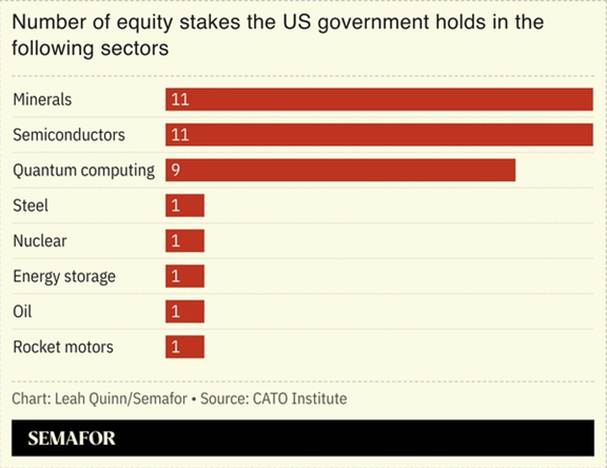
As President Trump Racks Up Equity Stakes in Private Companies, Democrats Take Note. To date, the Trump administration has announced 43 equity stakes in firms producing everything from minerals to semiconductors, 36 of which were negotiated without explicit legal authority—and more seem yet to come. While unwinding the administration’s investments would prove legally and politically difficult, Democrats likely won’t want to, at least not right away. Progressives are already weighing how to use equity stakes for their own ends, signaling that President Trump’s government intervention in the private sector may be the start of a permanent trend. Consider that former Biden administration officials have floated using equity stakes to rein in AI, shrink defense spending, box out China, and pressure gun and oil companies.