Thought of the Week
After some “encouragement” from my wife, I relented and made a visit to a general practitioner. It had been some time since I had seen a doctor, any doctor, beyond the annual executive appointment arranged by the company. The diagnosis wasn’t unexpected—eat better, exercise more, limit alcohol intake, sleep more, and trim down. Because it’s been well over a decade since I’ve even been anywhere near my marathon training weight of 185 lbs., I knew I had to really watch my diet if I was going to trim down. Trimming down isn’t just something that benefits men of a certain age. According to Federal Reserve Chair nominee Warsh, “trimmed averages” should be used in place of traditional inflation measures to better understand general prices changes in the economy. As you know, one of the Fed’s congressionally mandated goals is price stability. To address this, the central bank sets an inflation target, say 2%, and then measures that number against the Personal Consumption Expenditures (PCE) index, which the Fed prefers to the more familiar Consumer Price Index (CPI). To get a better idea of where inflation may be headed, the Federal Reserve goes even further, breaking the PCE down into two figures—overall, or headline, inflation and core inflation. The thinking goes that by removing the most volatile elements from the PCE—largely food and energy prices—a core PCE can be arrived at that provides a better measure of underlying inflation, and thus a more useful tool for policymakers to use to gauge inflation pressures, forecast future inflation, and set interest rates. However, Warsh believes that even the core PCE doesn’t go far enough in identifying underlying inflation trends. Instead, he advocates using “trimmed inflation” as an alternative to core PCE inflation. Without getting too far into the weeds, rather than simply excluding food and energy, trimmed inflation removes outliers by taking the price change of all items in its index, sorting the changes from smallest to largest, and then eliminating the most extreme observations from the bottom and top of the distribution. The trimmed inflation rate is then calculated by taking the weighted average of all the remaining items. Warsh’s contention is that because trimmed inflation eliminates the upper and lower ends of the price change distribution, and thus one-off price level changes due to such short-term factors as geopolitics, weather, or even tariffs, it offers a better predictor of where inflation is headed in the medium term. Trimmed inflation’s statistical approach to removing outliers—as compared to core PCE’s categorical approach—gives it the flexibility to exclude the most volatile elements on an ongoing monthly basis. In fact, data sets show that first-release trimmed inflation rates are better measures of inflation than first-release core PCE inflation rates (both trimmed and PCE inflation are revised after initial releases). One caution, although trimmed inflation tends to be a more useful estimate of inflation over longer time periods, it does depart from trend over shorter horizons. So, while trimmed inflation excludes much of the impact of President Trump’s tariffs and much of the energy shock from the war in Iran by design, these same shocks influence market, business, and consumer inflation expectations, and containing those expectations is also a key Fed objective. Me? I’ve lost a few pounds; it’ll all come down to whether my trimming is just a short term event or lasts over the medium term.
Thought Leadership from our Consultants, Think Tanks, and Trade Associations
Eurasia Group Says White House Believes It Can Endure Economic Pain from Iran War. Domestic pressures on President Trump to make concessions to Iran to reopen the Strait of Hormuz are growing, but the White House believes it can endure them for at least another few weeks. Gas prices, which have shot up and could hit $5/gallon by the end of the week, are the most immediate factor weighing on the president. But this is not as unequivocal as it might seem—the $5/gallon level, on an inflation-adjusted basis, is lower than the 2022 spike. Although cost increases are dragging on both President Trump’s approval and the GOP’s electoral outlook, neither appears to be an immediately constraining factor, as the president’s intraparty approval remains stable, and losing the midterms doesn’t seem to matter to him. Grumbling among congressional Republicans has become louder, but there is no near-term congressional deadline that would force a shift in the White House’s stance. Senate Republicans are likely to accept the administration’s claim that the 60-day clock on congressional authorization has been paused by the ceasefire. All this adds up to President Trump having the political will to see the current blockade on Iran through for at least another two weeks as he waits to see whether economic pressure forces Iran to cave. In the meantime, the strait is likely to remain essentially shut. Despite more positive reporting that the U.S. believes it is nearing a framework agreement to end the war while continuing negotiations on the nuclear issue, this should be viewed as a reflection of ongoing talks between the two sides, not an indication that an end is near.
Inside U.S. Trade Reports that Thirty-five Countries Back New U.S. ‘Trade Over Aid’ Initiative. The Trump administration launched its “Trade Over Aid” initiative to shift U.S. engagement with developing countries away from traditional development assistance and toward relationships underpinned by private-sector investment, commercial partnerships, and market-based reforms. UN Ambassador Waltz said the initiative would bring together UN member states, private companies, UN agencies, and international organizations to promote business partnerships and policies designed to spur economic growth. Ambassador Waltz recognized representatives from 35 countries at the launch, although a formal list of partners has not yet been released. The launch featured officials from the Commerce and State departments and the International Development Finance Corporation, as well as executives from the New York Stock Exchange, Goldman Sachs, J.P. Morgan, and Google. Under Secretary of Commerce Kimmitt said that the initiative is not based on the assumption that simply opening access to the U.S. market will allow growth, arguing that too many countries have undermined fair trade through subsidies, state direction, forced technology-transfer policies, and weak regulatory enforcement; he added that countries must build institutions that support enterprise and choose partners committed to “fair and reciprocal trade and investment.” The message behind Trade Over Aid is not that countries should declare themselves open for business or rely on U.S. market access, but that sovereign nations must create the conditions needed to foster investment, production, and long-term economic growth. The Trump administration sees the initiative as a more sustainable alternative to development aid, although it faces pushback from the UN and humanitarian groups who argue the shift may lead to consequences for vulnerable populations.
“Inside Baseball”
Bloomberg Government Argues that Tariff Relief Requires an ‘America First’ Lobbying Pitch. The Trump administration’s trade policy started with tariffs on steel and aluminum, grew to Chinese imports, and is still expanding. While President Trump’s first term included a process to file for exemptions, today, there is none. However, one can still petition the government for concessions, just without those words. Lobbying the White House on tariff relief is an art—not a science. You can’t just show up with a congressional letter of support and talk about job losses and severe economic harm. Such traditional arguments worked in the past, but they’re not enough today to strike a chord with the USTR, Commerce Department, or the administration. There are five ways to effectively petition for tariff relief. First, have an off-ramp. Explain that any tariff relief is temporary and show a timeline for phase outs. Focus on how tariff relief will free up capital, refocus core objectives, or triage profit-and-loss trauma. Second, create an “America First” endgame. If granting relief provides an opportunity to rebuild an industry, it serves a greater purpose for the administration. Speak to how manufacturing was gutted in the last century and lay out a future vision for American dominance. Even if not a manufacturer, think about how your imports provide support for that industrial renaissance. Third, forecast doomsday. Fourth, match relief with investment. On more than one occasion, the president has said that if companies commit to manufacturing in the U.S., they will be considered for relief. Finally, identify an enemy. Don’t just speak to how good a product or service is, explain why the alternative is bad. There are many countries (allied and non-allied) that manufacture products cheaply because of their lower costs for raw materials, labor, electricity, logistics, taxation, and compliance—call them out, explain why tariffs only exacerbate that inequity, and name names. Although some of these are obvious, from small businesses to the Fortune 500 companies, the biggest error made in tariff lobbying is solely focusing on individual problems. To be truly effective, look through the lens of the White House; ask for temporary relief; speak to an U.S. industrial rebirth; forecast a potential crisis; put investment skin in the game; and place a target on someone else.
In Other Words
“I’m putting up a lot of money myself. So, you know, it’s largely financed by me. All that they’re doing is financing some security. And it’s not a billion dollars. It’s just a few, what’s needed for security. It’s a small fraction of that. But no, not at all, because I’m putting up 100, I’m putting up $400 million,” President Trump speaking to PBS about the White House ballroom project; the allocation of taxpayer money for security-related aspects complicates the president’s argument that he is paying for the construction.
Did You Know
A new Public Affairs Council/Morning Consult Pulse poll finds that Americans expect businesses to speak up on federal policy issues. The greater risk today is not engagement, but lack of visibility. A plurality of adults polled (43%) view businesses speaking out on federal policy issues as appropriate civic engagement, compared to just 30% who say speaking out is corporate overreach. Other key findings:
- 40% say businesses have a responsibility to speak out when they disagree with major policy changes, 25% say businesses should remain politically neutral, and 16% actively support aligning with the Trump administration.
- 56% say companies should maintain their climate commitments, including majorities of both Republicans (54%) and Democrats (66%).
- 50% say recent foreign policy shifts are making global business conditions harder, underscoring demand for clearer communication on economic impacts.
Graphs of the Week
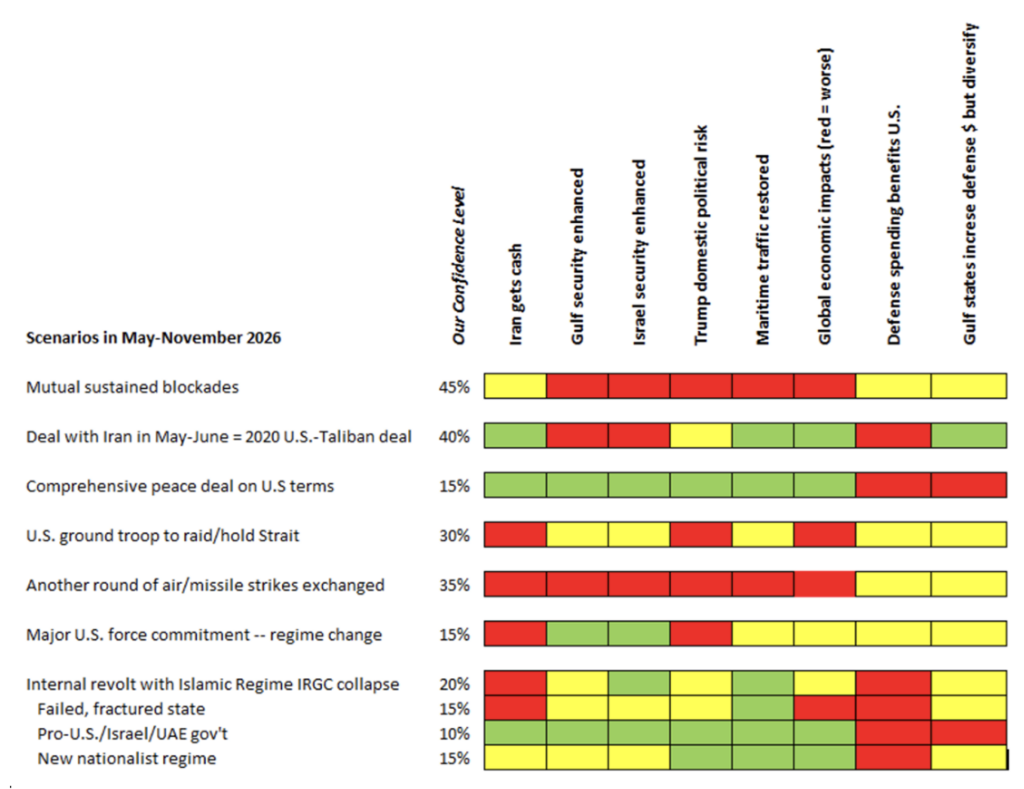
Capital Alpha Parses Potential Outcomes for the U.S.-Iran Conflict. Blockades are considered acts of war, and while Iran, Israel, and the U.S. are not presently trading strikes, the conflict is not over. It has only entered a different phase, and there are a variety of potential scenarios. The graph below summarizes plausible scenarios; although there is no high conviction for any single outcome, some are more probable than others (red means negative outcomes, yellow means neutral or too soon to tell, and green means positive outcomes). The most likely scenario is sustained blockades by Iran and the U.S. in 2026; the next-highest conviction is a hastily reached deal in the next 60 days, similar in nature to the one the Trump Administration negotiated with the Taliban in 2020. There are major disconnects between the outcomes the U.S. wants from negotiations and what Iran wants—the president’s primary goal is to prevent Iran from building a nuclear weapons inventory, while Iran’s goal is to get sanctions relief and cash, plus some guarantee that it won’t be attacked by the U.S. and/or Israel. It is highly improbable (15%) that Iran will capitulate to all U.S./Israeli demands (no nukes, long-range missiles, support for proxies, or shipping tolls).