Thought of the Week
With the Bureau of Labor Statistics reporting that the producer price index hit 6.0% in April, the highest since December 2022, and the consumer price index increased 3.8%, the highest since May 2023, I was going to write about how White House politics were taking on a Dr. Jekyll and Mr. Hyde dynamic. Consider that in an effort to address cost of living concerns, President Trump has called for a gas tax holiday and urged Congress to pass an affordable housing bill (that’s the Dr. Jekyll part); at the same time, his policies, including the war in Iran and wave after wave of tariffs, are—in part—the reason why prices are so high (that’s the Mr. Hyde part). I scrapped that idea for a take on President Kennedy’s Pulitzer Prize winning biography Profiles in Courage, where I was going to explain why such courage is now needed in Congress more than ever. Knowing I needed more time to do justice to such classics, I went to the “mail bag” to answer a basic question about how I see the current redistricting wave impacting political advocacy and lobbying. While redistricting will certainly play a key role in determining which party wins the House majority, constantly redrawing congressional lines will also affect advocacy and public affairs for years to come. Redistricting is meant to be a once-a-decade exercise, constitutionally mandated after each census to make sure each congressional district is the same size. Each member of the House is supposed to represent approximately the same number of people, so reapportionment and redistricting are the equalizing tools to account for population changes that happen over the course of 10 years. Mid-decade redistricting is not unprecedented, but is uncommon, particularly at its current pace. Florida and Tennessee are the seventh and eighth states to redraw congressional lines in the middle of this decade (they were the eighth and ninth until the Virginia Supreme Court negated the Democrats’ map last week). Louisiana, Alabama, South Carolina, and possibly Mississippi, are also now in the map-drawing process. Even without that quartet, the U.S. is already beyond the previous modern record of seven states back in 1984. The punching and counterpunching has reached new levels due to the Supreme Court’s decision in Louisiana v. Callais, which functionally makes the Voting Rights Act irrelevant and led more states into the fray. Because of the timing of the ruling, some states won’t join the fight this year, but it seems we may have entered an era of perpetual redistricting. The parties will be constantly trying to maximize partisan power to gain advantage and squeeze out as many seats as possible to stay ahead of political trends. This means more uncertainty for corporate and association advocacy practices. Consider that in North Carolina, where redistricting seems to take place every two years, one company’s headquarters has been in three different districts and represented by five different members just in the past decade. A similar scenario is likely to play out in states around the country with the proliferation of redistricting. This means that years, or even decades, of relationship building with members of Congress could be wiped out with one new set of congressional lines that shift a firm’s footprint from one district to another. It’s now apparent that companies need to build relationships with multiple members of a state delegation since it’s possible that someone other than the incumbent may end up representing headquarters at some point. Although most congressional offices will prioritize current constituents, companies should leverage their broader state footprint, including where employees live, to establish relevance with members who don’t represent specific physical facilities. Rather than just being aware of a changing of the guard because of defeat or retirement, corporations and associations will have to be even more flexible as redistricting complicates relationships and as new congressional lines potentially change the representation situation.
Thought Leadership from our Consultants, Think Tanks, and Trade Associations
Eurasia Group Predicts Export Restrictions on Refined Products Likely by the End of May. With U.S. diesel and gasoline stocks being depleted at historic rates, President Trump is likely to impose export restrictions on refined products by the end of May (55% odds), with 75% odds that restrictions are in place by the end of June. This reflects expectations of increasing pressures on both U.S. stockpiles and consumer prices over the next two months. The political pressure on the White House to do something to arrest prices will push the administration to act. Although President Trump’s legal options only allow for restrictions, and would likely roll off by late summer, politically powerful groups representing U.S. producers, refiners, and exporters will push for exports to resume once markets stabilize. The base case of an Iran deal by June does not alter these odds, as any deal that comes together in June will not result in immediate relief to shipping in the Strait of Hormuz or to global supply constraints.
Inside U.S. Trade Sees CIT Ruling Against Section 122 tariffs Leaving Uncertainty for Importers. The Court of International Trade’s decision to reject President Trump’s 10% tariffs on most goods but not block the duties nationwide creates confusion for importers on how the tariffs will be applied while the case moves through the courts. A divided three-judge CIT panel ruled that the Trump administration acted illegally when they imposed tariffs under Section 122 of the Trade Act of 1974. But the court refused to issue a “universal” injunction that would have explicitly forbidden U.S. Customs and Border Protection from collecting the duties on new entries. Instead, the judges approved only a narrow order limited to the state of Washington, and the case’s two private plaintiffs. What this means for other importers is not entirely clear. Section 122 allows the president to impose tariffs of up to 15% for as long as 150 days to address “large and serious balance-of-payments deficits,” but the plaintiffs argued—and CIT agreed—that no such problem exists, and the president was improperly using the law to target trade deficits instead. DOJ filed an appeal. Whichever side loses the next stage of litigation will be able to ask the Federal Circuit to hear the case “en banc,” before all 11 judges instead of a three-member panel or seek review from the Supreme Court. Although USTR Greer voiced optimism, he did not say whether the government will ask for a stay of CIT’s decision during appeals. The limited scope of the ruling may have the effect of slowing things down, because the government may not care about the three plaintiffs if they can continue to impose the tariffs through the July deadline, and then worry about refunds at a later date. In fact, it is doubtful that the government will refund even the prevailing challengers while litigation is pending. However, as long as CIT’s decision remains in place, other importers could file new suits based on the same claims that the judges agreed with and request their own narrow orders blocking further tariffs.
Politico Reports Companies Want Tariff Refunds, but Don’t Want Trump’s Wrath. When it comes to a choice between staying in President Trump’s good graces or getting back millions of dollars, companies are taking the cash. While many are doing their best to avoid the administration’s eye, the president is still stewing over his February defeat at the Supreme Court that knocked down many of the tariffs he imposed and forced his administration to start giving back $166 billion in tariff collections. On K Street, rumors have spread that the White House is keeping a blacklist of companies that have pursued refunds; in fact, more than 26,000 companies, including Apple and Mattel, have signed into the refund portal; payments are expected to begin being issued this week. Their bet is that by using the portal, which is not public, and burying refund totals in fine print, they will be less likely to attract Trump’s ire than headline-grabbing lawsuits. It’s a sign that, even as companies are eager to recoup millions, in some cases billions, in tariff payments, they are still wary of a president known for nursing grudges and not afraid of enacting retribution. Trade lawyers say such fear is giving companies pause, even as most are ultimately deciding to seek refunds. Over the course of his two terms, President Trump has never shied from using his bully pulpit, often in the form of social media, to push companies to do his bidding or punish those who don’t. Moreover, the White House has shown a willingness to use all sorts of federal levers to go after private entities that have crossed it, from investigations to withholding federal contracts, making clear that any threat is not just rhetorical. There’s another benefit for executives to keep their pursuit of tariff refunds under the radar. Becoming known as a company that got a windfall in refunds could open them up to lawsuits from consumers looking to push back on price increases.
“Inside Baseball”
One-year Renewals are Likely for USMCA Renegotiations. The Trump administration is set to announce its intentions concerning the U.S.-Mexico-Canada (USMCA) trade agreement on or around June 1 in a statement to Congress. The period for parties to officially review the treaty will start one month later. The current base case is that the USMCA will shift to annual reviews for the next ten years. The White House wants to exploit this new structure with associated bilateral negotiations to continuously shift USMCA terms in its favor. The Trump administration’s wider geopolitical motive for taking an aggressive stance towards Canada is to punish the country for its rapprochement with China and its “middle-power” initiative. The belief is that by doing so, it could deter other countries from making similar moves. Going forward, don’t be surprised if President Trump threatens to exit the USMCA unless Canada and Mexico grant the U.S. various concessions. Although such a step would represent the “nuclear option,” the U.S. could stall any official notice that would trigger the six-month countdown to leaving the USMCA. If this risk materializes, it would be after July 1.
In Other Words
“I’m introducing legislation today to suspend the gas tax,” Sen. Hawley (R-MO) following President Trump’s endorsement of the idea. While suspending the 18 cent-per-gallon tax requires congressional action, it is likely to do little to affect gas prices or voter sentiment blaming the president for them.
“Plus, I’d be a terrible Republican who still votes overwhelmingly with Democrats,” Sen. Fetterman (D-PA) dismissing talk he may switch parties.
Did You Know
Fireworks were first used to celebrate the Fourth of July on July 4, 1777, in Philadelphia, during the first organized, official celebration of Independence Day.
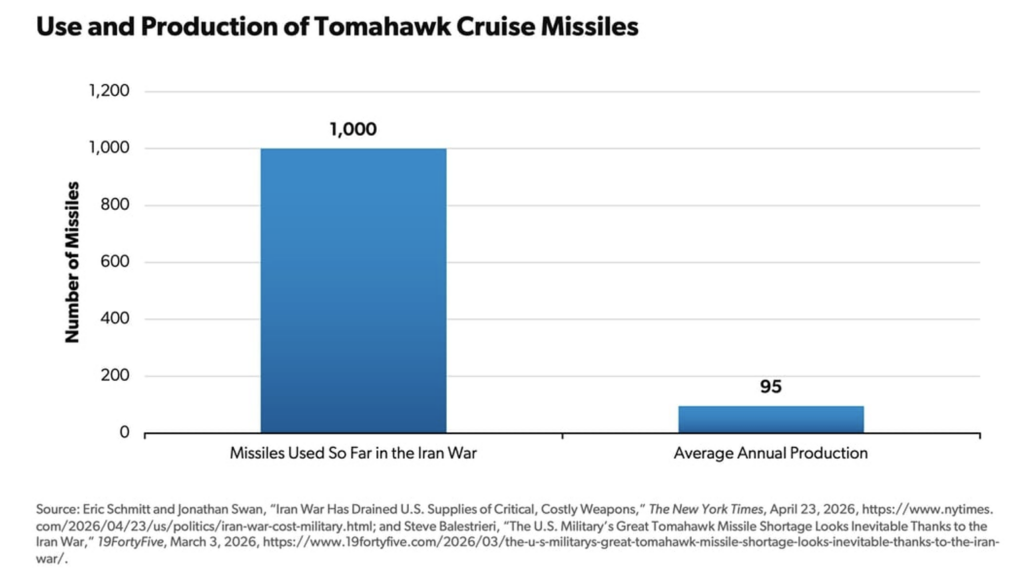
Graph of the Week
Operation Epic Fury has illuminated the dangerous shortage of America’s defensive- and offensive-weapon stockpiles. Although the U.S. military retains a plentiful supply of legacy munitions, these underperform against the high-tech weaponry of our adversaries, and Washington has alarmingly bare stocks of exquisite, high-probability-of-kill weapons. In Iran, the U.S. military recently fired more than 1,000 Tomahawk cruise missiles in a few weeks. Without accelerating production and procurement, it would take roughly 10 years to replenish this key armament.