Thought of the Week
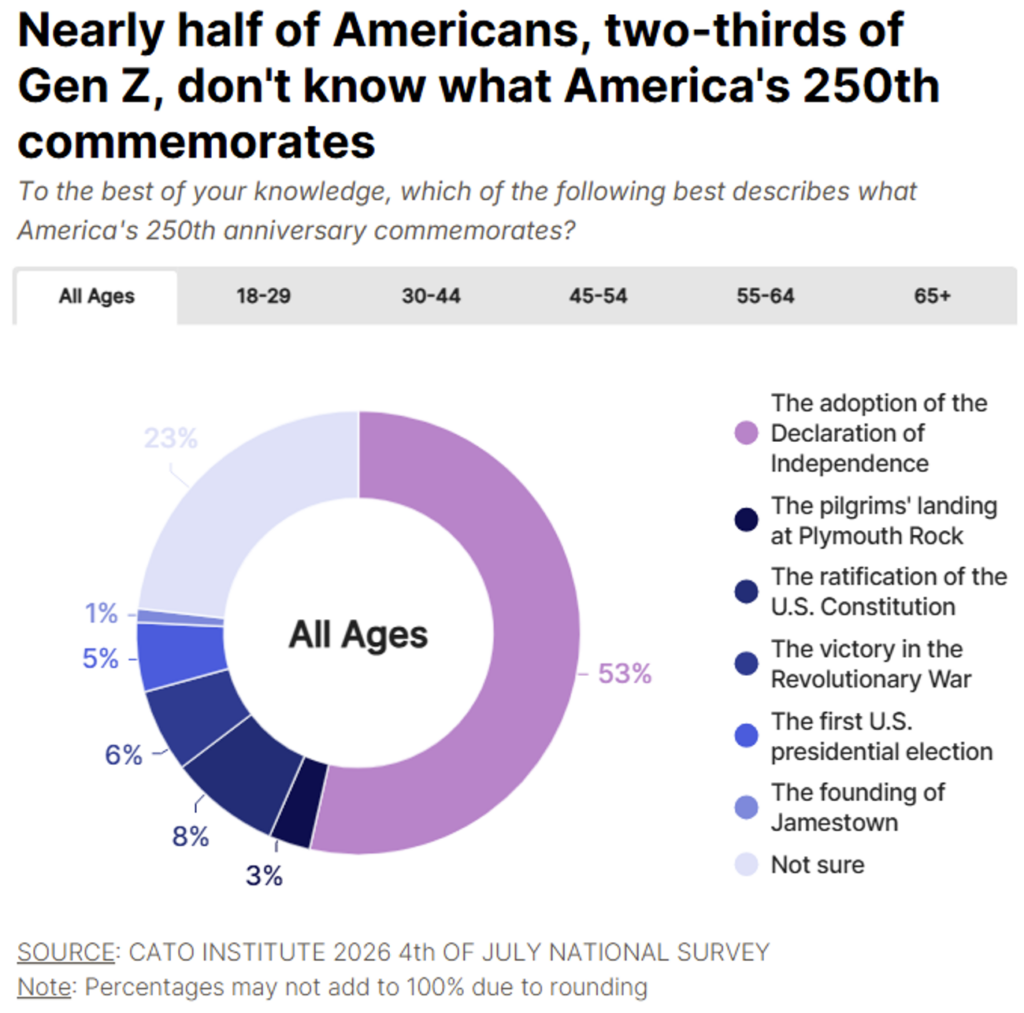
While Washington still basks in the glow of a spectacular 250th birthday celebration, Halloween is just a little more than three months away, and these are scary times in the nation’s capital. As this week’s “Graph of the Week” illustrates, almost half of all Americans (46%)—and nearly two-thirds of Gen Z (61%)—didn’t know what America’s 250th commemorated; merely 53% and only 39% of Gen Z correctly identified the adoption of the Declaration of Independence in 1776 as the reason for this year’s celebration. Even scarier comes a report from the Brookings Institution that Democratic Socialists are winning on their economic message. According to Brookings scholars, Democratic voters are supporting candidates with progressive economic policies, while pulling back from cultural positions associated with “woke” politics. What’s frightening is that these same economic policies have been tried before and failed. Consider New York City Mayor Mamdani’s citywide rent freeze. Although there are few concerns that enjoy a broader consensus among economists than the conclusion that rent control is counterproductive, with decades-old economic surveys confirming this, the attitude within the Democratic Party, particularly on the hard left, is that anything proposed by democratic socialists must be new. While candidate Mamdani vowed to take a “brave new course” and “chart a new path,” his rent freeze is seen as a fulfillment of his pledge, Sens. Warren (D-MA) and Sanders (I-VT), along with numerous other progressive politicians who should know better, continue to argue for similar price controls in one form or another. But failed price controls are, in fact, older than Christianity—Hammurabi set prices 4,000 years ago; Diocletian issued his Edict on Maximum Prices in 301 A.D.; and President Nixon implemented them to disastrous effect in 1971. Few progressives it seems are heeding Obama economic advisory council chair Furman’s warning that “Rent control has been about as disgraced as any economic policy in the tool kit,” or socialist economist Lindbeck’s declaration that “In many cases rent control appears to be the most efficient technique presently known to destroy a city—except for bombing.” Now gaining traction on the left comes the old as new idea of wealth taxes. California Gov. Newsom has endorsed the idea, which began in the Middle Ages as plunder. Like rent control, it is a time-worn idea with a history of failure; nearly every country that has adopted them has repealed them. But old ideas repackaged as new are not limited to the Democratic Party. President Trump has appealed to his history-deficient voters most famously with a robust tariff policy. To hear the president tell it, tariffs will Make America Great Again by eliminating the country’s trade deficit and increasing manufacturing employment. Yet, eighteen months into his second term, he has been as unsuccessful as he was during his first term, and the reason is obvious to anyone with an Econ 101 textbook. Economists have long known that a trade deficit is simply equal to domestic investment minus national savings. If a country spends more on physical investment than it generates in total savings, it must bridge the gap by borrowing from abroad, resulting in a trade deficit regardless of the tariff level. No matter the tariff level, as long as a country saves less than it invests, it will run a trade deficit. It’s no wonder then that despite even steeper hikes in tariffs than during his first term, the Trump trade deficit remains stubbornly high. In 2025 the trade deficit in goods increased 10% to a record $1.3 trillion, or 4.5% of GDP, and far from increasing as the president promised, manufacturing employment declined by nearly 80,000 (Pro tip: if the White House really wants to eliminate the trade deficit, it would take serious steps to rein in the budget deficit in a way that keeps public debt from growing at an unsustainable rate). As Winston Churchill once said, “Those that fail to learn from history are doomed to repeat it.” We are seeing this play out . What’s more, the failure to learn from history leads to poor policy choices and a rash of unintended consequences that inevitably impact business. While advocacy is often about moving positive legislation and regulation, just as often it is about playing defense and acting to block or, at the very least, limit the fallout from unintended consequences. Consider contacting the Washington office if you find that your business has been impacted by a political class that has failed to learn from the past.
Thought Leadership from our Consultants, Think Tanks, and Trade Associations
Akin Clarifies the Trump Administration’s Blocking of USMCA Renewal. Last week, the Trump administration officially declared that it would not back a 16-year renewal of the U.S.-Mexico-Canada Agreement lowering tariffs on North American trade. Although USTR Greer told Mexican and Canadian counterparts that the U.S. does not want to renew the USMCA in its current form, the agreement remains in force pending resolution of outstanding issues or until the Agreement’s termination; Canada and Mexico had both committed to renewing the agreement for the next 16 years. In terms of issues, the USTR detailed dozens of irritants it would like the countries to address. Chief among them is rules of origin: the regulations that govern how much content needs to be produced in North America to score lower tariffs. U.S. trade officials say they want to strengthen the requirements to prevent foreign countries—namely China—from passing goods through Mexico. The U.S. is scheduled to meet with Mexico the week of July 20 for a third round of negotiations on specific elements of the deal, but still hasn’t entered formal negotiations with Canada, although the two governments have been in touch regarding USMCA renewal and other trade issues. Although USTR Greer’s statement that the joint review that was required to take place happened and that the U.S. did not agree to renew the USMCA was no surprise, there should be no confusion that this is NOT a termination of the agreement. All “not renewing” means is that for now, USMCA will not be extended for another 16 years beyond its current expiration date of July 1, 2036. The U.S. decision not to renew was entirely expected and has no impact on the operation of the USMCA. As Ambassador Greer noted, “the Agreement remains in force pending resolution of these issues or until the Agreement’s termination.” So, what happens next? The parties will continue to discuss changes with the goal of reaching agreement to renew it. If no such agreement is reached before this time next year, the parties are required to meet again for another joint review on July 1, 2027, and every year thereafter on July 1 until either they reach agreement to renew it or the USMCA expires on July 1, 2036.
Eurasia Group Says Supreme Court Rulings on Executive Powers Deliver a Mixed Bag for President Trump. Last week, the Supreme Court delivered landmark rulings in two cases on the president’s powers to fire members of the executive branch and the Federal Reserve. Trump v. Slaughter, which concerned the president’s powers to fire members of independent agencies with for-cause removal protections, was a complete victory for the White House. By almost entirely overturning the 1935 precedent, the court nullified removal protections, substantially expanding the president’s powers over the executive branch. This was a major win for the White House, which made campaigns against agency independence a key feature of its early-2025 policy agenda. Trump v. Cook, President Trump’s attempt to fire Fed Governor Cook for “cause”—alleging mortgage fraud—went the other way. The court blocked the firing and carved out the Fed from the Slaughter, ruling that the Fed has a unique role in setting monetary policy. While President Trump can still attempt to fire Governor Cook by giving her notice and opportunity to respond, the ruling’s understanding of “cause” and clear defense of Fed independence raises a high bar. The significance of the Slaughter ruling makes the pair of rulings a victory for proponents of the “unitary executive” theory, which sees all executive-branch personnel as subordinate to the president; the Fed has never been central to this theory. The president’s power over independent agencies like the Federal Trade Commission has now been made explicit, and this personnel power will, over time, likely lead to independent agencies becoming fully partisan and operating more like typical executive-branch departments.
National Journal Reports How C-suites are Bracing for a Democratic Congress. Corporate America is bracing for Democrats to flip at least one chamber of Congress in November, and the first order for the business community is preparing for increased scrutiny from the House of Representatives. Democrats are favored to flip the chamber, and candidates on the campaign trail have pledged to hold the Trump administration’s feet to the fire. Such oversight could put CEOs in the crosshairs, given that many companies shifted their approach to Washington in recent years, focusing on winning executive branch approval as Congress suffered from gridlock. While numerous CEOs stepped into the political fray to advocate for their business interests, such an approach is likely to change under a Democratic House majority. House Oversight Committee ranking member Garcia (D-CA) has proclaimed that he will pursue investigations as chair of the panel if Democrats flip the lower chamber. Rep. Garcia, who led Democrats’ investigation into Jeffrey Epstein, has already unveiled an agenda that would target alleged Trump family corruption and pay-to-play schemes at the Homeland Security Department. Companies that won government contracts, gained White House influence, or donated to projects like the Freedom 250 initiative may offer information to congressional Democrats that the Trump administration would not. As Democrats set their oversight priorities, companies will have a legal obligation to provide information when Congress asks for it, unlike the White House, which has resisted previous requests. At the same time, Corporate American will try to maintain good relations with the White House. Congressional investigations involve staff interviews, document requests, and depositions—meaning time, money, and legal representation for any company under scrutiny. Companies undergoing congressional investigation are at risk of harming their brand, especially if the investigations are politically polarized. Firms will need to be able to defend their relationships with the White House to a Democratic-led Congress without jeopardizing the relationships themselves. Democrats pursued similar investigations into President Trump’s conduct after they retook the majority in the 2018 midterms. As Democrats attempt to campaign on reducing corruption, companies might serve as scapegoats. Although companies are not legally bound to respond to letters from Democrats while they’re in the minority, signaling a willingness to cooperate might bear fruit should party leaders become committee chairs.
“Inside Baseball”
Senior Congressional Staffers Offer a Midterm Election Outlook. Four months outfrom the midterm elections, an overwhelming majority of senior staffers on Capitol Hill believe the Democratic Party is in a stronger position than the GOP. Historical trendsindicate that the party out of power usually enjoys a successful midterm election. With Republicans controlling the White House, Senate, and House, Democrats are poised to pounce. Per Punchbowl News’ Canvass survey, 90%of staffers say Democrats are in a better position entering the campaign season—including 82%of GOP senior staffers. While 87%of senior staffers think Democrats will win back the House, 77%believe Republicans will retain control of the Senate. According to staffers, the top three issues for Americans as they consider who to vote for in November will be inflation and the rising cost of living, the economy and jobs, and gas prices. Another top issue will be the Iran war. A wide margin of staffers, 94%,said the war will harm Republicans in the November elections. As far as leaders go,staffers say Senate Majority Leader Thune(R-SD) is the most effective congressional leader—Thune leads with 47%approval,followed by Speaker Johnson (R-LA)with31%,House Minority Leader Jeffries(D-NY) with 17%,and Senate Minority Leader Schumer (D-NY)with 5%.
In Other Words
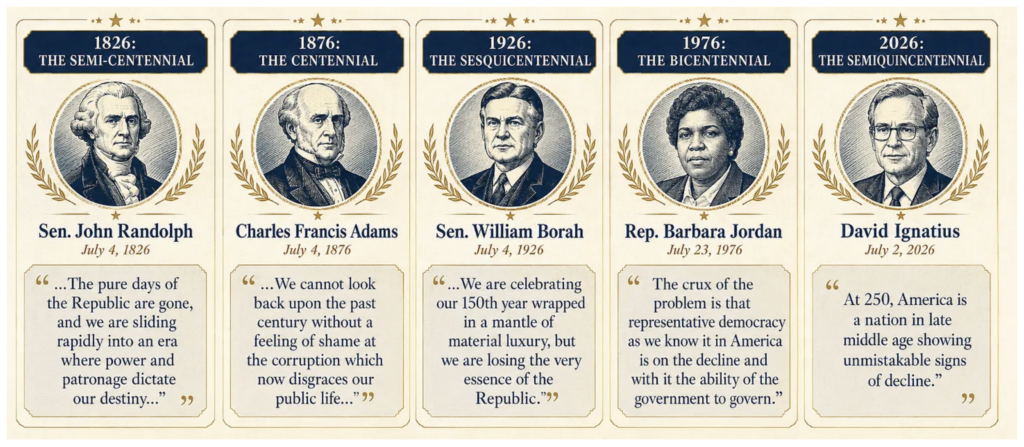
As the U.S. celebrated its 250th anniversary, many Americans seemed to express the notion that the country’s best days were behind it…but fear not. Americans have always worried that the nation was in decline. But, so far, the country has always found a way to innovate, improve, and overcome.
Did You Know
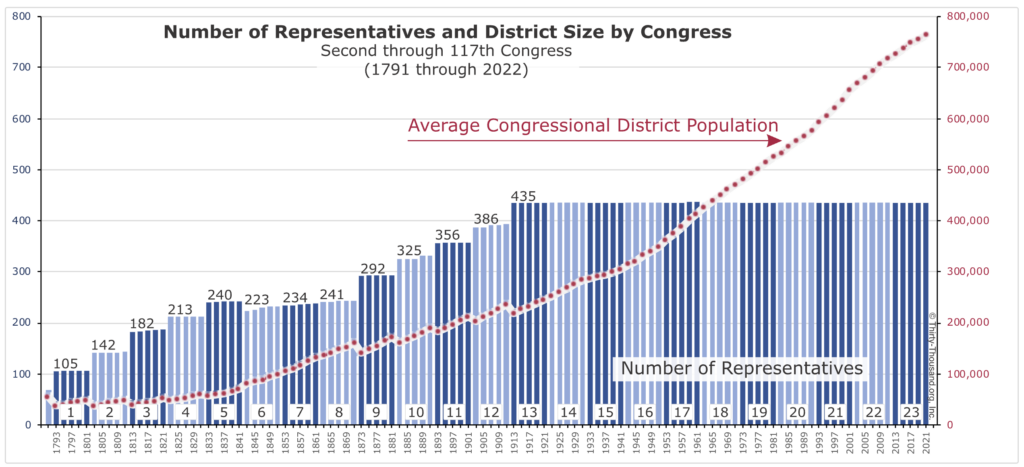
The Size of Congressional Districts. At the Constitutional Convention, George Washington spoke just once—to urge that representation remain close to the people, with a ratio of one representative for every 30,000 people. For more than a century, Congress followed that blueprint, with the House growing from 65 members in 1789 to 435 by 1913. Then it stopped. Today, the actual ratio is roughly one representative for every 760,000 Americans. Washington is beginning to reconsider whether there is a population at which a House district becomes too big to represent.
Graph of the Week
America’s 250th. Nearly half of Americans (46%)—and nearly two-thirds of Gen Z (61%)—don’t know what America’s 250th commemorates. Just over half (53%) and 39% of Gen Z correctly identified that the adoption of the Declaration of Independence in 1776 was the reason for this year’s celebration.