Thought of the Week
At the risk of coming off somewhat grandiose, I did find it a bit flattering when not one, not two, but three well-known research organizations reached out to me for my view as a “Washington insider.” While results from two of the organizations have not come out yet, the third looked at the growing trend of casting “big business” as the villain in Washington. It’s no secret that for the past year, many corporate DC in-house lobbying shops have operated under the assumption that by keeping its head down and staying out of political crosshairs, routine business decisions would stay routine. Unfortunately, that assumption seems to be breaking down amidst several high-profile incidents and a political environment primed to cast companies as boogeymen. In fact, a recent poll found that 37% of Americans now view “big business” as the greatest threat to the country’s future (over big government and big labor)—the highest level in two decades. At the same time, concern about “big government” has dropped from nearly 70% a decade ago to just 57% today. Although concern about government historically ebbs and flows among voters depending on which party holds power, the movement among independents is hard to dismiss: 40% identify business as the largest threat, up from 26% in 2016. For companies that have counted on staying out of the fray as a form of protection, growing skepticism across the political spectrum is a troubling trend. Although the entire picture for business is not bleak (the most recent Edelman Trust Barometer shows that a slim majority of Americans trust business and see it as competent), the coexistence of significant trust and significant threat points to a deeply polarized electorate—one that gives politicians across the spectrum a receptive audience for anti-business messaging in a midterm election year where affordability may be the defining issue. This exists whether that be the GOP deflecting blame for tariff-driven price increases or Democrats tying corporate profits and undue influence to the cost-of-living crisis. New research, of which yours truly was a part, on the state of anti-corporate sentiment digs into what this means in practice, and the picture is sobering. The risk isn’t just for companies that take public positions on contentious issues. It’s for companies doing ordinary things in an environment where ordinary things have become politically charged:
- A price increase to offset tariff costs gets framed as corporate greed by one side and a political statement against the Trump administration by the other.
- Workforce restructuring announced alongside strong earnings or AI investments becomes evidence of misplaced priorities.
- A government vendor contract or facility lease that no one would have noticed two years ago becomes the centerpiece of a public pressure campaign.
- A rebrand, advertising partnership, or marketing campaign gets dissected for political intent it was never meant to carry.
The central finding was that the definition of a “safe” corporate action has fundamentally narrowed. Economic anxiety, political polarization, and public scrutiny are converging and reinforcing each other, and companies don’t need to wade into a public debate to find themselves at the center of one. And the pressure is coming from all directions. A firm that publicly pushes back on tariffs risks being cast as undermining the administration; one that quietly raises prices to absorb tariff costs gets framed as profiteering; and AI-driven workforce decisions that alienate employees worried about displacement draw scrutiny from investors if the promised returns don’t materialize. Pricing, whether B2B or B2C, becomes a flashpoint regardless of intent—too high, and it’s greed; too low, and it’s unsustainable. The approaching midterms will only intensify this dynamic, as candidates look for villains and corporate decisions become convenient stand-ins for voters’ economic frustrations. Companies that haven’t stress-tested routine business activities against this environment may find themselves reactive when they can least afford to be. To best position for what’s coming, a growing number of companies are mapping where their business may be exposed; they’re auditing pricing strategies, vendor relationships, workforce decisions, AI investments, and even marketing campaigns through a political lens they didn’t need a few years ago. Although one may not need a playbook for every crisis, clarity on where your company might be invoked as shorthand in someone else’s debate could offer a workable point of view before that moment arrives.
Thought Leadership from our Consultants, Think Tanks, and Trade Associations
Eurasia Group Says President Trump’s Landing Zone for a Win in Iran is Shrinking. Expectations for a rapid resolution in Iran are fading, and the Trump administration’s timing expectations for the war have gone from days to weeks to now up to two months. The U.S.’s announcement of a shipping insurance effort, designed to quell oil prices, and reports of efforts to arm the Kurdish opposition to give the White House another front against the regime, are unlikely to significantly change this calculus. The fact that any replacement for the Supreme Leader is likely to be a hardliner focused on military reconstruction will also complicate American efforts going forward. While the Trump administration would prefer a compliant regime, barring that, it will look for all options to exert influence over whoever is in power. Developing political backlash in the U.S. will limit how long the administration can hold out. If Iran strikes poll poorly overall with voters, even while most Republicans remain supportive, support could and likely will erode as U.S. involvement is seen to drag on. And if oil price increases cannot be contained and U.S. gas prices increase and remain elevated, the speed of erosion will accelerate even further.
Inside U.S. Trade Reports Japan Will Stand by Its U.S. Trade Deal to Preserve Security Guarantees. Japan is unlikely to try to renegotiate or back out of the trade and investment deal it struck with the U.S. last year because any such attempt would threaten broader ties, including security guarantees Japan has long seen as critical. This comes despite the Supreme Court ruling that International Emergency Economic Powers Act (IEEPA) tariffs, used as leverage to negotiate trade deals, were imposed illegally. Since the ruling, a number of questions have been raised about whether many of the agreements would survive; to date, most U.S. trading partners have stood by their deals, avoided any talk of abandoning terms outright, and/or sought additional details on next steps. Meanwhile, President Trump is seeking to re-establish the previous tariff rates and structures through other authorities, starting with a 10% “global” duty enacted through Section 122, to be followed by country-specific tariffs under Section 301. Analysts expect Japan to continue implementing its deal, which calls for lowering tariffs and other barriers to U.S. goods and investing a total of $550 billion in U.S. industrial operations over four years, in exchange for White House commitments to cap tariffs on most Japanese goods at 15%. Japan has long prioritized smooth diplomatic relations and security guarantees with the U.S., and the investments Japan is using to satisfy the $550 billion commitment are seen as helpful for the Japanese economy overall and can be justified on economic grounds.
Observatory Group Explains What’s Next for U.S. Tariff Policy. There has been some confusion since the Supreme Court disallowed invoking the International Emergency Economic Powers Act (IEEPA) for tariffs. Going forward, it is expected that Section 122 tariffs will remain at 10% for most major trading partners from now to late July and then for Congress to vote not to maintain them after that. Tariff revenue will then be maintained via new Section 301 tariffs on individual countries, blocs, or themes in which many trading partners are involved. Extra Section 232s will be added on top for national security purposes. While refunds of IEEPA tariffs will be due to importing companies, which are mainly U.S. entities, under current procedures, the entire process is expected to take years to play out. For better or worse, companies should not expect a major structural shift in U.S. tariff policy. What’s more, Treasury Secretary Bessent’s claim that the total amount of tariffs collected in 2026 will likely be the same as estimated prior to the Supreme Court ruling is probably accurate.
“Inside Baseball”
House/Senate Reject Bid to Scale Back President Trump’s Iran War. The Senate rejected an attempt to rein in President Trump’s war on Iran, handing him what amounts to an endorsement of the nearly week-long military campaign. The 47-53 vote split largely along party lines, with Republican senators uniting to defeat a measure that would have required congressional approval to continue the operation. Sen. Paul (R-KY), a cosponsor, was the only Republican who supported the resolution, while Sen. Fetterman (D-PA) was the only Democrat who broke with his party in support of the strikes. A day later, the House also rebuffed an effort to halt the war, as Republicans teamed with a handful of Democrats to grant President Trump free rein to conduct the vast military campaign. House lawmakers, in a tight 212-219 vote, rejected a bipartisan war powers resolution that would require Congress to sign off on Middle East operations. The back-to-back defeats of war powers legislation come as top officials warn U.S. military operations could soon intensify, and it signals that Republicans are sticking with the White House—at least publicly.
In Other Words
“We got James Talarico, a far-left radical who wants to abolish ICE, saying that ‘God is nonbinary’—I’m not really sure what that means,” Texas Attorney General Paxton (R) on state Rep. Talarico (D).
Did You Know
The Democratic National Committee announced that Atlanta, Boston, Chicago, Denver, and Philadelphia are in contention to host the 2028 presidential convention. While no city is more synonymous with Democratic conventions than Chicago, which has hosted 12 times, beginning in 1864 and most recently in 2024, close behind is Baltimore, which has hosted nine conventions. Philadelphia has welcomed Democrats twice, Boston hosted once in 2004, Denver has hosted twice, but Atlanta has never hosted a Democratic convention. The dominance of Chicago and Baltimore reflect how 19th and early 20th century conventions were concentrated in rail-accessible power centers of the Midwest and Mid-Atlantic. Over time, the party broadened its geographic reach, moving conventions westward and into emerging battleground states.
Graph of the Week
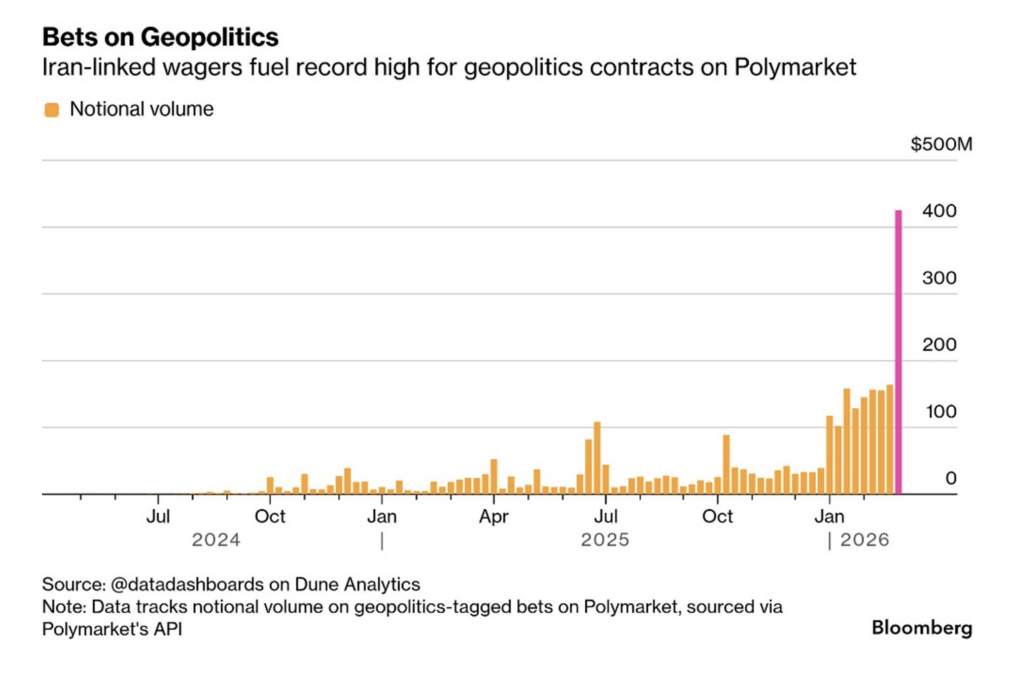
Conflict-Related Betting on Prediction Markets Hits a Record. While traders piled into wagers on U.S.-Israeli strikes on Iran, blockchain analysts flagged suspicious activity, and lawmakers called for a crackdown. Betters placed $425 million in wagers on geopolitical questions on Polymarket in the week ending March 1, up from $164 million the week before. Six accounts on Polymarket made nearly $1 million in profit by betting on a U.S. strike on Iran by February 28. Raising eyebrows, the accounts were all freshly created in February and had only ever placed bets on when American strikes might occur. Although U.S. regulations are broadly understood to prohibit financial contracts tied to war, Polymarket’s main exchange operates offshore and outside the oversight of U.S. regulators.