Thought of the Week
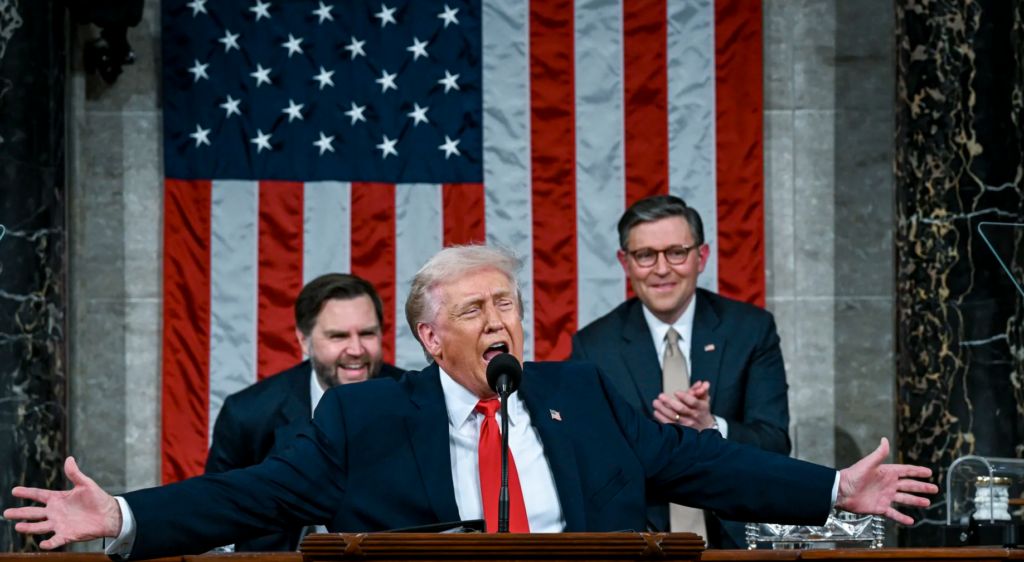
Although it’s estimated that somewhere between 27 and 32 million people tuned in to watch at least part of President Trump’s State of the Union (SOTU) address this past Tuesday, the speech didn’t quite hit in downtown D.C. like past SOTUs have. Yes, the president did (almost) everything Chief of Staff Wiles and top White House strategists asked of him, rattling off the administration’s biggest achievements; hailing American heroes; relating powerful, personal stories associated with GOP policy messages; and tearing into opponents without remorse. And yes, all the pomp and circumstance was still present—Hail to the Chief was played; the Supreme Court Justices were front row; the Joint Chiefs were in attendance; and the Vice President and Speaker of the House were perched in their seats directly behind President Trump. But in contrast to past State of the Unions, going back to at least the first Bush administration, the number of watch parties held in downtown Washington’s bars and restaurants seemed limited, SOTU drinking game punch sheets given out by news services and political journals were minimal (I only received one this year from Punchbowl News), and I didn’t get one SOTU Bingo card from a trade association or political consultant. Ok, ok, free beer did flow at the State of the Union watch party at Penn Social, but only up until the president made a jab or insult during his address. I’m told the bar near Capitol Hill assumed the free drinks would last no longer than five minutes, but the offer held up a full 15, when President Trump finally made his first dig—at the Supreme Court over last week’s tariff ruling. Yet, something seemed to be missing. There was no buzz in Uber rides or on the metro about the speech, and the day after, while walking to a Bloomberg Government SOTU recap, I overheard two Treasury Department employees talking about what they did the night before—one watched the new season of Lincoln Lawyer on Netflix, the other went to yoga and was asleep before the president’s first words. As expected, the president’s lines thrilled his supporters and triggered his opponents, but on a night when all the attention was on him, with midterm elections less than nine months away, was President Trump able to impress independent voters who have largely been turned off over the past twelve months. The polls are mixed. According to CNN, while two-thirds of voters liked the speech, the proportion of viewers who were “very positive” was only 38%. In a sign of encouragement for the White House and Republicans, 64% of speech-watchers felt the country is headed in the right direction, a number that shifted up over the course of the speech from 54% beforehand. Still, the disinterest extended beyond the 80 or so Democratic lawmakers who boycotted the speech. In fact, the alternative “People’s State of the Union” rally on the National Mall attracted no more than a few hundred people. The expressed apathy to the speech itself stands in complete contrast to the political polarization one feels in Washington each day. Maybe the answer could be found if we all spent a little more time together sharing a beer.
Thought Leadership from our Consultants, Think Tanks, and Trade Associations
CSIS On the Supreme Court’s IEEPA Ruling and What Comes Next. While smart countries will not rush to judgment on next steps since they know President Trump’s willingness to retaliate for every slight, real or imagined, they cannot help but conclude that the court’s decision puts the U.S. in a weaker position than it was the day before, if only because it makes White House threats of large new tariffs hollow. The court’s decision was clear, although the justices’ reasoning differed (the argument over which rationale to use to come to the same conclusion took up many of the 170 pages in opinions by seven justices), which probably explains the delay in issuing the decision. Justice Gorsuch’s 46-page concurrence, for example, was longer than the majority’s opinion. In the end six justices agreed on a relatively simple outcome: IEEPA does not permit tariffs. While this is an important decision limiting presidential power, the economic impact may be modest. The president has said frequently that he has a Plan B to reimpose the tariffs using other statutes, and in a press conference following the decision, he rolled out the first part of it, invoking Section 122 of the Trade Act of 1974 to deal with a large and serious balance of payments deficit, which allowed him to impose a 10% tariff for 150 days (which he raised to 15% a day later, continuing the confusion). Another issue for the business community is refunds. The law seems to require them, and there is an established procedure for obtaining them, but it has never been employed at the potential scale here – some $170 billion in refunds. The government can make this hard or easy and will probably choose the former.
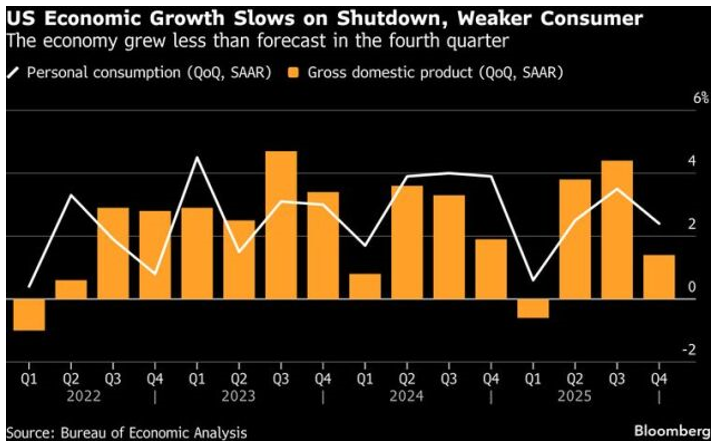
Conference Board Says Shutdown Aside, Growth Moderated Under Inflationary Pressures. A sharp drop in GDP growth in 2025’s fourth quarter was not only the result of the federal government shutdown, but also included broader moderation, particularly across the consumer sector. The federal shutdown in the fall of 2025 lasted almost 43 days, making it the longest in U.S. history, and subtracted roughly 1% off GDP growth in Q4, according to the Bureau of Economic Analysis (BEA). While the government’s reopening will likely reverse that impact, at least in part, in the first quarter of 2026, excluding the contribution from the government sector, GDP growth in Q4 moderated to just 2.3%, slightly more than half of what it was in Q3. This year, U.S. economic performance will depend heavily on the strength of the consumer, the sector that is currently under pressure. Elevated prices, higher borrowing costs, and uneven income growth are forcing households to make tougher trade-offs, testing the resilience that carried spending over recent years. Accelerated inflationary pressures last December, as reflected in the PCE (personal consumption expenditures) price index, will likely persist into Q1, continuing to weigh on consumer spending and overall GDP growth in 2026.
Observatory Group Explains Trump Strategy Better than the Trump—Says It’s an Attempt to Maintain Hegemony Via Resource and Tech Nationalism. Although recent U.S. initiatives may look separate, one should view them as elements of an integrated and coherent economic and security agenda. The goal being to create a U.S.-led world order that is far less dependent on China. Key pillars include:
- alliances to create “China-free” critical mineral supply chains,
- a critical minerals reserve – Project Vault,
- S. control of the Venezuelan oil industry and the use of natural gas as a bargaining chip,
- S. mining and fossil fuel exploration rights in Greenland, and
- an alliance for semiconductor production and AI development – Pax Silica.
The new order is based on a command of resources and technology, not rules, institutions, and promoting free trade and democracy. Rather, the U.S. is dedicated to creating independent supply chains for all products key to a modern economy. These include critical minerals, oil and natural gas, semiconductors and an AI hardware and software stack based on American protocols. Post WWII, the U.S. co-wrote and led a rules-based system with the consent of its allies. Now, it is looking to control resources first and then invite countries into its bloc, so long as they respect and solidify U.S. hegemony. This is a radical departure. While not explicitly coercive, it is rooted in hard power and wealth and favors economic and national security vs. shared ideals of democracy, freedom, free trade, and other forms of international cooperation. The risk is that the grand project to create independence from China fails. Many middle powers no longer trust the U.S. and are concerned about its indifference to democracy and their sovereign rights. As a result, they may not cooperate fully with the new initiatives, renege on inked agreements later, and/or hedge their bets via continuing relations with China. A lasting alliance that can mobilize armies and populations is typically based on deep societal and institutional connections, not merely the pressure of government.
“Inside Baseball”
How SCOTUS’ Tariff Bombshell Impacts the Hill. The Supreme Court’s ruling striking down President Trump’s tariff regime has set off a scramble on Capitol Hill over what role, if any, lawmakers will have to reassert their authority over trade policy. The high court’s decision raises the economic, political, and legal stakes of this midterm election year even further, if that’s possible. So, what’s next? The ruling came just as Democrats were in the middle of forcing votes on tariffs imposed under IEEPA, creating a headache for GOP leadership. But because the Supreme Court ruled that the president had no authority to trigger tariffs under IEEPA in the first place, those efforts aren’t as politically potent now. While the White House will turn to other authorities to wage its trade wars, in the short term, this situation could lead to fewer congressional tariff votes overall, which should be a reprieve for Senate Majority Leader Thune and Speaker Johnson. Those votes had put GOP trade divisions on display and prompted President Trump to lash out at vulnerable Republicans who opposed him. Still, there are big questions about what comes next. While the Trump administration has replaced the IEEPA levies with global tariffs under Section 122, which allows tariffs to be kept in place for up to 150 days, it is expected that the White House will use the coming months to ramp up trade investigations to draw on other tariff authorities. Still, the Section 122 expiration date will be a hard deadline. Democrats are already plotting the next stage of their tariff fight. In fact, Senate Minority Leader Schumer released a statement earlier this week declaring that Senate Democrats will not support extending tariffs beyond the initial 150-day window. Although this isn’t a surprise, it comes as Democrats also prepare to wage pressure campaigns over refunds for the tens of billions of dollars in IEEPA tariffs, demanding that the money the federal government collected be returned.
In Other Words
“These people are crazy, I’m telling ya, they’re crazy,” President Trump addressing Democrats during the State of the Union address when they declined to clap for a teen gender transition ban.
Did You Know
President Trump’s most recent State of the Union (SOTU) address was the longest in history, clocking in at 108 minutes. The speech was nearly 20 minutes longer than the second longest, delivered by President Clinton in 2000. Tuesday’s speech was also longer than President Trump’s joint address to Congress last year, which was not officially a SOTU address; that speech clocked in at one hour and 39 minutes.
Graph of the Week
The Longest Federal Government Shutdown in History Took a Toll on the National Economy. The Bureau of Economic Analysis said the shutdown subtracted about 1% from the gross domestic product (GDP) in the fourth quarter of last, which came in at a 1.4% annualized growth rate. Despite the year-end slowdown, the data showed the economy expanded 2.2% for the full year.