Thought of the Week
I always get a bit worried when I draw the 2:00 or 2:30pm conference speaking slot. It’s right after lunch, people have had a full morning, and I figure that at least half of the audience is already looking forward to happy hour or that evening’s festivities. This latest time, my angst spiked even higher when I learned that pasta was served for lunch. The immediate question that ran through my mind was not whether the presentation I was about to give on the U.S. economic outlook, the current state of American politics and upcoming midterm elections, and Washington office lobbying activity was interesting enough to keep people engaged for 2+ hours but whether it was stimulating enough to keep them awake. To my pleasant surprise, the latest group of TOMODACHI scholars to visit SCOA hung in there, and the questions I received were surprisingly thoughtful. Is the U.S. experiencing stagflation? No, not 1970s style stagflation. Although inflation is sticky, running just under 3%, at present, it is only 1% above the Federal Reserve’s target; and while jobs and upward mobility are more difficult to come by, a 4.4% unemployment rate is actually near full employment. I’d accept calling the current economic state “stagflation-light” but not stagflation. President Trump seems so powerful; is the system of checks and balances still working? While the president’s constant media presence makes him seem ubiquitous and his creative use of executive authority has caused his detractors to label him an authoritarian, both the courts and Congress have checked and balanced his power. For instance, the Supreme Court recently ruled that the Trump administration imposed IEEPA tariffs unconstitutionally, and Congress is using its “power of the purse” by keeping the Department of Homeland Security (DHS) unfunded. Can you give us a relatable, everyday example of how lobbying works? For college students, some who remain under the legal drinking age, I explained that the drinking age in the U.S. was once 18, and I pointed to the lobbying clashes between Mothers Against Drunk Driving (MADD) and the U.S. beverage industry to raise the drinking age to 21 as an example. In the feedback I received during Q&A and afterwards, I learned that although the intricacies involved in how a bill becomes a law were difficult to grasp, the 1970s-80s era Schoolhouse Rock video “I’m Just a Bill” included in the presentation still held up and helped clarify the process under regular order. At dinner, I learned that there was a general consensus that college towns, especially Knoxville, TN, and Champaign, IL, do not have authentic Japanese food; that Disney performers in Tokyo are better than the ones in Orlando; that Columbus, OH, much more than New Orleans or San Francisco seems stereotypically American; and that during the Super Bowl halftime show, while everyone knew who Lady Gaga was, they weren’t sure about Bad Bunny. Although I’m fairly certain that Q&A and discussion afterwards might run in different directions, if your office or strategic business unit could benefit from a customized presentation on the U.S. economic outlook or the present state of American politics, please consider contacting the Washington office.
Thought Leadership from our Consultants, Think Tanks, and Trade Associations
Eurasia Group Says a Midterm Convention would be a Risky Bet on President Trump. The Republican National Committee is reportedly planning a “midterm convention” to be held in Dallas, Texas, sometime shortly after Labor Day, aimed at ginning up enthusiasm among the party base ahead of the November elections. There are two countervailing forces at work—first, Republicans have historically performed better when Trump is on the ballot, so boosting the midterm profile of the president might generate higher turnout among casual voters who don’t normally turn up at midterms; and second, the president is personally unpopular, and a high-profile convention that places the President Trump firmly at the center of the Republican Party could drag down moderate Republicans in swing districts or Senators who are trying to distinguish themselves from a MAGA national brand that plays poorly with independent voters. On net, a midterm convention—with all the pageantry of the presidential-cycle edition, complete with a keynote speech from Trump himself—is unlikely to pay off for Republicans, especially so in the vulnerable Senate seat in Maine, where Senator Collins’s (R-ME) political appeal relies on non-MAGA bona fides.
Inside U.S. Trade Reports: WTO Analysis Shows Iran War Will Slow World Trade Growth in 2026, Even After 2025 Beat Projections. Global trade grew almost twice as fast as expected in 2025, according to the World Trade Organization’s annual review, but growth is projected to slow by more than half this year due to the Iran war and eased investment in artificial intelligence—with even sharper declines possible if the war drives energy prices higher than already expected. The WTO’s latest Global Trade Outlook and Statistics report forecasts goods trade growth of 1.9% in 2026, which would be sharply down from 4.6% in 2025, although it expects a rebound to 2.6% in 2027. According to the report, world trade grew faster than expected in 2025, as surging demand for AI-related goods offset the negative impacts of increased trade policy uncertainty and higher tariffs. Until recently, prospects for trade in 2026 and 2027 were also improving, with GDP projections and trade-related indicators receiving modest upgrades. However, the conflict in the Middle East has cast doubt on the near-term outlook for the global economy. The surge in global trade growth in 2025 was unusual because economists typically expect growth in global trade in goods and services to match or slightly exceed growth in GDP. But the numbers for 2025 indicate that global trade in goods and services grew at 4.7 %, which was much faster than the 2.9% growth in global GDP in 2025. The WTO’s 2026 forecasts imply that the relationship between growth in global trade and growth in global GDP will fall back in line with historical trends (global GDP growth in 2026 is predicted to be 2.8%, roughly similar to the predicted 2026 growth in the volume of goods and services).
Politico Asks, “Where are the 232s?” After the Supreme Court struck down a wide band of President Trump’s tariffs, his administration reached for a set of specific tools to reconstruct his trade agenda. One tool missing from the effort is new Section 232 tariffs. Following the ruling, the White House reimposed a global 10% tariff using Section 122 of the Trade Act of 1974, and USTR Greer launched two Section 301 investigations into dozens of countries for unfair trade practices and forced labor. But the administration has done little to adjust industry-specific tariffs under existing Section 232 national security probes, or to launch new investigations. Analysts believe 301 may be the better match for what the administration wants to do at a macro level, which is country-specific—not necessarily sector-specific, possibly looking to 232s as a way to supplement as needed. While the Trump administration hasn’t imposed Section 232 tariffs since November, when it placed a 25% duty on medium- and heavy-duty trucks, it even backed off of new tariffs on timber, lumber, and upholstered furniture on New Year’s Eve. Others think the White House may not be leaning on 232 because it is having success using other tools. Consider that the administration has already used the threat of tariffs on pharmaceuticals to secure deals with individual companies, and rather than impose new tariffs as part of a separate 232, USTR has been effective at negotiating critical minerals deals to diminish China’s influence across supply chains. Even as the Trump administration prepares to reconstruct its tariff policies via Section 301 tariffs, the existing 232 tariffs on goods like automobiles and auto parts, steel, aluminum, lumber, and copper have played roles in sealing trade agreements with other countries. In fact, 25% tariffs on autos and auto parts were crucial in bringing both Japan and South Korea to the table, as they tried to relieve pressure on signature domestic industries. As the administration shifts to its next stage tariffs, it is likely to rely on 301 tariffs to make deals more durable.
“Inside Baseball”
Need for Defense and Immigration Funding Lift Odds of a Second Reconciliation Bill. According to the Eurasia Group, the odds of a reconciliation bill passing in 2026 have increased substantially to 30% (from 10%) on the back of new needs to pass a defense supplemental and immigration-enforcement funding. However, the difficulty of securing near-unanimous support among congressional Republicans for a reconciliation bill means that passage is not the base case. Tariff rebate checks are unlikely to be included in a reconciliation bill given their high fiscal cost; including elements of the SAVE America Act on federal elections would also be a heavy lift, likely running into hurdles with the rules of the reconciliation process.
Punchbowl News Asks What Happens to House GOP Leadership if Republicans Lose in November. With 220 days until Election Day, the House Republican Conference remains publicly confident that the GOP will keep its majority despite numerous problems, including the Iran war. Privately, the candid assessment is grimmer—Republicans are likely to lose their razor-thin majority. In fact, leadership parlor games are already underway. The big question: will Speaker Johnson remain the GOP leader if Republicans lose the House? If not, who succeeds him as minority leader? Although no one would go on record, included below are some of the reflections heard concerning GOP leadership succession. Johnson stays. The last two times Republicans lost the majority—2006 and 2018—the speaker did not return as minority leader. Because one would have to go back to the 1950s to find a Republican speaker who lost the majority yet remained as minority leader, history is against Speaker Johnson. He could do it; getting half of the conference in a secret vote is easier than getting 218 votes on the House floor for Speaker. And it doesn’t hurt that Johnson has raised tons of cash and just transferred $18 million to the NRCC. What’s more, Johnson currently has President Trump’s support. Jordan rises. Being minority leader means fighting the majority every day about everything. The top Republican in any minority would have to be an attack dog, and Rep. Jordan (R-OH) has useful experience. Not only is he chair of the House Judiciary Committee, but he made his name sticking up for President Trump and lambasting Democrats. If the GOP loses the midterms, Jordan would be a prime choice if Republicans want to dump current leadership slate start over. Republican Study Committee Chair Pfluger (R-TX) could be another choice. What about Scalise? House Majority Leader Scalise (R-LA) is the longest serving member of the GOP leadership, and doesn’t appear interested in leaving Congress anytime soon. While he seems to relish the grind, even after 12 years as an elected leader, the question will be how much of the blame he gets if Republicans lose; the majority leader sets the agenda, and that’s been heavily criticized by rank-and-file members. Does Emmer get a second chance? The reason House Minority Whip Emmer (R-MN) isn’t Speaker is because Trump labeled him a “globalist RINO” who is “totally out of touch with Republican voters.” Not anymore. Rep. Emmer has grown close to the president, but the knock is that that Johnson and Scalise do the heavy lifting while he simply canvasses the conference for its views.
In Other Words
“Mail-in voting means mail-in cheating. I call it mail-in cheating, and we’ve got to do something about it,” President Trump just days after he had voted by mail in a Florida special election.
Did You Know
Washington, D.C.’s, famed cherry blossoms are almost at peak bloom. The cherry blossom cam can be watched HERE—it’s quickly becoming the new panda cam.
Graphs of the Week
Drawing on an analysis of anti-U.S. brand conversations, earnings calls from consumer-facing multinationals, and private survey data, Gravity Research has determined that geopolitical flashpoints are translating into real-time reputational risks for multinational companies, and most firms remain unprepared for the fallout. Data shows that across international markets: (1) consumer boycott intent is highest in affluent markets where shoppers have both the motivation and alternatives to switch; (2) government-led “buy local” campaigns are accelerating shifts from sentiment to behavior; and (3) retail and consumer goods companies face the steepest exposure, given low switching costs and high visibility. The determination is that this is not merely a protest cycle, but a behavioral shift, and most companies are not adapting their messaging or marketing strategy to reflect it.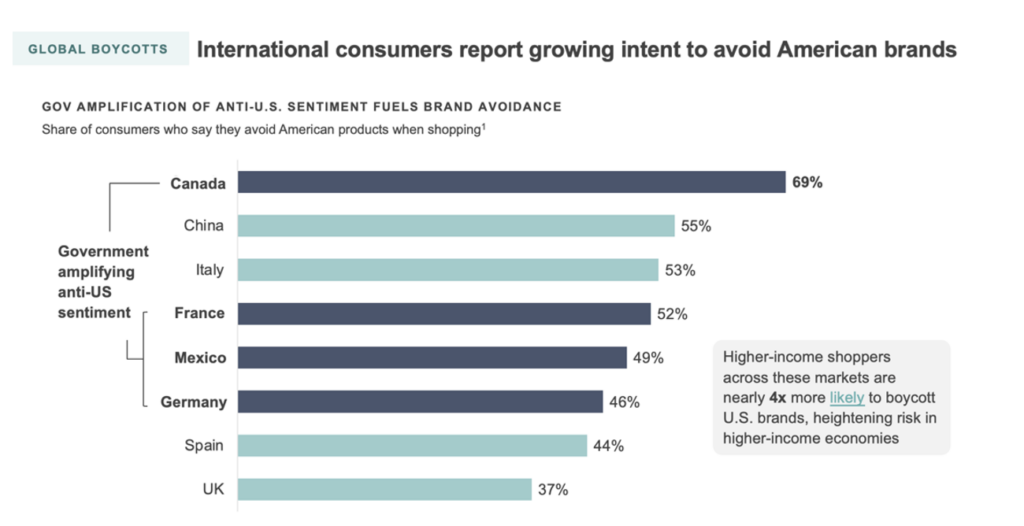
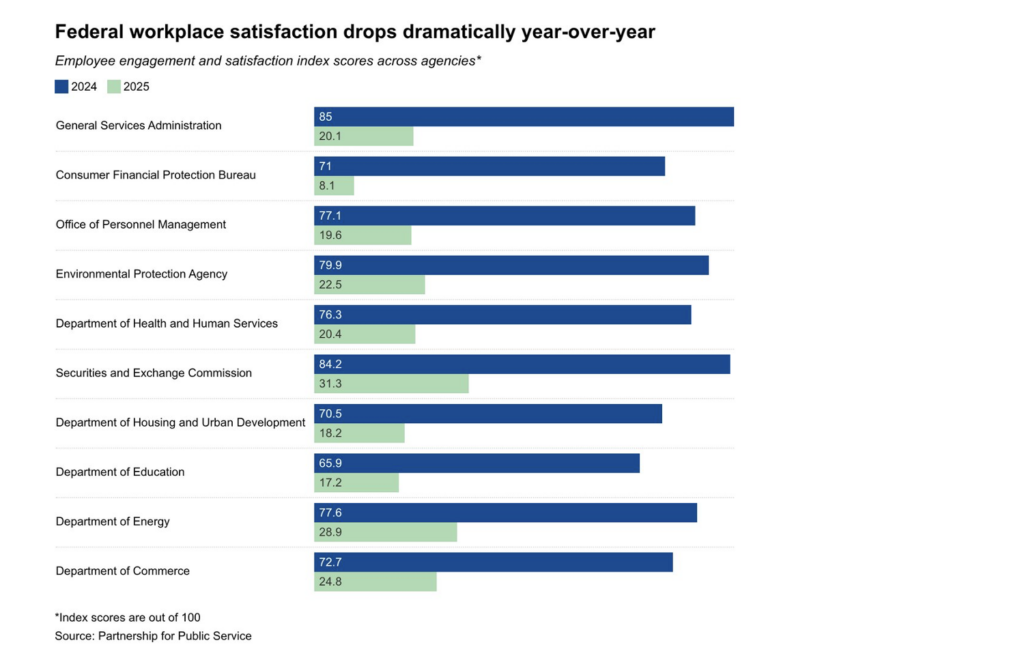
Vowing to “drain the swamp,” President Trump spent the past year reshaping and downsizing the federal workforce, sometimes in wholesale fashion. According to a new survey of federal employees, it’s led to a disengaged and dissatisfied workforce. Index scores (out of 100) for 30 federal agencies dropped so low in 2025 that none registered at 50 or above. In 2024 (President Biden’s last full year), no federal agency had a score at 50 or below.