Thought of the Week
A snowmageddon, a snowpocalypse, an Arctic blast, a bomb cyclone; whatever you want to call it, a major winter storm is probably barreling your way. Forecast to impact at least 35 states, the Washington, D.C., area is expecting at least 10 inches of snowfall, a tally the nation’s capital hasn’t seen in at least a decade. The prospect of such a mega-snow event foreshadows what some believe will be a different kind of snow job that is fast approaching—the advertising associated with the 2026 midterm elections. No doubt, the midterm messaging war has already begun. In fact, 2025 was a busy year on the political airwaves, with both Democrats and Republicans scrambling to shape voters’ early impression of the GOP’s reconciliation law, better known as the One Big Beautiful Bill or OB3. AdImpact analyzed every ad run across House and Senate races last year—from candidates as well as outside political groups. The disparity between the GOP and Democratic messaging was dramatic, with the top takeaway being that Democrats want to make 2026 all about health care, while Republicans do not. The analysis found that 56% of Democratic ads run in House races in 2025 mentioned health care, outpacing the 17% figure for GOP-backed House ads. What’s more, while there was a clear trend of left-leaning outside groups spending heavily to slam the hundreds of billions of dollars in looming Medicaid cuts mandated by the One Big Beautiful Bill, GOP pushback centered on defending the law’s policy changes as countering waste, fraud, and abuse. Taken together, Republican groups are choosing to message less on the issue of health care. In Senate ads, the disparity was smaller. Thirty-one percent of Democratic ads featured health care messaging, while 23% of GOP ads mentioned the issue. The second distinct takeaway is that President Trump will most certainly dominate the midterm elections. The president continues to be the dominant figure in the Republican Party, and that’s reflected in how GOP groups are framing their ads. In both GOP-backed House and Senate ads, President Trump was the most featured topic—63% for House ads and 83% for Senate ads. Almost every Republican candidate running in 2026 wants voters to know that they will stand with the president. Interestingly, 58% of Democratic ads in Senate races in 2025 also featured President Trump, suggesting that Democrats will continue to use the president as a foil throughout the midterms. The third major takeaway is that both parties want to talk taxes. Sixty-two percent of House GOP ads mentioned tax policy, in addition to 29% of Senate GOP ads. No tax on tips and no tax on overtime pay were the critical pillars of Republican messaging. Democrats are also messaging on taxes: 49% of Senate ads and 41% of House ads mentioned tax policy with the Democratic stance focusing on the accusation that Republicans cut taxes for wealthy Americans while ignoring the working class. The snow that will blanket most of the country this weekend will make for captive audiences, and mixed in between the NFL conference championships and binge-watching Netflix, I’m sure we’ll all get a taste of 2026’s first political ads. On the menu, I’m expecting “affordability” and President Trump.
Thought Leadership from our Consultants, Think Tanks, and Trade Associations
Brookings Institution Says President Trump’s Personality may be Unique, but His Foreign Policy Not So Much. A survey of American national security policy and history experts suggests that, for all of President Trump’s idiosyncrasies, and all of his departures from post-World War II strategic norms about the importance of alliances and promotion of a freer, more prosperous world, he echoes many of the worldviews and ideas that have been seen and heard from previous American presidents. Although it may be debatable whether this is a good thing, as there have been various raw periods and questionable decisions in the annals of American history, after examining U.S. defense strategy over the nation’s 250 years, and invoking precedents set by presidents like Madison, Jackson, Polk, McKinley, Roosevelt, and Nixon, President Trump does not seem quite the historical enigma that many contend. Although it may not matter whether the Trump administration’s national security policy is unprecedented, as different readers will draw different lessons, for some, it may be reassuring to think that a president who often seems hell-bent on disrupting the existing order is not unique in the annals of American foreign policy. For others, it will come as a warning that Americans are far more assertive than we understand ourselves to be. What’s more, a year ago, there was talk that a second-term Trump would be isolationist; that now seems to be about the last word that explains administration behavior. Because styles and patterns of conduct that may have worked in the 19th century for the U.S. may not be appropriate for the 21st, it may come as both a reassurance and a warning to remember William Faulkner’s admonition that “the past is never dead. It’s not even past.” As a personality, President Trump is unique; as a policymaker, most of his ideas have been seen before, and many are likely to endure even after he leaves the Oval Office.
Inside U.S. Trade Reports on State Department’s enshrinement of the ‘Donroe Doctrine’ in its New Strategic Plan. The State Department’s new strategic plan calls for economic and security “primacy” in the Western Hemisphere, enshrining as official policy what the administration terms the “Donroe Doctrine.” The push for primacy includes an emphasis on trade, as State’s new strategic plan for 2026-2030 promises to prioritize agreements in the hemisphere and to “near-shore key industries in neighboring countries with comparative advantages—not as charity, but because doing so improves the security of U.S. supply chains.” The document, which State has not announced publicly, says the U.S. military’s ouster of Venezuelan leader Nicolás Maduro was part of the new U.S. approach to the region, which will involve both security and economic dominance. The pursuit of economic primacy in the hemisphere is an updated version of the Monroe Doctrine, which State says was the lodestar of U.S. foreign policy during the country’s rise to superpower status. While the doctrine has evolved over time, it hews to the “same core truth: that the United States is safest, strongest, and most prosperous when outside adversaries cannot establish themselves in the Western Hemisphere.” State says it is targeting predatory and coercive countries’ influence in the hemisphere and promises to upend it with a new kind of American system.
Observatory Group Sees White House Affordability Agenda Making Noise, but Political Relief Unlikely. President Trump has begun to heed the clear warning signal from the November 2025 off-year elections: affordability will be the defining issue of the 2026 midterms. The president has moved on from dismissing affordability concerns as a hoax with a flurry of affordability-focused announcements—from housing to nutrition guidelines—signaling Republicans’ nervousness about their ability to win over swing voters on this issue. The Trump administration will continue to flex maximum executive power throughout the year on the issue, but announcements alone will do little to protect Republican candidates from voter frustration. With some midterm mail-in voting starting in as soon as 9 months, there simply may not be enough time for the White House to alter the trajectory of voting behavior this fall. Democrats remain well positioned to win control of the House but are likely to fall short on taking the Senate. The implication being that President Trump is heading toward lame-duck status even before the midterms, constraining his capacity to execute his domestic agenda, and inducing him to spend his time on issues abroad.
“Inside Baseball”
CFIUS News. The Committee on Foreign Investment in the U.S. (CFIUS) is advancing a “Known Investor Program” to expedite transactions from allied nations. Assistant Treasury Secretary Pilkerton announced that the pilot, directed by a February 2025 executive order, will collect detailed data upfront to fast-track low-risk investments in strategic sectors. Treasury expects to release a public request for information soon, initiating a 60-day comment period. Responding to Rep. Davidson’s (R-OH) concerns about bureaucratic bloat, Assistant Secretary Pilkerton argued the program is essential for gathering the data needed to streamline national security reviews. CFIUS is also implementing the COINS Act—codified in December’s defense bill—to scrutinize U.S. outbound investments and establish a confidential feedback process for investors. During Congressional hearings, House Financial Services Chair Hill (R-AR) pressed officials on why close allies like Japan lack “excepted foreign state” status, a privilege currently limited to the “Five Eyes” nations (Australia, Canada, New Zealand, and the U.K.). Chair Hill argued expanding exemptions is vital for critical mineral processing. Assistant Secretary Pilkerton indicated the Known Investor Program could serve as a pathway to reevaluating these status designations.
In Other Words
“We have formed the framework of a future deal with respect to Greenland and, in fact, the entire Arctic Region. This solution, if consummated, will be a great one for the United States of America, and all NATO Nations,” President Trump.
“I should have brought knee pads for all the world leaders…this is pathetic,” California Governor Newsome, a likely 2028 presidential candidate, speaking at the World Economic Forum. Newsome is taking a hard line on European leaders who he sees as being “complicit” with the Trump administration, potentially an effort to push them to look past the current administration and to 2029.
Did You Know
Usha Vance’s announcement that she’s pregnant with her and Vice President Vance’s fourth child puts her on course to become only the second second lady in recorded history to give birth during a term in office. The only known precedent is Ellen Colfax, the wife of Schuyler Colfax—vice president to President Grant—who gave birth to a son in 1870.
Graph of the Week
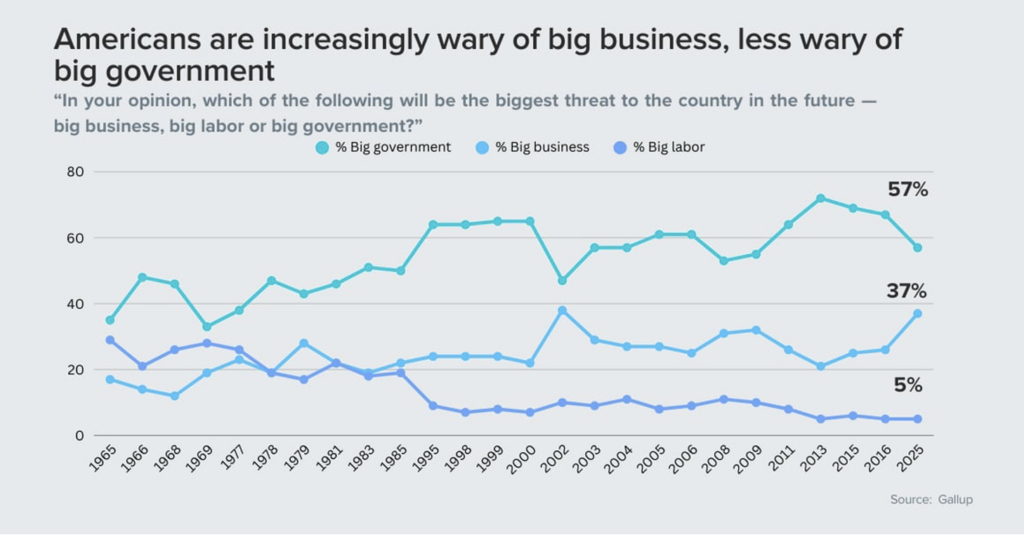
As far back as the 1960s, Americans have felt more threatened by big government than big business. That’s still the case, but the gap has narrowed significantly. In a Gallup survey, 37% of respondents named big business as a larger threat, its highest-ever mark except for the early 2000s, when the country was reeling from Enron and other accounting scandals. Just 5% said big labor posed the greatest threat, a figure that’s been steadily declining since its 29% level in 1965.