Thought of the Week
One of the things I try to do at the end of the year is look back, take stock, and actually make a plan for the coming year. It’s different than a New Year’s resolution, which for me is typically nothing more than a wildly optimistic, downright unrealistic personal commitment to self-improvement—I’m going to lose 20lbs by summer, learn Italian before my trip to Rome, get off social media and read more books (all actual resolutions, all abject failures). Crucial to the ultimate success of any plan is gaining situational awareness, which involves gathering raw data, understanding the significance of that data, and moving from basic awareness to action. For a lobbyist, this starts with decoding the second Trump administration’s first year—determining how things have changed, what methods were used, what are future goals; and how one wins attention or resists effectively? In making a personal plan, one might turn to a doctor, a golf pro, or a financial consultant. To appreciate Trump 2.0, political consultants are everywhere in D.C., and Mehlman Consulting has outlined their six critical elements to understanding the administration. First, is a recognition that this is a very different presidency than Trump 1.0. Attitudinally, politically and globally, Trump 2.0 is operating with broader ambitions and a greater understanding of how to maneuver the levers of power to get things done. Trump 2.0 knew exactly whom they wanted in the Cabinet, how to flood the zone to overwhelm resistance, and how to engage other Washington centers of power. Second, this administration is willing to act unilaterally. In fact, the Trump 2.0 White House has issued more executive orders in its first year than any administration since FDR’s and declared more first-year emergencies than the seven prior Administrations combined. Third, this administration operates transactionally, not ideologically. Although most other Presidents begin with an ideology—anti-Communism, pro-ESG/DEI, neo-con, democracies vs autocracies—and aim for policies that fit their over-arching world views, President Trump lives to make deals. Notice that Trump 2.0 has shown a willingness to change its mind, and is far less concerned about “interfering in the market” than traditional conservatives. Fourth, domination is imperative. When challenged, the White House has only one response…to hit back twice as hard. The aim is to give critics pause and prompt negotiation rather than retaliation. And it appears to be working as businesses and foreign leaders seem to prefer an inside game of maximum alignment, flattery, and conciliation in an effort to seek “wins” for the president that are not “losses” for themselves. Fifth, markets should accept that there will be tariffs. President Trump’s most consistent policy belief over five decades is that other nations take advantage of the U.S. by selling more than they buy (trade deficits) and restricting their own markets while expecting America’s to be more open (lack of reciprocity). His solution is tariffs. Whether or not the Supreme Court overturns the use of the International Emergency Economic Powers Act (IEEPA), there will be tariffs. The President believes deeply in their need and effectiveness, and the White House can leverage many other statutory authorities to impose them broadly. Last, the administration will respond to events on the ground. As confident as President Trump seems, the administration knows it cannot win every battle. While losses, through litigation or electorally, may force the White House to stop what they’re doing at the moment, they will seek alternative approaches to achieve desired outcomes. For me, 2026 is the year I lose those 20.
Thought Leadership from our Consultants, Think Tanks, and Trade Associations
Conference Board Sees CPI Inflation Decline as Holiday Gift for Fed Doves. Looking through the prism of the Federal Reserve’s dual mandate of price stability and maximum employment, the November combination of sharply lower consumer price inflation and rising unemployment portends more interest rate cuts in 2026. However, the federal government shutdown distortions in data collection over October and November suggest the latest figures, showing a slowdown in inflation to 2.7% in November from 3.0% in September, should be viewed with some skepticism by the Fed as most October indices were missing due to the shutdown. The Fed will wait for cleaner December data on both inflation and employment to assess the balance of risks ahead of the January 27-28 FOMC meeting; in fact, Chair Powell did warn about the data quality at the December 2025 FOMC press conference. Taken at a face value, the November CPI report showed broad-based declines in the pace of annual inflation. While a sharp drop in the pace of shelter inflation was a big reason for the CPI weakness in November, slowing inflation was evident across many other services categories. This further supports Chair Powell’s assertion that the labor market is no longer a major source of inflation. Going forward, weaker growth and a more fragile labor market in the beginning of 2026 will likely result in slower inflation later in the year after peaking in Q1. This suggests the Fed will keep reducing policy rates, even as the timing of the ultimate moves remains uncertain. Expect two interest rate cuts in H1 2026.
Eurasia Group Contends Indiana Redistricting Loss was a Blow to President Trump Electorally and Politically. The Indiana state senate rejected Republicans’ proposed redistricting by a 31-19 vote, closing off the pathway to Republicans’ hoped-for two-seat gain in the state. In addition to narrowing the upside for Republicans legislatively, the loss seems to be the latest crack in President Trump’s power within the GOP, and it is an early sign that his influence may be waning among the Republican grassroots. While the president and national Republicans had leaned hard on Indiana lawmakers, a majority of Republicans in the state senate voted against the plan. With Indiana out of the picture, redistricting is increasingly likely to end up as a near-wash; the three remaining states—Florida, Louisiana, and Virginia—are likely to cancel each other out. What’s more, the vote may be part of a bigger picture—last week, twenty GOP House members joined with Democrats to support a bill to override President Trump’s executive order weakening union rights at federal agencies; several weeks ago, a handful of Republicans bucked the White House to force the release of federal files related to disgraced sex-abuser Jeffrey Epstein; and Republicans are lining up additional routes of resistance, including over his military build-up in the Caribbean. The Indiana loss reaffirms Democrats as 80% favorites to flip the House next year. Now, a Supreme Court ruling striking down much or all of Section 2 of the Voting Rights Act seems the only way Republicans could emerge as clear redistricting winners, but it is uncertain whether that ruling may come early enough to allow for a round of pre-midterm redistricting.
Ian Bremmer on President Trump’s Second Year. President Trump has consolidated more power around himself—in terms of loyalty from the Republican Party, from within his administration, and from inside the administrative state—than any American president in recent memory. There is now pressure to leverage this power into three distinct areas with tangible policy outcomes—on the economy, on security, and on domestic politics. (1) On the Economy. It’s been a historic year for tariffs—the Trump administration’s principal geopolitical tool leading to the highest U.S. rates in nearly a century. White House policies should become significantly more predictable as midterm elections approach, the president tries to boost his poll numbers, particularly on the economy and affordability, and the U.S. needs more international coordination on critical minerals/rare earths to reduce vulnerability to Chinese leverage. (2) On Security. The Trump administration has spent most of the year trying to end conflicts (and talking about success in doing so), but with mixed results. In the context of a global security environment that remains unipolar, a greater resolution to act is emerging. (3) On Domestic Politics. President Trump has expended a great deal of effort across the board over the past year—some symbolic, some meaningful. While he has begun to face some institutional resistance, next year, given the midterm elections, is where the rubber will meet the road.
“Inside Baseball”
Punchbowl News Reports on the Coming AI Campaign War. The battle over artificial intelligence policy moves to the campaign trail where opposing camps plan to spend big money to elect candidates at the federal and state levels who support their vision for the technology. The dynamic echoes the crypto community’s involvement in the 2024 election, an unprecedented effort by an industry to reward its friends and defeat its enemies with tons of cash. Unlike the crypto industry, the pro-AI effort will have an opposing group fighting for the hearts and minds of voters. It’s a battle between the AI boomers and the AI doomers. Together, the two groups plan to spend at least $150 million, which is more than the $100 million the crypto industry doled out in 2024. It’s hard to overstate how influential the spending could be in key races. The AI boomers are represented by the industry-backed Leading the Future super-PAC, while the doomers are represented by PACs run by two former lawmakers. The Boomers: Leading the Future was seeded with money from industry leaders such as OpenAI, 16z, and Palantir, and it’s ready to spend $100 million. The group will support candidates who want the federal government to block states from enacting individual rules for AI, which the industry says will cripple its ability to win the AI race with China. The Doomers: AI skeptics plan to put a mountain of cash on the table in 2026 to counter tech companies’ narratives about regulation and the U.S.-China race. Former Reps. Stewart (R-UT) and Carson (D-OK) are launching separate super PACs with a promise to raise $50 million to pump up pro-AI regulation candidates. While the figure is half of what Leading the Future is promising, the bipartisan duo is hopeful they’ll be able to fight Big Tech’s cash flow. The PACs will support candidates for the House and Senate, as well as state legislature and governor’s races, from both sides of the aisle, with the main issues being AI regulation and export controls of AI chips to China. The PACs will endorse candidates who believe the government has a role in regulating AI, including the belief that states have a regulatory role, absent a federal framework.
In Other Words
“A gentleman’s C…Fair growth, not a great labor market, inflation problem—it’s hard to get an A+++ out of that,” Douglas Holtz-Eakin, chief economist on President Bush’s Council of Economic Advisers and later director of the Congressional Budget Office, on his grade for the economy after President Trump claimed an “A+++”. Holtz-Eakin’s comments belie a growing issue for the president: while the U.S. is not in recession, economic pain and affordability concerns remain central in voters’ minds, and Democrats are playing that to their advantage.
“The Biden staff, they ruined any type of good library for him. He’ll be lucky to have a bookmobile,” Democratic donor John Morgan on former President Biden’s presidential library fundraising challenges.
Did You Know
House in Final Stretch of a Historically Unproductive Year. The House of Representatives has taken just 336 roll call votes this year, the lowest total in three decades, save for the 2020 session that saw the onset of Covid-19.
Graph of the Week
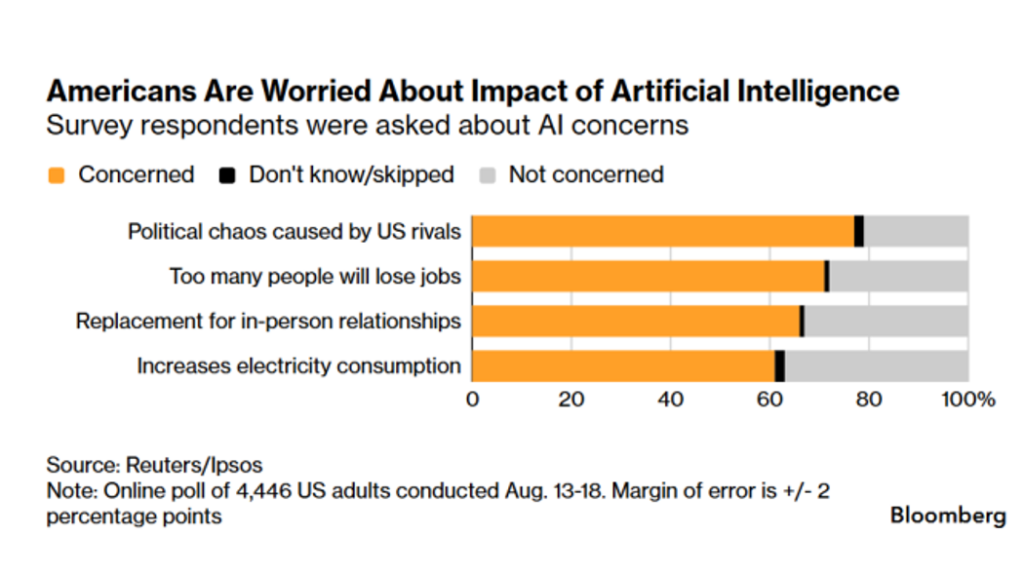
Voter Backlash to AI Is Brewing. American voters are starting to voice concerns about artificial intelligence, even as President Trump is pushing to support the technology. At the local level, there are rising objections to data centers whose huge demand for electricity is getting linked to bigger household bills. In addition, there’s the employment risk, including widespread fears that the technologies may turn out to be job-killers.