Thought of the Week
Years ago, as our kids began to get older, my sister and I did away with giving Christmas presents to each other, our spouses, and each other’s kids. From a logistics point of view, it made sense; we didn’t have to struggle to come up with gifts that were nice enough so there were no hurt feelings, but not so expensive that they would break the bank. Because I’m not the best at following directions, I still give them all small gifts centered around a specific theme—parody Christmas t-shirts, gag gifts, pictures from a visit to our family’s roots in Italy, things like that. This year, I thought about giving pocket editions of the U.S. Constitution. Think about it, when was the last time you read the Constitution? While I’d suspect that relatively few of us have a deep understanding of the primary constitutional clauses that significantly impact business operations in the U.S., several establish the legal frameworks for regulation and protecting corporate rights, including the Commerce Clause, Due Process Clauses, Takings Clause, and Contract Clause. In fact, rulings from this year’s Supreme Court term may be more relevant and consequential to business than ever before. Here’s a short review about some of the cases on the Court’s docket for business:
1) Trump v. Cook about the president’s right to fire a member of the Federal Reserve.
What the case is about: The Supreme Court will decide whether President Trump can fire a Federal Reserve board member. A temporary ruling allowed Lisa Cook to remain on the job for the time being.
Why it matters: The Federal Reserve plays an unparalleled role in steering the U.S. economy, so Congress set it up to be insulated from political pressure from the president. Enabling the White House to remove Cook, or any Fed board member, could jeopardize the credibility and efficacy of U.S. monetary policy.
2) Trump v. Slaughter about the independence of federal agencies.
What the case is about: Rebecca Slaughter, the sole Democratic member of the Federal Trade Commission, is challenging her removal by President Trump. The Court allowed the president to remove her for the time being. The court will also weigh whether to overturn a 90-year-old precedent that allows Congress to create non-partisan, independent agencies whose leaders are insulated from political interference by the president.
Why it matters: Congress set up the FTC to be independent of the president by mandating commissioners could be removed only for “inefficiency, neglect of duty, or malfeasance.” While the White House has not alleged any misconduct by Slaughter, a win for the president would give him and future presidents far greater political control over a range of powerful agencies, including the Federal Communications Commission, National Labor Relations Board, and Federal Trade Commission.
3) Trump v. V.O.S. Selections, Learning Resources, Inc. v. Trump about the legality of most of President Trump’s tariffs.
What the case is about: Does a 1977 law that grants the president economic powers to address emergencies give him broad power to levy tariffs.
Why it matters: The justices appeared skeptical of the legality of most of President Trump’s tariffs. Lower courts found the president exceeded his authority under the law. The case is the most significant to date concerning Trump’s second term and perhaps the biggest of the Supreme Court’s term. A ruling for the White House would ratify his assertion of broad presidential power over the economy. A loss would significantly curtail his power and could require refunds of more than $100 billion.
Other major cases involve copyright infringement, limits on political party spending, a challenge to mail-in ballots, and race and voting districts. If not pocket-sized Constitutions, what am I giving this year? I’ll tell you after the new year (my mother reads this blog, and she’s a tattletale).
Thought Leadership from our Consultants, Think Tanks, and Trade Associations
Browstein Summarizes USTR’s Public Hearing on the USMCA Joint Review. Last week, the Office of the U.S. Trade Representative (USTR) held a three-day public hearing to hear from stakeholders ahead of the Joint Review of the U.S.-Mexico-Canada Agreement (USMCA). In September, USTR initiated its public consultation process, requesting public comment and inviting stakeholders to provide public testimony on the operation and implementation of USMCA. More than 1,500 stakeholders submitted comments, and USTR heard from roughly 100 witnesses representing various industries. The feedback will inform USTR’s assessment of how USMCA is functioning in practice and guide its recommendations on any issues that merit attention during the formal review. The public hearing comes as President Trump continues to cast doubt on the continuation of the USMCA. During a White House event, the president responded to a reporter’s question on renegotiating the agreement, stating, “We’ll either let it expire, or we’ll maybe work out another deal with Mexico and Canada.” USTR Greer reiterated the president’s statements in POLITICO, suggesting the U.S. withdrawal from the USMCA is “always a scenario.” Greer added, “The president…only wants deals that are a good deal. The reason why we built a review period into USMCA was in case we needed to revise it, review it or exit it…Our relationship with the Canadian economy is totally different than our relationship with the Mexican economy. It actually doesn’t make a ton of economic sense why we would marry those three together.” USTR is required to compile a detailed report for Congress by January 2, 2026; the report will include an evaluation of the agreement’s operation, the U.S. position on whether to extend the USMCA beyond its initial 16-year term, and specific proposals for actions to be considered at the Joint Review meeting, which should occur on or around July 1, 2026.
National Journal Recognizes that Politics Makes Strange Bedfellows. While the governors of two states both geographically and ideologically opposed have not been shy about their feelings towards each other, Florida Governor Ron DeSantis (R) and California Gov. Gavin Newsom (D) have something in common—a distaste for President Trump’s new offshore drilling plan. The new proposition from the Department of the Interior offers as many as 34 offshore drilling leases across nearly 1.3 billion acres off the coasts of Alaska, California, and Florida—essentially reversing Biden-era protections and overriding President Trump’s own 2020 directive. According to Governor DeSantis, President Trump’s 2020 memorandum protecting Florida’s eastern Gulf waters was a thoughtful approach to the issue, and he believes the Interior Department should not depart from the 2020 policy. President Trump’s 2020 memorandum banned offshore drilling around Florida, Georgia, and South Carolina until 2032, and was also supported by Sen. Scott (R-FL). In fact, Sen. Scott has already said he’s been in contact with Interior Secretary Burgum about returning to the 2020 memorandum. Although it remains unclear whether the two states will team up to fight the proposal or advocate for carve-outs, what is clear is that Newsom and DeSantis are momentarily united against the same thing. Always happy to go on the offense, Newsom didn’t mince words when responding to the president: “Trump’s idiotic plan endangers our coastal economy and communities and hurts the well-being of Californians. This reckless attempt to sell out our coastline to his Big Oil donors is dead in the water. It’s interesting that Donald’s proposal doesn’t include the waters off Mar-a-Lago.”
Observatory Group Says Low Morale of Republicans in Congress Could Make Trump an Early Lame Duck. Political stability and the capacity to pass legislation are being jeopardized by the rapid fall of morale among Republicans in Congress. Since passage of the OBBBA—the last major point of internal alignment—the GOP has faced increasing conflict between factions, the longest ever government shutdown, sweeping losses in the 2025 elections, and a big rise in resignations and retirements. These departures are materially different from prior periods. Many House GOP lawmakers are leaving due to disillusionment, institutional fatigue, and loss of confidence in party direction, not because they expect to be defeated in the midterms. There is a non-zero probability that the Republicans could lose functional control of the House before November 2026 through resignations, and senior Republicans are becoming increasingly concerned about this. While still a tail-risk scenario, its plausibility is a key factor leading up to the midterms. The low morale is also creating a downward spiral for the Republicans’ midterm prospects. They may find it harder to raise money, campaign effectively, find good candidates, and counter scathing opposition narratives. Regardless of these new dynamics, President Trump will continue shaping policy via executive action. However, his capacity to effect real change will be undermined by not having a united party behind him in Congress. As a result, lame-duck conditions are likely to emerge for the president well before they usually do for a second-term President after a clean sweep.
“Inside Baseball”
Democrats Move to Ban Trump Dollar Coin. Senate Democrats, led by Sens. Merkley (D-OR) and Cortez Masto (D-NV), have introduced a bill that would prohibit the U.S. Treasury and Mint from producing a coin bearing the likeness of President Trump. The legislation, called the Change Corruption Act, would prevent federal authorities from minting U.S. currency that features “the likeness of a living or sitting president.” The bill is specifically aimed at this White House. The U.S. Mint’s webpage detailing possible designs for a semi-quincentennial (250th Independence Day; July 4, 2026) coin features President Trump’s face prominently.
In Other Words
“Here’s a hard truth Republicans don’t want to hear: Nancy Pelosi was a more effective House Speaker than any Republican this century,” Rep. Mace (R-SC).
Did You Know
A 53-foot-tall red fir will become the nation’s latest Capitol Christmas Tree. Hailing from Nevada’s Humboldt-Toiyabe National Forest, it is the first Capitol tree to be harvested from the more than 5-million-acre forest. Each year, the USDA’s Forest Service selects a tree from one of the country’s 154 national forests for display on the West Lawn of the Capitol. The tradition started in 1964. The smallest tree came in at 24 feet tall from Pennsylvania the first year of the tradition, while the tallest trees came in at 88 feet in 2013 and 2014 from Washington and Minnesota, respectively.
Graphs of the Week
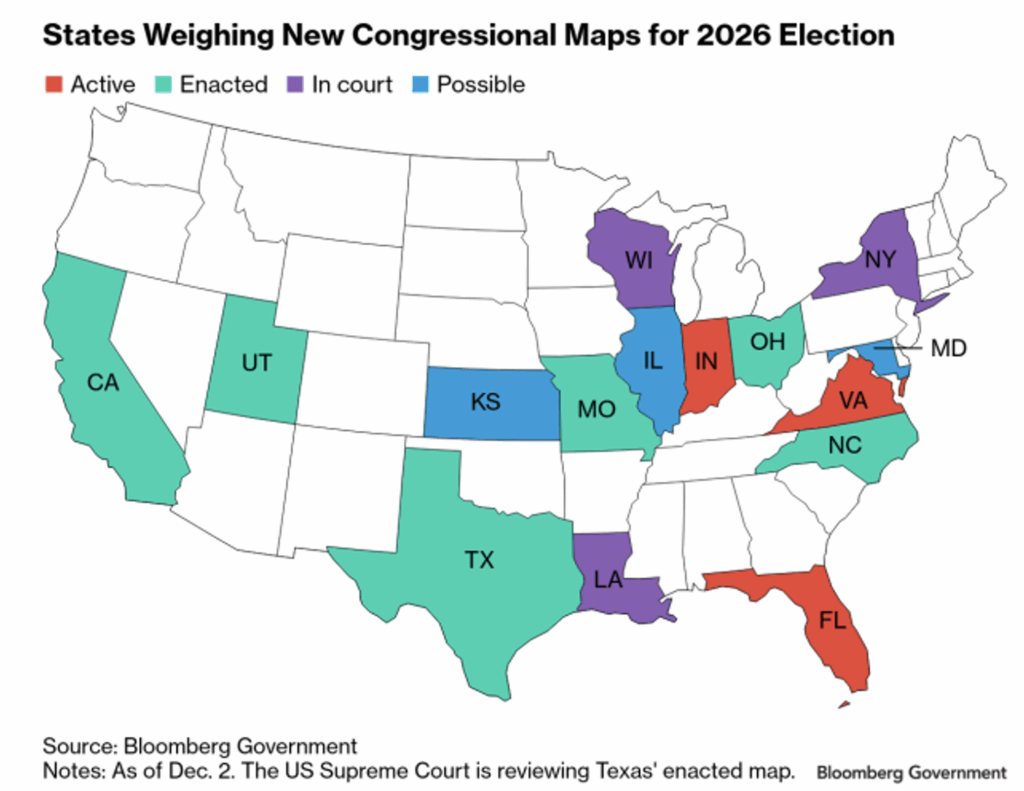
The Supreme Court’s decision to allow Texas to use its new congressional maps for next year’s midterm elections could have far-reaching implications for election law. By shutting down federal court oversight so early in the election cycle, state legislatures appear to gain a path to game federal law. In fact, if legislatures change election policies close to an election, federal courts might be prohibited from interfering.
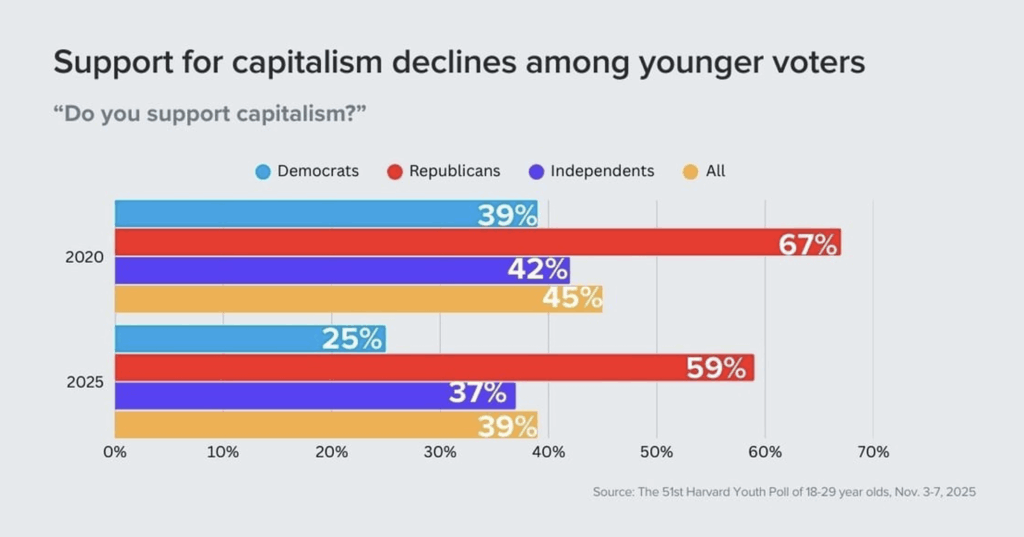
The latest Harvard Youth Poll reveals that “support for capitalism continues to erode among young Americans, with polarization persisting across most demographics.” However, even young Republicans’ support for the free market dropped from 67% in 2020 to 59% this year.