Thought of the Week
I experienced one of those Unknown Knowns this past week while attending the Hootie and the Blowfish Monday After the Masters Celebrity Pro/Am golf tournament. For the past 15 years my non-profit, the Salute Military Golf Association (SMGA), has been sending post-9/11 wounded veterans to play in pro/am golf tournaments, including the AT&T National, Quicken Loans National, Wells Fargo Championship, Denny and Mark Pro/Am Jam, and of course, the Hootie event. That’s the Known. What was Unknown to me was that Chris Kirkpatrick, one of the founding members of the band N*SYNC, has not only played with our veterans, as well as kept in touch with a number of them, but carries our headcover with him to every round of golf he plays. Now, you might be saying to yourself, “Jamie, what are you talking about ‘Unknown Knowns’?” Well, in the run-up to the U.S. war in Iraq in the early 2000s, former Defense Secretary Rumsfeld gave us what eventually would come to be known as the Rumsfeld Matrix. Plotted on an X-axis of level of understanding and Y-axis of level of awareness we were told there were Unknown Unknowns (things we aren’t aware of and don’t understand), Unknown Knowns (things we aren’t aware of but understand), Known Unknowns (things we are aware of and don’t understand), and Known Knowns (things we are aware of and understand). This week, following United States Trade Representative (USTR) Greer’s testimony on Capitol Hill, we were once again reminded of Rumsfeld’s matrix through a series of four Known Unknowns in U.S. trade policy that are expected to reach inflection points in the very near future. The first involves the progress and outcomes associated with the Section 301 investigations, which contain the prospect that the White House could reimpose tariffs or other trade restrictions at any level against any of the named trade partners. In fact, even countries that are excused from any upcoming accusations of unfair trade practices could find themselves back in the crosshairs, as Section 301 allows relatively easy future adjustments to scope and coverage. The second unknown involves the new policy on imported metals, which creates more uncertainty about how goods may be included or excluded from coverage going forward. Third, is the continuing legal saga resulting from President Trump’s trade authority, which engenders its own wider set of “unknowns.” And fourth is the status of the series of bilateral trade arrangements the Trump administration has made with various trade partners, drafted when there was an IEEPA tariff regime. While the White House continues to argue that all the deals still stand, the ‘reciprocal’ tariff rates covered in each agreement are no longer applicable. Bottom line: trade partners are left with having to grapple with uncertainty; Section 301 investigations will only increase pressure on foreign governments; the timelines for potential new changes emanating from the White House are short; and it remains unknown what might happen in the near term, but the likelihood of new trade adjustments remains high.
Thought Leadership from our Consultants, Think Tanks, and Trade Associations
Brookings Institution Explains What Special Elections Tell Us about the Upcoming Midterms. Although special elections tend to be low-turnout affairs, to the extent they preview the November midterms, it is because they serve as a reliable predictor of the enthusiasm within each party. If recent races are viewed alongside the substantial 2025 Democratic wins in New Jersey and Virginia, the midterm outlook appears favorable for Democrats. The swings toward Democrats in recent special elections have been unusually large, and are likely a reflection of sharp declines in President Trump’s approval ratings.
Eurasia Group Says Hormuz Set to Remain Mostly Shut. Despite recent Iranian firings on ships attempting to sail through Hormuz and the U.S. seizure of Iranian container ships, the current ceasefire is likely to hold (65%). While further talks are likely to emerge in the coming weeks, the risk of ceasefire collapse remains at 35%. Iran will likely remain publicly committed to the ceasefire but respond to recent ship seizures through asymmetric attacks on shipping. If talks go ahead, it will be an indication both sides are committed to diplomacy and will not resume the war. Volumes passing through the Strait will remain between 5-30% of pre-war levels until a final deal is reached. Iran will not relax its posture on the Strait absent an understanding with the U.S., particularly while the White House shows a willingness to escalate. A ceasefire extension is likely, although tensions will remain elevated absent moves to de-escalate, such as the partial withdrawal of American military assets and/or Iran relaxing its hold over the Strait.
Eurasia Group Believes Democrats are Overwhelming Favorites to Flip the House. The odds of Democrats flipping the House in the November midterms have risen to 90% from 80% on the back of President Trump’s faltering popularity and a stable Democratic lead in the generic congressional ballot. A “wave” election akin to 2018 or 2010 is becoming a real possibility, with Democrats flipping over 30 seats to deliver a comfortable House majority. However, a smaller victory, with Democrats flipping between 11 and 30 seats, remains the base case. Triangulating between different points of historical precedent informs the prevailing view: parties whose presidents have President Trump’s current approval rating in April of the midterm year tend to lose around 30 seats, while the generic-ballot lead implies a 25-seat flip. Republicans won 19 seats by 7 points or fewer in 2024; all of those seats remain highly vulnerable this year, with the national environment having shifted about 7 points to the left. A larger majority would make life easier for House Minority Leader Jeffries (D-NY) as Speaker, insulating him from strong pressures to make deals with progressives or moderates to secure his speakership. At the same time, Democrats’ position to retain the House in 2028 would be stronger with a larger majority.
“Inside Baseball”
A Bold Option to Counter Virginia’s Extreme Gerrymander Scheme? Rather than an effort to “restore fairness” or “level the playing field,” this week’s Virginia gerrymander vote seemed to be nothing more than a political power play aimed to stack the deck in favor of Democrats. However, the White House does have a redistricting tool it could choose to use. In 1790, Virginia and Maryland each gave five square miles of land to the Federal government to create a district for a new national capital. The Virginia land remained part of the District of Columbia until 1847, when it was retroceded to the commonwealth (the reason for the retrocession was to protect slavery in Virginia when the District abolished it). Although several presidents, including William Howard Taft, considered the retrocession unconstitutional and wanted to reclaim the land for the District, the Supreme Court has never weighed in. President Trump could issue an Executive Order declaring the retrocession unconstitutional, triggering legal action, and allowing the courts to weigh in on whether the county of Arlington and the city of Alexandria in fact belong to the District of Columbia. Being some of the deepest blue areas in the commonwealth—and the country—and loaded with federal government employees, it’s not unreasonable to believe that residents of northern Virginia might actually feel right at home as part of D.C. A number of conservatives are encouraging the president to re-district Virginia. Their claim: not only would it neutralize the president’s political opponents’ move to stack Congress against him, protecting him from another likely impeachment, but, most importantly, it would save a great number of downstate Virginians from having their votes canceled out by D.C.-adjacent constituents.
I’m Just a Bill. For those of us of a certain age, a School House Rock tune cheerfully explained the orthodox lawmaking process—a legislator introduces a bill, which gets referred to committee, marked up, then reported, and then voted upon; if the two chambers move different versions of the legislation, they go to a conference committee to hammer out an agreement that then gets passed by both chambers and sent to the president. That process still happens on Capitol Hill, but it has become the exception to the rule. About two-thirds of the text that eventually becomes law is injected into bills after they are introduced, according to the most recent analysis by political scientists at the Royal Holloway University of London and University of Washington. They used computational text analysis to examine 160,000 bills introduced between 1993 and 2022 and measured the legislative content change using n‑gram similarity between bill versions. The finding: many enacted bills share very little overlap with what was originally introduced—a clear indication of the effectiveness of lobbying.
In Other Words
“I will wager, right now, $100, that Schumer intends—on October 1—to do the same thing, to shut the whole federal government down for a month, so that on Election Day, the government is shut down, you have four-hour lines again in airports, and the Democrats can say, ‘See, the Republicans are in charge, they don’t know what they’re doing,’” Senator Cruz (R-TX).
“This referendum is a blatant partisan power grab that nobody’s really ever seen anything like it,” President Trump on Virginia’s redistricting referendum that could give House Democrats a 10-1 advantage in the state.
Did You Know
Former Rep. Loretta Sanchez (D-CA) and current Rep. Linda Sanchez (D-CA 38) were the first set of sisters to serve simultaneously in the House of Representatives.
Graphs of the Week
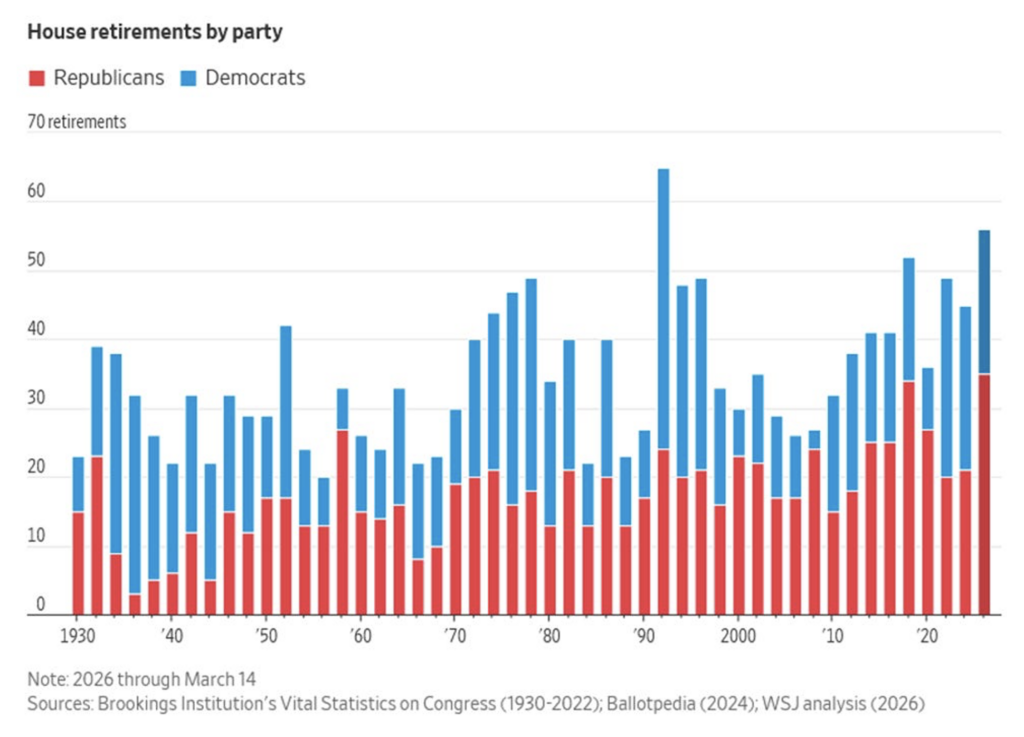
Record Number of Lawmakers Quitting Congress. Multiple members of Congress have announced their retirement over the past few weeks, bringing the cycle totals to a new record for midterm elections (1992 was a Presidential year). In fact, this cycle marks the largest midterm exodus of House members in nearly a century of data. The moves signal broader unease inside the chamber about the direction of the political winds—and the value of remaining in office in a fraught political environment.