Thought of the Week
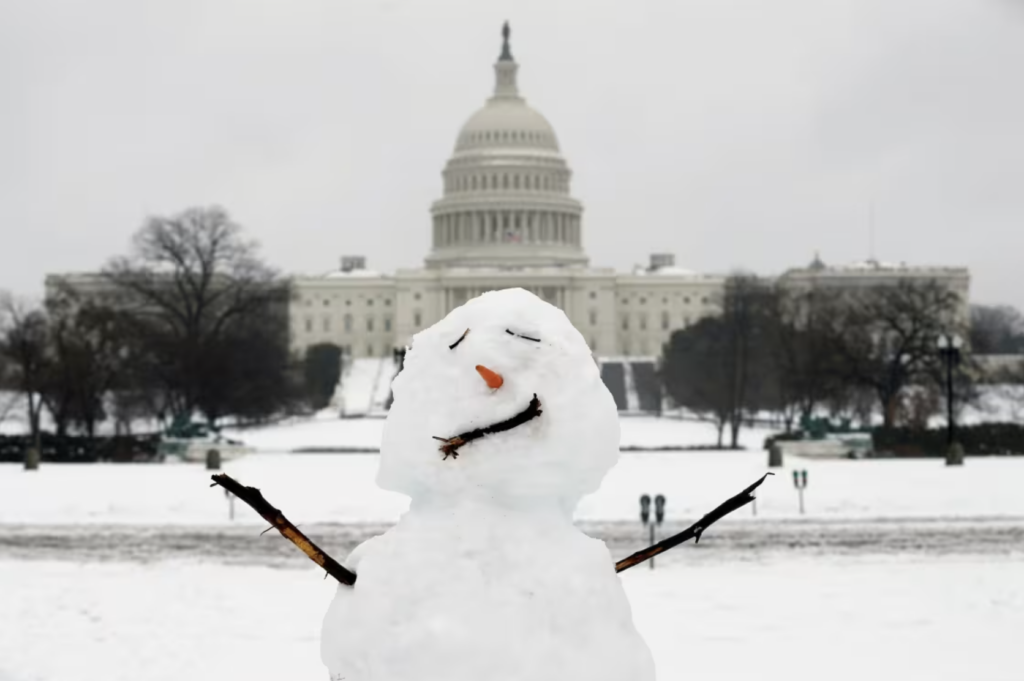
The Inuit’s have roughly four dozen specific terms for snow. To name a few, there’s qana for falling snow, aput for snow on the ground, pukka for crystalline powder, and matsaaruti for wet snow. In fact, the snow we still have on the ground in Washington, D.C., could be referred to as qirsuqaktuq, katakaqtanaq, or sitilluqaq. While the Inuits have numerous words for snow, lobbyists have numerous words describing various congressional votes. Among others there are voice, roll call, yea or nay, unanimous consent, discharge petition, cloture, and messaging votes. This week’s vote to revoke tariffs imposed on Canada under the International Emergency Economic Powers Act (IEEPA) has its own name—a resolution of disapproval. In the end, six House Republicans broke ranks with President Trump by voting with all but one Democrat to pass a resolution to repeal tariffs on Canada. Although largely a symbolic rebuke that will have no immediate impact on Trump administration trade policy (the president would surely veto any anti-tariff resolution that passed both chambers, and there is no prospect of generating two-thirds majorities in both Houses to override a veto), the vote not only signals that there is opposition within the GOP to the White House’s tariff agenda, but it also announces the start of the 2026 midterm election season. In fact, members of Congress, especially members of the president’s own party, vote against the president more often during election years, with the probability of defections increasing even more in midterms when compared to presidential election years (2026 is a midterm election year). History shows that during election years, especially midterms, members in competitive districts tend to be more likely to distance themselves from the White House on unpopular, high-visibility issues like tariffs. These members, particularly those in swing districts, find it necessary to emphasize constituency interests over party unity, when, as in midterms, turnout and national mood matter the most. And this is exactly what we saw happen. Despite severe threats of primary challenges to rank-and-file Republicans who supported the resolution, the Trump administration saw six members, consisting primarily of moderates from embattled swing districts, defect. Consider that Rep. Kiley (R-CA) is facing mid-decade redistricting, making his electoral situation extremely fluid; Congressman Massie (R-KY), although from a solid Republican district, is facing a Trump endorsed primary challenger; Rep. Bacon (R-NE) sits in a perennial swing district, which President Biden won in 2020 and Vice President Harris caried in 2024; Congressman Fitzpatrick (R-PA) represents Pennsylvania’s 1st, considered the “swingiest” district in the country; Rep. Hurd, although from a district that historically leans Republican, is considered competitive, and it’s one he won by an extremely narrow margin in 2024; and Rep. Newhouse (R-WA), although his is a solid Republican district, he voted to impeach President Trump in 2021 and is likely to see a primary challenge. Tariff votes will not get any easier for members. Last week, staffers in Minority Leader Schumer’s (D-NY) office told us that they would keep the tariff votes going throughout the year, with the intention being to increase defections by swing-district members looking to distance themselves from the president’s unpopular trade policy.
Thought Leadership from our Consultants, Think Tanks, and Trade Associations
Eurasia Group Says White House Policy Will Depress Net Migration Through 2026. Net migration to the U.S. fell to recent lows in 2025, driven by a substantial drop in border crossings and ramped-up immigration enforcement; it will likely remain depressed throughout the year as the Trump administration maintains a near-shutdown of the border, pushes forward on deportations, and implements policy changes that reduce the flow of legal migrants. This negative supply shock has pushed overall job growth and the breakeven job growth rate toward zero; the latter will likely remain there throughout 2026. Despite the labor supply restrictions, wage gains have remained subdued amid broader market dynamics, while significant costs in terms of lower growth and higher deficits will accumulate gradually over the long term; absent idiosyncratic sector-specific negative shocks, economic considerations are unlikely to influence President Trump’s broader immigration strategy.
Politico Asks What Might Happen if the Endangerment Finding Actually Dies. EPA’s repeal this week of a monumental scientific finding on global warming could close the door on a decade and a half of U.S. climate policy. The so-called endangerment finding undergirds federal authority to regulate climate change. Revoking it would have the immediate effect of sweeping aside two rules meant to lower greenhouse gases from cars and trucks, and it would help clear the way for the Trump administration’s attempts to upend environmental standards for other carbon intensive sectors, such as power plants. Future fallout from the repeal, which was announced yesterday, includes a potential ruling by the Supreme Court that former EPA officials say would effectively bar any president from issuing a new endangerment finding. While that outcome might drive renewed interest among congressional Democrats to pass a climate bill, if they gain control of Congress, any legislation would still be subject to a presidential veto. Repeal could also push states and the courts into higher-profile roles addressing climate change.
According to the Punchbowl Canvass,* K Street Says Dems are Stronger in 2026 and Not to Expect a Crackdown on Prediction Markets…Yet. Most K Street leaders (90%) say Democrats are in a stronger position than the GOP ahead of the 2026 midterm elections. Notably, 84% of Republicans ranked the Democratic Party in the more favorable position heading into the campaign season. In midterm messaging so far, Democrats have focused heavily on health care and affordability, and Democratic leaders have worked to offset key House GOP redistricting gains, although which party comes out with the edge heading into November remains to be seen. More than eight out of 10 said President Trump’s immigration and deportation policies will be a top issue; more than two-thirds said the president’s tariff and trade negotiations will have an impact; while 51% said mid-decade redistricting would weigh on the election. Other major factors K Street predicts will have an impact in November: the Epstein files (35%); military actions in Venezuela and other foreign nations (24%); and the reconciliation law (23%).
At the same time, lobbyists are bearish on the odds that Congress cracks down on mobile gambling and prediction markets this year, although there’s growing interest in the idea. Just 17% of K Street leaders say legislation addressing the issue is likely in 2026, compared to 72% who view it as unlikely, with responses relatively even across party lines. Skepticism about a successful effort this Congress makes sense. While there’s been interest in reining in prediction markets, it’s mostly Democrats that have been vocal on the issue so far; Rep. Torres (D-N.Y.) introduced a bill to ban lawmakers, aides, and administration officials from betting on government outcomes on prediction platforms like Kalshi and Polymarket. Outside groups have also begun to pressure Congress over the rise in gambling markets. While tribal governments are pressing federal regulators and lawmakers to target the prediction industry and the NFL has raised concerns, businesses offering bets have been building their own influence in the nation’s capital. Kalshi, Crypto.com, and Robinhood recently launched an advocacy group, the Coalition for Prediction Markets, bringing on former Reps. Patrick Maloney (D-NY) and McHenry (R-NC).
*The Washington, D.C., office participates in ‘Punchbowl Canvass’ surveys.
“Inside Baseball” (well, Olympics)
Although the 2026 Milan Cortina Winter Olympics have opened, and 232 American athletes are competing for gold, the halls of Congress could remain Olympian-free next year. No former Olympic athlete has jumped into a congressional race this cycle, likely prolonging Capitol Hill’s two-decade Olympic drought. Between 1967 and 2007, at least one former Olympian served in each congressional term. Seven Olympians have served in Congress, collectively winning a total of four gold medals, four silver, and one bronze between 1932 and 1972. Former Sen. Bill Bradley (D-NJ) and former Rep. Tom McMillen (D-MD) played basketball; former Rep. Jim Ryun (R-KS) and the late Reps. Bob Mathias (R-CA) and Ralph Metcalfe (D-IL) medaled in track and field; and the late Sens. Ben Nighthorse Campbell (R-CO) and Wendell Anderson (D-MN) competed in judo and hockey, respectively. No Olympian has won a congressional race since Ryun’s defeat in 2006, even as five former NFL players have made their way to Congress. Several Olympic alums have unsuccessfully run for Congress in the past decade, including 2018 PA-07 nominee Marty Nothstein (R), a former Olympic cycling champion; 2022 CO Senate candidate Eli Bremer (R), a former modern pentathlete; 2022 GA Senate nominee Herschel Walker (R), a former Heisman trophy winner and a member of the U.S.’s 1992 Olympic bobsled team; and 2024 NY-04 candidate Sarah Hughes (D), a former Olympic figure skating champion. Former Olympic rower Monica Tranel (D), who competed in 1996 and 2000, lost to Rep. Ryan Zinke (R-MT 01) in 2022 and 2024. Olympians might be out of luck in the 2026 midterms, but Paralympians could strike congressional gold. In Iowa, state Rep. Josh Turek (D), who won two gold medals and one bronze for wheelchair basketball in 2012, 2016, and 2020, is running to replace retiring Sen. Joni Ernst (R), potentially becoming the first Paralympian in Congress.
In Other Words
“When Japan is strong, the U.S. is strong in Asia,” Treasury Secretary Bessent speaking after Japanese Prime Minister Takaichi won a landslide victory in parliamentary elections.
“This amounts to the largest act of deregulation in the history of the United States,” EPA Administrator Zeldin on plans to repeal the Obama-era endangerment finding, which determined that greenhouse gases endanger human health and welfare.
Did You Know
Used by law clerks, staff, and sometimes justices, there is a basketball court located on the fifth floor of the United States Supreme Court Building, directly above the Supreme Court Chamber. It’s known as the “Highest Court in the Land,” and features a smaller-than-regulation, hardwood court, with wooden backboards and low ceilings.
Graphs of the Week
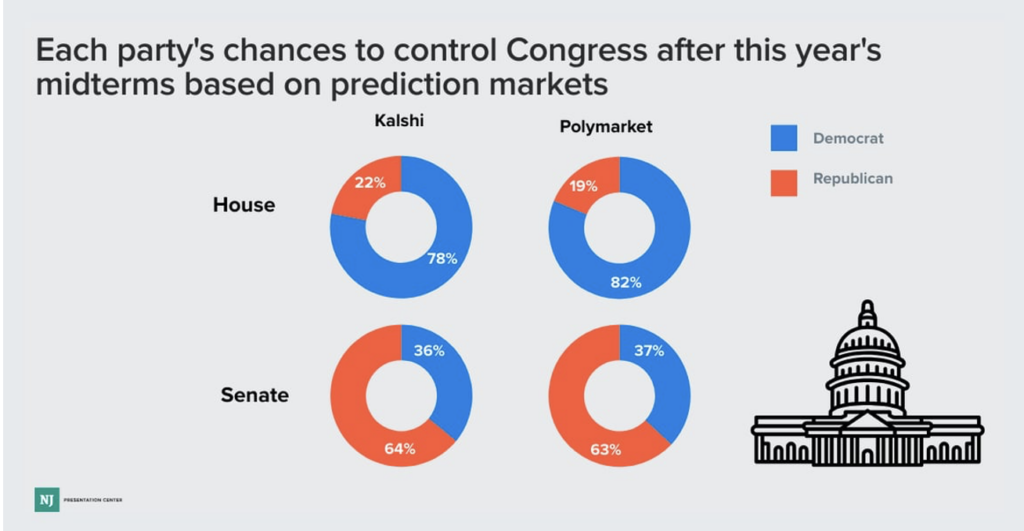
As the Super Bowl just proved, everyone seems to be betting on everything. On the political front, the two main peer-to-peer wagering markets, Kalshi and Polymarket, will give you action on the results of this year’s midterm elections. Each site offers about a 4-in-5 chance that Democrats will take the House, but only about a 1-in-3 chance that they will recapture the Senate.
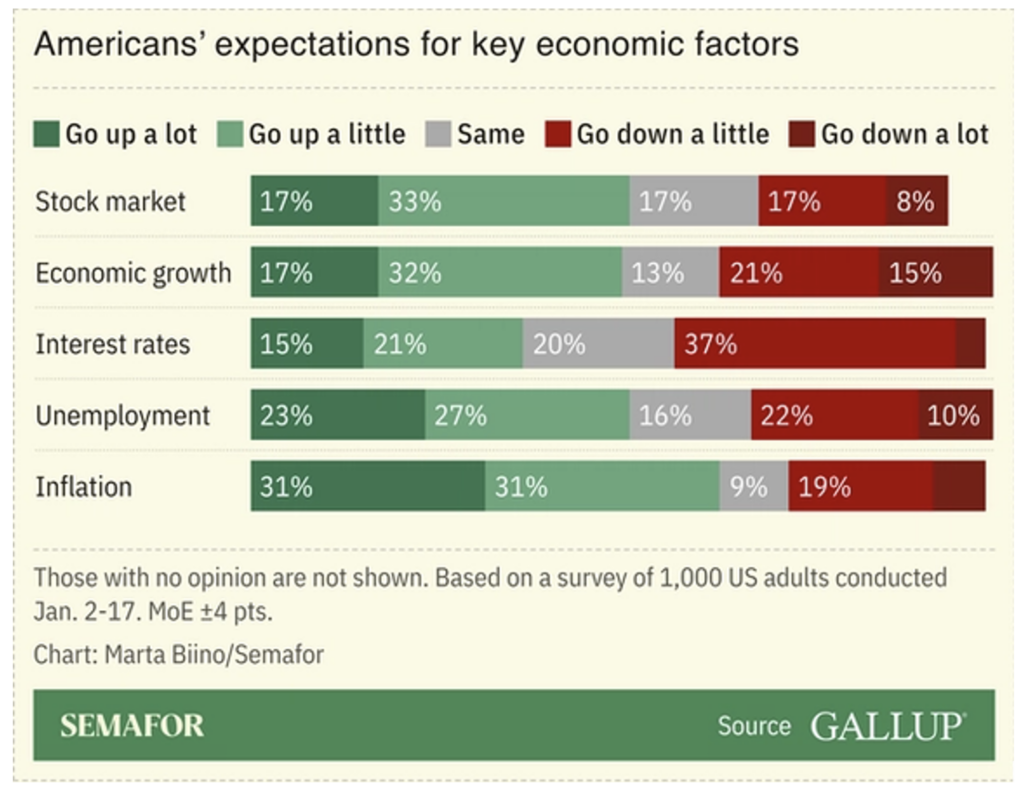
Economic Optimism Rising? More Americans expect economic growth to rise over the next six months than believe it will fall, a sign of optimism despite persistent concerns about inflation. 49% believe economic growth will rise in the first half of this year, and 50% believe the stock market will go up during the same period (only 25% predict it will fall). This is not to say Americans aren’t worried about their wallets: 62% believe inflation will increase, while 50% see unemployment worsening. Economic sentiment will be a key factor in the November midterm elections. While the White House is banking that bigger tax refunds will benefit the GOP, others project that the political upside will be short-lived.