Thought of the Week
Because there is nothing going on in Washington right now — besides the House and Senate both being in session and reaching a deal to avoid another government shutdown; President Trump’s signing of an executive order to impose tariffs on any country that sells oil to Cuba; the White House’s nomination of Kevin Warsh to serve as the next Federal Reserve chairman; the release of 3 million documents associated with the Jeffrey Epstein investigation; Treasury Secretary Bessent’s congressional testimony; the administration’s announcement of an agreement to lower tariffs on Indian goods; the president’s creation of a $12 billion strategic reserve for rare earth elements; an agreement by former President Clinton and Hillary Clinton to testify before Congress; the Supreme Court’s refusal to hear an emergency challenge to California’s redistricted map and anticipation about the Court’s ruling on President Trump’s IEEPA tariffs; the start of the 2026 midterm election primary season; the Washington Post’s announcement of significant layoffs; SCOA Washington, D.C.’s meetings with the Senate Finance Committee and the Senate Minority Leader’s office; USTR’s review of the USMCA free trade agreement; the birth of a baby elephant at the Smithsonian National Zoo — I’ve decided to write about something completely different this week. On Tuesday, I was pleasantly surprised to learn that I was selected as one of SCOA’s inaugural 2025 Volunteers of the Year. According to the selection criteria, the Volunteer of the Year program honors five employees who have demonstrated exceptional dedication to volunteering. For more than twenty years, I’ve worked primarily with two organizations, the Rock Creek Foundation (RCF) and the Salute Military Golf Association (SMGA). RCF is an organization that provides residential, vocational, and educational services to adults with developmental disabilities and/or chronic mental illnesses, and the SMGA is a 501c3 non-profit corporation that incorporates the game of golf into the mental and physical rehabilitation programs of post-9/11 wounded and injured veterans. SCOA’s recognition that volunteering in local communities is part of a positive work-life balance that leads to more productive employees is admirable; I know volunteering has been a fulfilling part of my life. What’s more, the recognition comes with a generous gift of $2000 to donate to a nonprofit of my choice. When it is considered that somewhere between 30%-50% of nonprofits fail within their first several years, the Kifinity gift will provide crucial financial support to a more than worthy cause. Thank you, SCOA.
Thought Leadership from our Consultants, Think Tanks, and Trade Associations
Conference Board Sees Low Hire-Low Fire Equilibrium Persisting. December’s Job Openings and Labor Turnover Survey (JOLTS) corroborated what consumers have recently been voicing concerns about—poor job availability. The decline in job openings suggests the unemployment rate may rise in the coming months. At the same time, most people are still working and getting paid, suggesting the labor market remains healthy. Falling immigration and baby boomer retirements will likely limit the extent of any increase in the unemployment rate. A sharp 0.3pp drop in the job openings rate in December follows a decline of a similar magnitude in November. At 3.9%, the vacancy rate stands at the lowest level in almost a decade, excluding a brief drop during Covid-19. In fact, excluding the pandemic, both jobs availability assessment and vacancies are down to levels last seen during the post Great Recession era. The sluggish churn in the labor market, with employers slow to hire and fire, with workers being cautious to quit, means the labor market is unlikely to be a source of inflationary pressure, and wage growth in the vicinity of 3-4% is historically consistent with overall inflation of around 2-3%. Services inflation will continue to ease and offset goods’ inflation for an overall inflation peak at slightly above 3% in H1. In practical terms, today’s lower vacancy rates suggest that firms are hiring cautiously, workers have less bargaining power, and wage growth is likely to slow or stabilize, which, take together, reduce the risk that labor costs will accelerate and reignite inflation. As a result, the Fed is less likely to see labor as a near-term inflation threat, supporting expectations for two interest rate cuts this year.
Eurasia Group Notes that Progress on U.S. Nuclear Projects Still Faces Significant Hurdles. The environment for constructing new gigawatt-scale nuclear plants in the U.S. is improving, but structural hurdles on issues like cost overruns, construction delays, and operational challenges still need to be cleared before new projects become more likely. Even with these challenges, the outlook for new American nuclear plants is now significantly more plausible than it has been in recent years. The next watchpoint that could improve the outlook is a decision to restart construction at VC Summer in South Carolina; another potential signpost will be any nuclear projects announced under framework investment deals, including with Japan and South Korea. The Trump administration will continue to support nuclear as its preferred non-fossil energy source, but decisive new policy support is unlikely in 2026; any new U.S. projects are likely to use Westinghouse AP1000 reactors.
Eurasia Group Says U.S. Policy Volatility Spurs Global Rebalancing. Strategic hedging against American policy shifts is growing but remains selective rather than systemic. The clearest signs of U.S. de-risking are emerging not among rivals, but among close allies, who increasingly view the uncertainty in Washington as a strategic liability. Canada is taking some of the most consequential hedging steps, while Europe is also taking steps to reduce reliance on U.S. military systems and accelerate trade policy hedging. While these steps remain incremental, and defense purchases continue, they signal a recalibration of strategic trust. The EU’s push to finalize the EU-Mercosur agreement—after nearly 25 years of deadlock—reflects urgency to secure non-U.S. sources of food, energy, and industrial inputs. India is pursuing a similar multi-vector hedge; in fact, India’s new EU trade agreement is a landmark shift, granting Indian exporters greater access to European markets while easing regulatory barriers and protecting against tariff changes. Gradual de-risking from the U.S. is likely to endure as the U.S.’s rejection of global trade leadership has increased the determination of American partners to make a transition. Whether this trend deepens will depend on how U.S. allies perceive U.S. reliability.
Inside U.S. Trade Reports on Senate Democrats’ Attempt to Understand Trump Administration’s ‘Opaque’ Tariff Exclusion Moves. Senate Democrats are pressing the Office of the U.S. Trade Representative (USTR) and the Commerce Department for details on how the Trump administration decided on exclusions from the president’s “emergency” tariffs, arguing that by avoiding public comment on the process officials locked out numerous businesses from seeking relief. Democrats are asking USTR Greer and Commerce Secretary Lutnick to provide answers by March 4 to a litany of questions on how officials decided which products or categories to exclude from various tariffs President Trump has imposed under the International Emergency Economic Powers Act (IEEPA); why there has been no public administrative process or “objective criteria” for those choices; and information any new exclusions the administration is considering. Lawmakers note that the White House has repeatedly created and expanded exclusions from original “reciprocal” IEEPA tariffs on most U.S. trading partners without ever formally seeking public input on their scope or setting clear decision-making criteria, which they argue has locked many businesses out of the process.
“Inside Baseball”
Baseline is for No Federal Reserve Cuts Until at Least June. The Observatory Group contends that Federal Reserve Chair Powell has built a high hurdle to clear before any rate cut prior to mid-year, when policymakers expect tariff effects on goods prices to be washed out of the data. The view that tariff effects will be paid domestically but remain, on balance, one-off price increases is still being tested. Although that optimism has not been contradicted by the data, most policymakers still think it is too early to reach a definite conclusion. With the policy stance in the ballpark of neutral, the case for any policy moves in the short run is weak.
In Other Words
“A swing of this magnitude is not something that can be dismissed. Republicans should be clear-eyed about the political environment heading into the midterms,” Florida Governor Desantis (R) on the 14-point victory of Democrat Taylor Rehmet in a Texas State Senate special election.
“It’s a business argument. You know, if we’re spending $100 or $200 million in Texas in the general election, that’s $100 to $200 million we can’t be spending in other places in races we have a chance to win,” Sen. Majority Leader Thune (R-SD) explaining why President Trump should endorse Sen. Cornyn (R-TX) in his primary election against Texas Attorney General Paxton; Sen. Thune’s argument hinges on Sen. Cornyn’s stronger polling against likely Democratic challengers.
Did You Know
Japanese Prime Minister Takaichi will visit the White House on March 19.
As part of a broad celebration of the U.S.’s 250th birthday, President Trump signed an Executive Order to launch the Freedom 250 Grand Prix of Washington, D.C.—the first ever INDYCAR race in the nation’s capital. While the Interior and Transportation departments will work together to design a suitable route, the event is tentatively scheduled to take place August 21 to 23.
Graphs of the Week
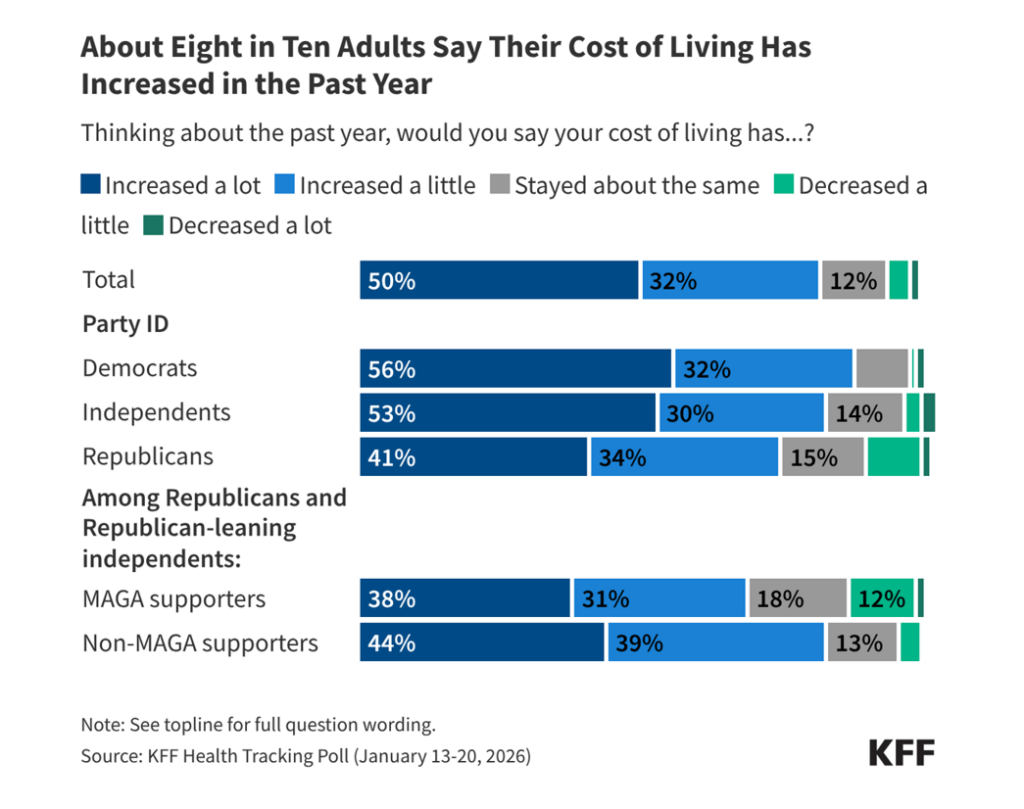
The Big Picture. Even though inflation is ticking down, Americans aren’t feeling it in their wallets. According to a recent survey, 82% feel their cost of living has risen in the last 12 months; this includes 75% of Republicans, 86% of Democrats, and 83% of independents. Thirty-two percent said they are “very worried” about health care costs, the highest of any category of expense.