Thought of the Week
How was your Thanksgiving? Did you graduate to the adult table or are you still relegated to the kids’ table? Yes, I know, I know…Thanksgiving was so last week, but it is the quintessential American holiday (my favorite, actually), and I think it gets short shrift coming just a day before Black Friday. Think about it, the Macy’s Thanksgiving Day parade always concludes with the arrival of Santa Claus, meaning that Christmas starts to overshadow Thanksgiving even before it has the chance to get started. Maybe people are just excited to get on with the holiday cheer and avoid the political discussions that seem to be held around every Thanksgiving Day dinner table. Like many others, I’m sure, we had our political debates, but this year ours wasn’t about the off-year elections and what they might mean for next year’s midterms, President Trump, climate change, gun laws, immigration, drug interdiction, or even voter IDs. Ours took a different, if unexpected, turn. In essence, it was an examination of whether the left-to-right or liberal-to-conservative political spectrum means anything anymore. Think about it. What if I told you that a presidential administration would be protectionist and anti-free trade; would not make fiscal responsibility paramount and concern itself with deficit reduction; would attack Federal Reserve independence; and circumvent free markets by taking equity stakes in private companies. Does that sound like a far-right administration or something along the lines a Democratic Socialist might propose? Exactly. Labels like Republican, Democrat, right, and left just don’t seem to mean what they used to. Years ago, to get around a conundrum like this, people would say things like, “I’m socially liberal, but fiscally conservative.” No one ever knew exactly what that meant, but we knew what they were trying to say. Regardless, traditional political labels along the liberal-conservative continuum are relative. In fact, a “liberal” in rural Texas looks a lot different than a “liberal” in suburban Maryland; just as a “conservative” in Connecticut looks a lot different than a “conservative” in Wyoming. The key to unlocking better policymaking, better representation, better polling, and better chances to win elections might be found in retiring the liberal-to-conservative spectrum and coming up with something more descriptive. Echelon Insight has done just that; take their quiz to see where you stand, and please pass the stuffing.
Thought Leadership from our Consultants, Think Tanks, and Trade Associations
Bloomberg Government Says White House is Preparing Tariff Fallbacks. The Trump administration is working behind the scenes on fallback options if the Supreme Court strikes down one of its major tariff authorities, looking to replace the levies as quickly as possible. Both the Commerce Department and the USTR have Plan B options if the court rules against the administration, including Sections 301 and 122 of the Trade Act, which grant the president unilateral ability to impose duties. While the replacements come with risks—they tend to be slower and more limited than the wide-ranging powers the president has asserted so far and could face their own legal challenges—the White House is holding out hope that it will win the case outright. Still, the preparations are the latest signal the administration is bracing for an unfavorable outcome, after the court appeared skeptical of President Trump’s global tariffs during last month’s oral arguments. They also show the White House’s commitment to imposing tariffs, including through untested means. Although it’s not clear when the Supreme Court will rule, the justices could uphold the tariffs; knock them down entirely; or take a targeted approach, and any decision threatens to generate further uncertainty for businesses and foreign governments. In some cases, backup plans are already in motion. For instance, President Trump launched a 301 investigation against Brazil, and already has 301 levies on certain Chinese products from his first term. What’s more, Section 122 would let the president impose tariffs of 15%—a threshold he’s settled on in several deals with other nations—but only for a maximum of 150 days. The president has also used Section 232 of the Trade Expansion Act to apply tariffs to sectors including metals and autos. Section 338 of the Tariff Act is another potential tool, but one that would be ripe for a fresh legal challenge given that it has never before been used. White House Deputy Chief of Staff Blair said he thinks there’s a 50-50 chance of the administration winning the case.
Eurasia Group Believes National Economic Council (NEC) Chair Hassett is the Clear Frontrunner to Replace Fed Chair Powell. White House leaks to Bloomberg over the Thanksgiving holiday that NEC Chair Hassett is the president’s favorite were a trial balloon. President Trump later commented that he had made up his mind, and Chair Hassett himself pointed out that markets had not reacted negatively to the trial balloon, suggesting he had effectively been blessed for the job. For the president, “it ain’t over till the fat lady sings,” and Hassett’s status as favorite could change in the coming weeks. But he makes sense as the pick if the White House is prioritizing loyalty. While there is little clarity yet on the timing of an announcement, there seem to be three options: (1) nominate Hassett to the seat currently occupied by Stephen Miran when his term expires on 31 January; (2) wait to replace Miran later in Q1 or Q2; or (3) nominate Hassett to fill Powell’s seat directly if Powell resigns as a governor when his term as chair expires. The longer President Trump waits, the weaker Hassett’s edge will be. While Hassett is the leader right now, there are still several high-profile choices interested in the position, and there is every opportunity for Trump to rethink his choice. If no announcement is made prior to the expiration of Miran’s term, it may be necessary to revisit this view.
Eurasia Group Sees Tennessee Result as Consistent with Democratic-Leaning Midterm Environment. Although Republicans won a special election for a House seat in Tennessee by nine points—a stronger showing than the 2-point lead public polling suggested—the result was much weaker than President Trump’s 22-point victory in the district in 2024. As with the Virginia and New Jersey gubernatorial elections last month, the Tennessee result suggests an electorate that is about eight to twelve points more Democratic leaning than in 2024, a strong Republican year. Taken together, the outcomes affirm Democrats as strong favorites to flip the House next year (80% odds), but are still not enough to flip the Senate, where Republicans remain the favorites (70% odds). The nine-point victory buys some breathing room for the White House and House leadership, who have been bearing the brunt of concerns from vulnerable House members. Pressure will continue to build over the next few months as the midterms come into closer view, likely making the House Republican conference more difficult for leadership to manage.
Inside U.S. Trade Reports that Importers, Eyeing Refunds, have Filed New Tariff Lawsuits. An array of importers, including the retail giant Costco, have launched new lawsuits over President Trump’s International Emergency Economic Powers Act (IEEPA) tariffs even as the Supreme Court considers whether to scrap them, aiming to speed what some analysts say could be a long and complex refund process if the justices rule against the White House. In recent weeks, more than a dozen companies have filed separate suits over the tariffs in the Court of International Trade (CIT). Many of those filings note that both the CIT and the U.S. Court of Appeals for the Federal Circuit have already declared that the administration violated the law when they used IEEPA to impose steep duties on Mexico, Canada, China, and U.S. trading partners generally. The new cases will not affect whether the duties ultimately survive; that is up to the Supreme Court, which heard oral arguments on November 5. While observers expect the Court to hand down its ruling in early 2026, or even by the end of December, based on the justices’ harsh questioning of the administration, many believe that the Court is more likely than not to rule for the challengers. The new complaints emphasize that if the Supreme Court does strike down the tariffs, it could nonetheless mandate refunds for only the handful of importers directly involved in the consolidated cases that went to the Supreme Court—namely 12 states with Democratic attorneys general, a coalition of five small private importers that sued together at CIT, and a pair of education-technology companies that filed their suit in the U.S. District Court for D.C. Several of the new litigants say they are also concerned about the possibility that a decision opening the door to refunds might come after their shipments conclude the “liquidation” process where tariff payments are finalized. Liquidation usually happens 314 days after a shipment’s physical arrival, meaning the deadline has just started to arrive for Trump’s first round of IEEPA tariffs, which he imposed in February.
“Inside Baseball”
Add Corporate Lobbying to the List of Ways Washington Works Differently Under President Trump. At a time when the federal government’s actions are centralized within the White House and the public is highly polarized, companies are pivoting their approaches to wielding influence in the nation’s capital. Under the Trump administration, more companies are bypassing traditional congressional connections to seek an audience with President Trump and/or those in his inner circle. Additionally, due to the risk of blowback from the Oval Office, firms are being more careful with their public statements and reframing lobbying asks so they don’t come off as criticisms of key policies. Consider that companies no longer ask for exemptions or exclusions from tariffs, but explain that there are “insufficient domestic resources” for needed inputs. With Congress largely taking a backseat—especially on trade—and much of the executive branch’s decision-making centralized with the president himself, companies are tailoring their lobbying messages with President Trump in mind.
In Other Words
Alton Brown’s Recipe for Making Large Batch Egg Nog. Because egg nog needs to mellow and age—at least two weeks—in order to achieve maximum…nog-ness, now is the time to make it.Ingredients:
- 12 eggs
- 1 lb sugar
- 1 pt each half and half, heavy cream, and whole milk
- 1 cup each Jamaican rum, cognac, and bourbon
- 1/4 tsp kosher salt
- 1 tsp grated nutmeg
Separate the egg yolks from the whites and beat yolks with sugar and nutmeg. Combine liquor, dairy, and salt in a separate bowl and gradually add the egg mixture. Using a funnel, transfer to glass jars or spring-top bottles. Store refrigerated for two weeks.
Did You Know
The 2026 midterm election is just 333 days away.
One of the National Zoo’s Asian elephants is pregnant and could give birth in the next few months, which would mark the first elephant calf born in the nation’s capital in 25 years. The zoo has had only two elephant births in its 136-year history; the last was in 2001.
Graph of the Week
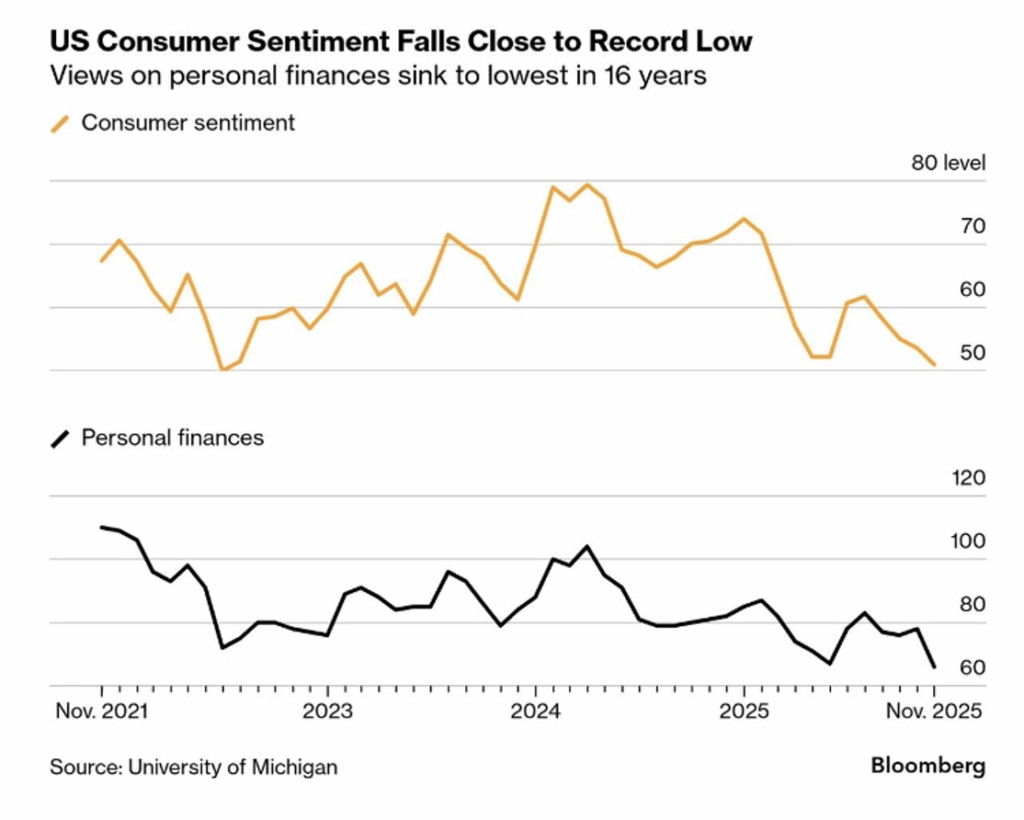
The U.S. economy is wavering, and Americans are concerned about the future of their wallets. With inflation at 3% and unemployment rising to 4.4%, the third part of the troubled trifecta, consumer sentiment, has fallen to one of the lowest levels on record. The University of Michigan’s final November sentiment index dropped to 51 from 53.6 in October, one of the dimmest views of personal finances since 2009.